THE DOZENS: CHRISTIAN MCBRIDE SELECTS CLASSIC RAY BROWN TRACKS by Ted Panken (editor)
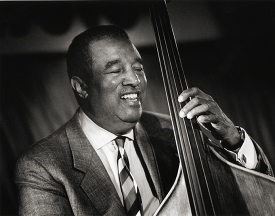
An apropos torch-passing occurred last May, when Christian McBride took possession of an acoustic bass that had belonged to Ray Brown [1926-2002], his prime influence, mentor, and frequent employer in the 90s ensemble Super Bass, along with John Clayton. We had a very fatherly relationship, McBride said in the cover feature in Downbeats August issue, which cited his victory as Acoustic Bassist of the Year in the magazines 57th annual critics poll. I dont want to sound selfish, but I feel I SHOULD have it, since John has one of Rays other ones.
A student of the Brown effect since his middle teens, McBride met the maestro around 1990, when Brown came to hear him play duo with pianist Benny Green at the Knickerbocker, a raucous piano bar-and-grill on University Place in Greenwich Village. At the time, he recalls, he was focused, as I wrote, on the unamplified, raise-the-strings approach to bass expression which, as McBride puts it, seemed to be the new religious experience for young bass players coming to New York. Ray said, Why are you young cats playing so hard? You dont need your strings up that high.

Before I responded, something said, Shut up, and listen to Ray Brown. Dont say one word. Benny and I saw him at the Blue Note a few nights later, and it hit me like a ton of bricks. Ray seemed to be playing the bass like it was a toy. He seemed to be having fun. Playing jazz, he had that locomotion I heard in the great soul bass players, like James Jamerson and Bootsy Collins and Larry Graham. He wasnt yanking the strings that hard, and he had the biggest, fattest, woodiest sound Id ever heard, and I could tell that most of it was coming from the bass, not from the amp. At that point, I slowly started saying to myself, Its not about what they think. Its about whats best for the music that Im trying to play. Its about trying to get the best possible sound out of the instrument.
In selecting his bakers dozen favorite tracks of the definitive bassist of modern jazz, McBride selected tracks that, as he put it, arent so much different one from the other as much as each one exemplifies Ray Browns sound, his time, his ideas.
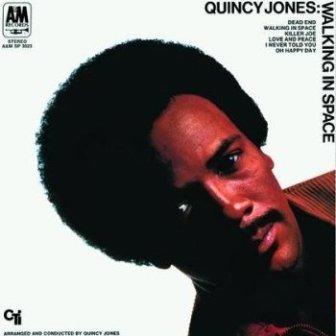
Quincy Jones: Killer Joe
Track
Killer Joe
Group
Quincy Jones and his Orchestra
CD
Walking in Space (A&M CDA0801)
Musicians:
Quincy Jones (conductor, arranger), Ray Brown (bass), Grady Tate (drums),
Eric Gale (electric guitar); Freddie Hubbard, Lloyd Michaels, Dick Williams, Marvin Stamm (trumpet); Jimmy Cleveland, Jay Jay Johnson, Alan Raph, Tony Studd (trombone); Joel Kaye, Roland Kirk, Hubert Laws, Jerome Richardson (reeds) Paul Griffin (piano)
.Benny Golson (composer)
.Recorded: Englewood Cliffs, New Jersey, June 18-19, 1969
Rating: 100/100 (learn more)
According to an interview I saw with Quincy maybe 6 or 7 years ago, Killer Joe was the last straight-ahead tune that actually made the BillboardTop 100 Singles Chart in 1969. Quincy also said that this particular arrangement was specifically written with Ray Browns walking style in mind. As you can hear on the original recording, its just bass in your face the whole way through. It really is a lesson in everything that I think encompasses the golden standard in modern bass playinghow you can get the most harmonic, linear creativity from just two chords. It just goes back and forth from C-VII to B-flat-VII, and Ray Brown is milking these two chords to death. Its swinging real hard. His sound... Well, actually (and I tread lightly when I say this), I was never a big fan of the bass sound on Rudy Van Gelders recordings once he started using the DI, once he started using the pickup on acoustic basses, which he started doing it around that time, 69-70. Somehow, Ron Carter was probably the only bass player who was able to get a decent sound from the DI in Rudys studio. But save for what I feel was sort of a muffled sound... You listen to Ray Brown on any other recording, then listen to him on Walking in Space. It almost sounds like theres a towel over the bass, so you cant really hear the clarity. But if you can get past that and just hear all of the magnificent notes and the force with which Ray Brown is driving the band, to me thats a huge reason why that probably was the last straight-ahead jazz tune in the Billboard Top 100. You cant help but dance when you listen to that. In a Downbeat piece a few months ago, I mentioned how the acoustic bass has this all-encompassing, encircling quality, like a big arm just surrounding the band. Ray really does that on Killer Joe. Definitely one of my favorites.
Reviewer: Christian McBride
Oscar Peterson: Sometimes I'm Happy
Track
Sometimes I'm Happy
Group
Oscar Peterson Trio
CD
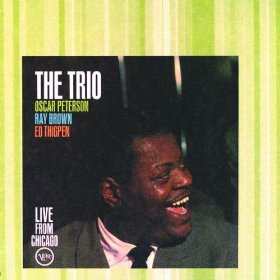
The Trio (Verve 731453906327)
Musicians:
Oscar Peterson (piano), Ray Brown (bass), Ed Thigpen (drums).
(composed by Vincent Youmans and Irving Caesar)
.Recorded: live, "London House", Chicago, July 29, 1961
Rating: 100/100 (learn more)
Sometimes Im Happy is one of the few tracks that I know on many Oscar Peterson records where the trio actually just stretches out. Theres really not much of an arrangement...well, only a slight arrangement (Oscar Peterson plays Lester Youngs famous solo as an intro, but then for the rest of the way theyre just blowing. The track is 11 minutes, and its just Oscar, Ray Brown, and Ed Thigpen blowing the whole way. To me, not only is it a great Ray Brown track, but but also because the Oscar Peterson Trio is always known for their surgical execution of all of these difficult soli passages, and their almost gymnastic-like technique on all of their instruments, and trhis is one of the few tracks I can think of where everybody is not doing that. Its almost like a Bradleys gig. Theyre just in the pocket, having a good time, and Ray Brown stretches out and takes a very, very long solo which is very melodic. I've always loved listening to this track just for the fact theyre all stretching out, having a good time, and not particularly playing a difficult arrangement as they were accustomed to doing in that trio.
Someone once asked Oscar Peterson what was the difference with Ray Brown before and after the drummer. He said that he found that Rays notes got longer once Ed Thigpen joined the trio. But when I listen to Ray before Ed Thigpen, when it was just Herb Ellis on guitar, to me his notes were still much more elongated than his peers. When you listen to a lot of bass players from the mid and late 50s, the notes were very short. Everybody used gut strings at that time. Everybody had pretty high action, where you get that real percussive sound on the bass. But to me Ray always had a nice balance between that percussive sound and a very ringing, melodic sound. Ive always felt he had that in the trio, even before the drums. His time was always impeccable---you could set your pacemaker to him in the trio before Ed joined. Of course, his time feel was much more exposed without the drums, which I think is a great study, particularly for bass players learning how to strengthen their time. Ray was the master of that.
Reviewer: Christian McBride
Ray Brown-Milt Jackson: Lined With A Groove
Track
Lined With A Groove
Artist
Ray Brown (bass) and Milt Jackson (vibes)
CD
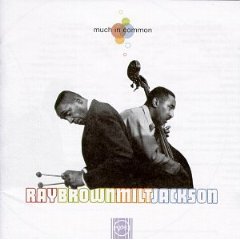
Much In Common (Verve 314 533 259-2)
Musicians:
Ray Brown (bass), Milt Jackson (vibes), Oliver Nelson (arranger, conductor), Clark Terry (flugelhorn),
Ernie Royal, Snooky Young (trumpets); Jimmy Cleveland, Urbie Green, Tom McIntosh, Tony Studd (trombones); Ray Alonge (french horn); Bob Ashton, Danny Bank, Jimmy Heath, Romeo Penque, Jerome Richardson, Phil Woods (reeds); Hank Jones (piano); Grady Tate (drums)
.(composed by Ray Brown)
.Recorded: New York, January 4, 1965
Rating: 100/100 (learn more)
This recording is with Oliver Nelsons big bandGrady Tate is playing drums, Clark Terry is playing flugelhorn, Milt Jackson, Ray Brown, Hank Jones. Its great to hear Ray Brown in this setting, because if Im not mistaken, it was one of the first recordings---if not the first recording---that he made either as he was in the process of leaving Oscar Petersons Trio or had just left Oscar Petersons trio. He was starting to really focus on his development as a bandleaderor so he thought. Thats when he moved to L.A. and started becoming a studio ace on the West Coast. But its great to hear him play his tunes, and to hear the band sort of under his direction... Even though Oliver Nelson was the arranger-conductor on the date, somehow you got the notion that Ray Brown was running things! Its also interesting to listen to Ray Brown during this period, because in the early to mid 60s you never really heard him play with too many other drummers other than Ed Thigpen. Now, you did hear him on a couple of sessions with Sinatra and people like that. But these were structured sections where he didnt get much chance to stretch out. Now, this was one of the first times that Ray played with Grady Tate. Its great to hear him hook up with somebody else, and you can hear that the hookup maybe wasnt as instant as it was with Ed Thigpen. You can hear that there are some discrepancies in where the tempo might lay. But somehow, that blur in the tempo actually works. For some reason, I always liked hearing that. Ray always pushed. He was always ahead of the beat, just on the border of speeding up, and you can hear that Grady Tate is kind of in the pocket. You can feel this real hip tension, kind of like Ray going, come on Grady...UNNH... Its fun to listen to.
Reviewer: Christian McBride
Milt Jackson-Ray Brown: Frankie and Johnnie
Track
Frankie and Johnnile
Group
Milt Jackson Quintet Featuring Ray Brown
CD
That's the Way It Is! (Impulse AS 9189)
Musicians:
Milt Jackson (vibes), Ray Brown (bass), Teddy Edwards (tenor sax), Monty Alexander (piano), Dick Berk (drums).
(traditional song)
.Recorded: live at "Shelly's Manne-Hole", Hollywood, CA, August 1 & 2, 1969
Rating: 100/100 (learn more)
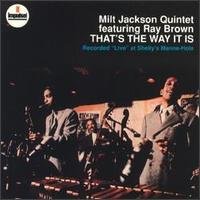
Frankie and Johnnie is just a great jam. Milt Jackson and Ray Brown were inseparable cronies. They were very much like Fred and Barney, Cramden and Norton. Ray was definitely Ralph Cramden or Fred Flintstone. Definitely the leader of the two. I think their kinship really comes across well all through that particular recording. Once again, Ray is in his element, just playing the straight 12-bar blues, having a good time, swinging real hard. Dick Berk is playing drums on this record. This is an early recording session for Monty Alexander on piano, and Teddy Edwards is on tenor. Theyve got their teeth sunk right into the groove, Ray is propelling the band, and they stretch out on the blues for about 10 minutes and have a really good time. You can hear Ray talking to the guys throughout the track. Yeah, Jackson! when Milts taking a solo. You can hear Ray yelling down to Monty, Play the left hand. Its a really cool, fun track.
Reviewer: Christian McBride
Ray Brown: Time After Time
Track
Time After Time
Group
Ray Brown Trio
CD
Three Dimensional (Concord CCD4520)
Musicians:
Ray Brown (bass), Gene Harris (piano), Jeff Hamilton (drums).
(composed by Sammy Cahn and Jule Styne)
.Recorded: San Francisco, August 4, 1991
Rating: 100/100 (learn more)
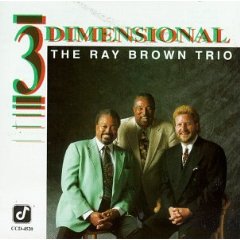
The first time I saw Ray Brown perform live at the Blue Note was right on the heels of this recording, Three Dimensional. So I have a very soft spot for Rays trio with Gene Harris and Jeff Hamilton, and for this whole album. He did some amazing work with that trio, which, of course, was his last trio before he kind of took the Art Blakey-Betty Carter model of hiring exclusively young, up-and-coming cats. He was very prolific with all of his trios once he came back from the studios and really focused on his career as a bandleader and as a mentor. The entire album is a really good example of Ray's excellent arranging skills coming into play. He takes "Time After Time" at a real medium-swinging tempo, and I think Rays sound here is very interesting. You can tell that probably he was using a pickup, a DI, but somehow the natural sound was never, ever lost. You can still feel the wood in the instrument. Thats a good example of Ray balancing that pickup sound with the natural sound, taking control of his trio, writing some good arrangements, and being the pirate.
Reviewer: Christian McBride
Ray Brown Trio: Lady Be Good
Track
Lady Be Good
Group
Ray Brown Trio
CD
The Red Hot Ray Brown Trio (Concord Jazz/Groove Note SACD GRV1028-3)
Recorded: live at the "Blue Note", New York, November 12, 1985
Rating: 100/100 (learn more)
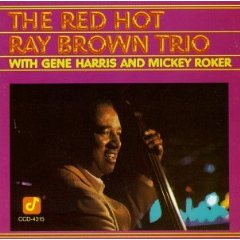
When I was just getting really serious about the music, and going out and buying records with the allowance my mother would give me every week, I remember going to the store specifically saying, Ive got to buy a Ray Brown record. Dont know why I didnt buy an Oscar Peterson record. But instead, I went right to the Ray Brown section, Im kind of thumbing through the records, and I saw Soular Energy, I saw Dont Forget the Blues, I saw Something For Lester, and I saw The Red Hot Ray Brown Trio. I just liked the cover. It was red, had this yellow writing, and it said red-hot, so I thought, Well, it must be swinging. So I picked up that one. So that has a REAL soft spot in my heart because it was my first Ray Brown recording. Not the best record to listen to if you really want to get a good dose of Ray Brown, because hes not really playing very much on it. Its Gene Harris record almost, Mickey Roker is playing drums, and Ray and Mickey are swinging real hard. But "Lady Be Good" is the one track where you get that classic Ray Brown intro... Theres a little inside joke with people in the Ray Brown family. He had this one intro that he put on almost every song he ever arranged. If he couldnt think of an intro, he would play this. He would slap his E-string real hard, hed play a low G on the E-string, and it was BOHM-BOHM, MMM, MMM-HMM, MMM-HMM, MMM-HMM, MMM...BOHM-BOHM. DE-MMM, MMM-HMM... He plays that intro on about 50 different arrangements he has, and that might have been one of the first times he used that intro. All of us in the Ray Brown family, John Clayton, Benny Green, Diana Krall, Geoff Keezer, Geoff Hutchinson, Kareem Riggins, Russell Malone...we all hear that intro, and we just die laughing.
Reviewer: Christian McBride
Superbass: It Ain't Necessarily So
Track
It Aint Necessarily So
Group
Superbass
CD
Superbass2 (Telarc CD83483)
Musicians:
Ray Brown (bass), John Clayton (bass), Christian McBride (bass).
George Gershwin (composer)
.Recorded: live at the Blue Note, New York, December 15-17, 2000
Rating: 100/100 (learn more)
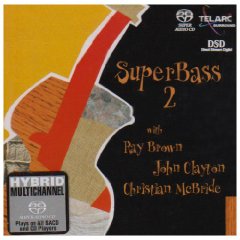
Certainly, playing with Ray and John Clayton in Superbass was one of the highlights of my entire career. Getting to actually play WITH Ray Brown and know what it feels like to have Ray Brown walking behind you, was pretty overwhelming. Ray was so driving and so forceful, I just remember thinking, How in the world am I supposed to solo? How am I supposed to get over on top of that as a bass player? Ray would just look at you and say, come on, youd better sink or swim, because Im not going to quiet down. So you had to just get on up there and blow.
He wrote an arrangement of a Porgy and Bess medley---Summertime, I Loves You, Porgy, and It Aint Necessarily So. This arrangement of It Aint Necessarily So is one of the funkiest, most down-home, most chicken-grease, rib-bone arrangements you could ever imagine. It definitely will get your foot tapping. Its a real gritty, funky arrangement. Its right up my alley.
Ray always demystified everything. John and I would constantly look at him and go, Wow, thats Ray Brown; lets respect him; he has the final say-so with everything, and however the arrangements go, well let him dictate that. Ray would always look at us and say, Look, man, please cut the shit. Yes, I know Im old, but you guys are as much responsible for keeping the sound of this trio going as I am. I dont want to be the center of this trio ALL the time. So Ray gave us very much equal responsibility to create the sound of that trio. We all seemed to have our own natural thing that we did well. John, of course, with his classical background and his Basie background, usually when he would bring an arrangement it would be something kind of Basie-ish, or Ray would feature him on a sort of European type of thing where he could use his bow. They used to do this arrangement of My Funny Valentine. When it came time for me to get featured, Rays phrase was, Ok, now the party gets started. So Ray always left the crowd-pleasing stuff for us.
He asked me to bring an arrangement. He said, Christian, I know you know all those old funk tunes. Why dont you arrange an old funk song for the bass trio? So I brought in Papa Was A Rolling Stone. we did it on this Super Bass, Part 2 recording. But I think the one on that date that particularly features Ray the best was It Aint Necessarily So. That was the track where, dare I say, I got to walk on top of HIM a little bit, and hes just on top of everybody, just soloing like nuts. It was a real crowd pleaser.
Reviewer: Christian McBride
Ray Brown Trio: F.S.R.
Track
F.S.R.
Group
Ray Brown Trio
CD
Walk On: The Final Trio Recordings (Telarc 2CD 83515)
Musicians:
Ray Brown (bass, composer), Benny Green (piano), Gregory Hutchinson (drums).
Recorded: live at Scullers Jazz Club, Boston, Massachusetts, Oct. 17 or 18, 1996
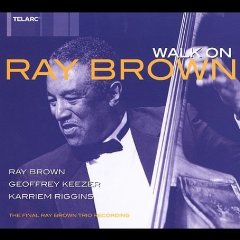
Rating: 100/100 (learn more)
F.S.R. was one of the Ray Brown Trios most popular songs. The story is: It was a Milt Jackson record for Pablo called A London Bridge with Monty Alexander, Ray, and Mickey Roker, and they were recording Doxy. Ray, of course, always in arranging mode, came up with a shout chorus to play after the solos. Apparently, Ray and all of the guys liked the shout chorus so much they said, Well, why play Doxy? Lets just make the shout chorus the actual chorus. Allegedly, Ray said, Yeah, thats right. F Sonny Rollins. So thats where FSR" came from. So this is Rays take on Doxy.
Once he made that transition as the teacher, always hiring guys like Keezer and Benny Green and Larry Fuller, and Kareem Riggins and Greg Hutchinson and George Fludas, it was great to hear Ray keep these cats on their toes---almost like Betty Carter and Art Blakey did. These guys would be sweating hard. They had that look on their face, like Id really better come through, or Im gonna be flat on my ass. This is a really good example of Ray just in the pocket with these young cats for a good 7 to 8 minutes, walking his ass off. It was beautiful to hear them pushing Ray, and Ray pushing them back, and this real hard-core swinging tension in the middle of it all.
Reviewer: Christian McBride
James Brown: Its A Mans, Man's, Mans World
Track
Its A Mans, Mans, Mans World
Artist
James Brown (vocals, composer)
CD
Soul On Top (Verve 0602498617182 )
Musicians:
James Brown (vocals, composer), Ray Brown (electric bass), Louis Bellson (drums).
John Audino, Al Aarons, Chuck Findley, Tom Porello (trumpet); Nick DiMaio, Kenny Shroyer, Jimmy Cleveland, Bill Tole (trombone); Ernie Watts, Joe Romano (alto saxophone); Maceo Parker, Buddy Collette, Peter Christlieb (tenor saxophone); Jim Mulidore (baritone saxophone); Frank Vincent (piano); Bill Pittman, Louis Shelton (guitar); Jack Arnold (percussion)
.Recorded: Los Angeles, November 10, 1969
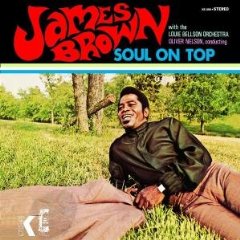
Rating: 100/100 (learn more)
Not many people know that Ray Brown was actually a very good electric bass player. He adapted to the smaller instrument much quicker and, frankly, I think, much better than anyone else coming from the golden era of jazz. You can tell from the way hes playing on "It's A Man's, Man's, Man's World" that theres a certain comfort level with his technique, theres a comfort level in conceptbecause hes not playing jazzy basslines. Hes playing real R&B-soul-style bass. Hes playing like James Jamerson almost. For that reason, I was always surprised that Ray never played more electric bass. I would always ask him, Ray, how come you dont play electric bass no more? He said, Nah, I never liked it. I said, Thats hard to believe considering how good you sounded on it. Ray was right in the pocket. Very fun to hear him play with James Brown on electric. Guys who didnt like electric bass, you can tell---it sounds like they don't like it. A lot of other bass players who were kind of forced to play the electric bass because thats where the commercial scene was going at that time didnt adjust very well. Ron Carter, Al McKibbon... Bob Cranshaw adjusted very well, but Cranshaw took more of a workmanlike approach to the electric bass. He wasnt flashy or virtuoso. But Ray is showing off a little bit on this track. So it's a very good example of Ray Browns unfortunately obscure electric bass playing.
Reviewer: Christian McBride
Ray Brown: Bass Solo Medley: Full Moon and Empty Arms/The Very Thought Of You/The Work Song
Track
Bass Solo Medley: Full Moon and Empty Arms/The Very Thought Of You/The Work Song
Artist
Ray Brown (bass)
CD
The Very Tall Band (Telarc CD83443)
Musicians:
Ray Brown (bass).
Recorded: live at the Blue Note, New York, November 1998

Rating: 100/100 (learn more)
On The Very Tall Band, which is a quartet with Oscar Peterson, Milt Jackson, and Karriem Riggins, Ray Brown does a medley does a medley on this record with Full Moon and Empty Arms, The Very Thought of You and Work Song. To me, its a case study in how the bass can execute at the highest level of melody. Ray Brown was always known almost as a boorish type of bass player, a pile-driving bulldozer of a bass player. But when Ray Brown played a ballad, just playing the melody and soloing, playing it free, no time, it was crystalline and beautiful. You can imagine transcribing that to a piano and having Oscar Peterson put something to it, and it would sound absolutely gorgeous. I think its pretty marvelous.
It was interesting to hear Ray talk about tone production. When you talk about the other major bass players, the most influential bass players of his generation, Oscar Pettiford and Charles Mingus... Ray, of course, loved Oscar Pettiford, and he admittedly stole a lot of his ideas, stole a lot of his concept. But Ray said that one thing he always wanted to do differently than Oscar Pettiford was make his notes longer. He always felt that bass notes were too short. They came out as much more of a thud than a ring. A lot of bass players pulled their strings out instead of down. but Ray would pull them down, so almost his finger was hitting the finger board as he was pulling the string, which freed the string to vibrate up and down instead of side-to-side. That gave it that crisp, percussive sound. He always kept the strings at a comfortable height that was never too low, never too high, which gave him just the right amount of tension so he could get a nice chunk of flesh into the string, without (a) killing the bass or (b) killing his fingers. So I think he always had the perfect setup and he had the perfect concept to be able to make his notes ring, still keep that big sound, and not overplay. When I saw him play in person and discovered thats what he was doing, it was a revelation. I had been used to either the low-action, high-speed guys, or guys my age who were raising their strings way-way up high off the fingerboard, trying to go for that old-school, 1940s or early 50s bass sound. Guys were getting gut strings, and they were just yanking the crap out of their basses. I was doing that for a little while, but then I saw Ray Brown and went, Ahh! So thats how its done. What am I doing? I think Ray Brown was both a musical and a scientific master in learning how to get that perfect sound out of the instrument. Unfortunately, I never sat down and asked him directly about whether that was a conscious... I mean, did you know that you were plucking this way instead of that way? It just seemed so natural, I have a feeling thats what he got to through trial-and-error.
Reviewer: Christian McBride
Sonny Rollins: I'm an Old Cowhand
Musicians:
Sonny Rollins (tenor sax), Ray Brown (bass), Shelly Manne (drums).
Composed by Johnny Mercer and Harry Warren
.Recorded: Los Angeles, March 7, 1957

Rating: 100/100 (learn more)
Even before I got a chance to really thoroughly understand what Ray Brown was doing, if there was one record everybody knew, and knew well, it was Way Out West. That was kind of the gold standard for pianoless saxophone trios. I remember Wynton Marsalis was the first one who told me about that record. He pointed out, which rings very true to this day, that if you listen to Ray Browns basslines, he outlines the chords so well, you dont miss the piano. Most of the time, when bass players are playing without a piano, it exposes the weaknesses or shortcomings of their harmonic vocabulary. In four notes, you have a chord for one measure and you have four beats. Sometimes, two out of those four notes make perfect sense. Sometimes, three of those four notes make perfect sense. But rarely do we hear all four notes, every bar throughout the song make perfect harmonic sense, almost like a baroque piano piece, like a Bach piece, a two-part invention, where these bass lines not only are outlining the chord that youre playing at that particular bar, but also setting up and anticipating the next chord. I think Im An Old Cowhand is a case study of the way Ray Brown is using these passing tones, these leading tones, and I think Ron Carter---who in terms of harmonic evolution is the next step after Ray Brown---picked up on the way he perfectly constructed these basslines. I can just imagine Ron Carter listening to that recording, going, Ok, theres something in there Im going to really focus my style on, and that was building these perfect basslines that kind of go through the chords. They are not so much in the chord, but theyre through the chord. You can hear the chord that youre playing, but it also sets up the next chord very, very well.
Reviewer: Christian McBride
Oscar Peterson Trio: Wheatland
Musicians:
Oscar Peterson (piano), Ray Brown (bass), Ed Thigpen (drums).
Composed by Oscar Peterson
.Recorded: New York, September 9, 1964

Rating: 100/100 (learn more)
I think this is the next-to-last recording that Ray did with the Oscar Peterson trio, the classic trio with Ed Thigpen. This is one of my favorite recordings, because its Ray, Oscar and Ed cooking at a low volume throughout that whole performance. Its one of these classic, mid-tempo swingers, kind of like they do on Sometimes Im Happy, Frankie and Johnny, FSR, which are all full-out, head-banging swingersbut Wheatland stays low-volume pretty much throughout the whole performance. These guys are cooking on a slow, slow burn. Its all that real heavy swinging that Ray Brown usually does, but at low volume, which to me makes it swing even harder. When you listen to it, youre waiting for Ed Thigpen to go to the sticks, which he does at a certain point, but its still like TING, TING, TA-TING, TING, and Ray is just kind of creepin, and youre just like, give it to me, give it to me! They never quite give it to you, but you love that. Because after the track is over, youre like, Aw, man, what a big tease. So thats one of my favorite tracks, to hear those guys burning at a slow fire. A great concept, to swing really hard at low volume. Very Basieish of them.
Reviewer: Christian McBride
Duke Ellington-Ray Brown: Pitter, Panther, Patter
Track
Pitter, Panther, Patter
Artist
Duke Ellington (piano, composer) and Ray Brown (bass)
CD
This Ones For Blanton (Pablo 2310-721; OJCCD-810-2)
Musicians:
Duke Ellington (piano, composer), Ray Brown (bass).
Recorded: Las Vegas, Nev., December 5, 1972
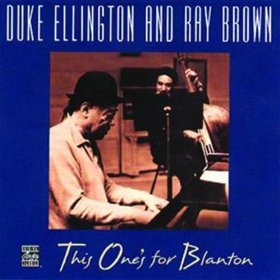
Rating: 100/100 (learn more)
I almost purposely decided to leave This Ones For Blanton off the list, because the whole album is so completely perfect. But I would have to pick Pitter, Panther, Patter, because that is the track that almost defines the Ellington-Blanton duets, and to hear Ray Brown interpret it note-for-note, you really did get a clear picture of, had Jimmy Blanton lived and he and Ellington were to do that stuff again, it probably would have had that same sound, that same kind of feel. Jimmy Blanton, of course, was Ray Browns number-one main man, and it shows blatantly on this recording. I also think that is a case study, maybe, just maybe, on the most perfect acoustic bass sound ever produced in the recording studio. Considering that was in late 1972, during the era when they said jazz died and there was nothing hip going on, it just so happens that one of the greatest bass sounds ever produced in the studio was done. Every single note that Ray Brown produces out of that instrument rings like a bell, from the low E all the way up to the top of the bass. You can tell it was just miked. There was no pickup, just a really perfect-perfect sound. You could almost hear the affection and the humility Ray has playing with Ellington, this joy of, Wow, Im playing Jimmy Blantons original part. It really does sound like Jimmy Blanton in a time capsule.
From Blanton, Ray got the way he constructed his basslines, the power in his basslines. When you listen to Blanton on In a Mellow Tone, Ko-Ko, things like that, the way hes putting his notes was very linear, much more forward-thinking, I believe, than any other bass players of that eraeven Milt Hinton, God rest his soul. Jimmy Blanton was definitely from another planet. He set the pace for modern bass playing. But the thing that Ray Brown always admired most about Blanton, I know for certain, was his sound. He said when he was a kid delivering papers in Pittsburgh, there was this big jukebox in the neighborhood, and Jack The Bear was playing out of this jukebox, and the thing he remembered most was the bass. He said the bass was just rocking! He was like, Man, who is that bass player?" Of course, he found out it was Jimmy Blanton and decided to learn every note that he ever played on those Ellington records. So year, Blanton was the genesis.
Ray also made a lot of records with Count Basie on Pablo in the 70s. Well, actually he made records with Basie in the 60s that werent credited. The famous record with Sammy Davis, Jr. and the Basie band has Ray Brown. But Ray heard Walter Page early on, when he was 11, at Pittsburghs William Penn Ballroom, when Basie was coming east, and he soaked up all of that Blanton language and the Walter Page language. Walter Page was much more of a...you talk about a piledriving bass player! Didnt have a lot of technique, didnt have much melody in his basslines, but I mean, its like running a truck through the wall, he was so strong. He and Papa Jo Jones... Even Ellington said in Music is My Mistress, if I had that rhythm section with my horn section, it would be all oversomething to that effect. So Ray Brown was very much able to prove that notion that you cant really create anything new until you have absorbed all that has come before you.
Reviewer: Christian McBride