THE DOZENS: JASON MORAN SELECTS 12 CLASSIC JAKI BYARD TRACKS by Ted Panken (editor)
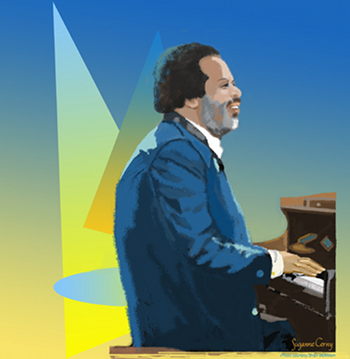
During high school, when, as he puts it, what was coming out of me as a player was strongly based in McCoy Tyner and Herbie Hancock, Jason Moran became aware of pianist Jaki Byard via Byards early 60s recordings by Eric Dolphy and Charles Mingus, and made a crucial decision.
I was looking for a school to try to further what I was learning in high school, and I saw that Jaki was teaching at Manhattan School of Music, he recalls. It seemed that was the best place to go. Jaki was the oldest cat that I saw who was teaching somewhere, and for some reason I didnt want to study with anybody who was young. It seemed that Jaki was playing from the center of jazz history, but then you could see that line stretch very far away from it, and that interested me.
"Also, you could clearly hear his techniquewhen he made those runs, it was evident how thorough he was on his instrument. I read an interview where he was talking about the history of piano, or referencing Earl Hines and Art Tatum. That kind of scared me, because I was thinking, I really dont know that stuff so well. So that summer before I came to New York, I started trying to learn Art Tatums stuff, so that when I had my first lesson with him it wouldnt seem like I was totally devoid of listening to people before 1940 or 1950.
The initial encountera gig by Byards big band, the Apollo Stompers a few weeks before school beganwas memorable. The arrangements were hip, but basic, but Jaki had all these toys and whistles and bells and things that he was playing from the pianoand also screaming and yelling from the piano in joy. I remember thinking, This guys out of his mind. After the set, I went up to him, introduced myself, and said that I would be studying with him. He said something to the effect of, get ready.
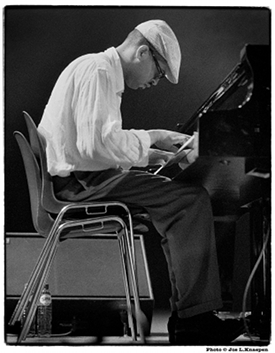
Moran recalls that Byard was totally agitated by how I sounded at his first lesson. He said, Man, dont ever play that loud in here. What do you think this is? A Chick Corea-Herbie Hancock record? So my first lesson was to really understand dynamics, especially when two pianos are paying at the same time.
Jaki had two very large binders filled with music that he had transcribed grand style for piano for his own tunes, for Charlie Parker tunes, for all kinds of peoples tunes. A lot of them were stride pieces, dedicated to Fats Waller or Earl Hines or Erroll Garner. Over my four years with him, I may have gone through 100-150 of those pieces. You would work from that material, and also from some exercises on how to do 20-30 permutations on one scale so that youd learn to hear things in different orders. He did this for chords as well. He had his own intervallic concepts, and he had exercises for stretching out your fingers so that you were able to reach larger intervals. It was a really thorough pedagogy.
Over the course of his studies with Byard, Moran learned to incorporate into the here-and-now older vocabulary passed over in orthodox jazz pedagogy, and, in the process, transitioned from a pianist whose goal was to be able to flow like Kenny Barron flows to a postmodern experimentalist devoted to trying continually to express the diversity of the things that influence me.
Had I not come to Manhattan School of Music and studied with Jaki Byard (its a combination), I definitely wouldnt be in the position I am right now, he says. If an older cat tells you something thats smart, then heed their advice. Jaki sent me 50 stride tunes. Hmm! Maybe I should learn this stuff. Maybe I should be able to understand how this is built, and find the freedom within that.
Jaki Byard: Out Front
Recorded: Englewood Cliffs, NJ, May 28, 1964
Rating: 100/100 (learn more)
Out Front is one of my favorite Jaki Byard albums, though it doesn't really get to his wilder side. I love hearing him play with Bob Cranshaw and Walter Perkins on this trackthey lay down some serious music. Jaki has a certain way of playing his bebop knowledgehes able to turn the phrases to make them feel just a bit off. Thats to say, he switches the phrase to the other side of the beat with such ease, and then switches it back. Also, I remember him telling me that he wrote this piece with Herbie Nichols' touch in mind. I thought that was such a great way to start a composition, with "touch" in mind.
Reviewer: Jason Moran
Jaki Byard: European Episode
Recorded: New York, December 16, 1960
Rating: 100/100 (learn more)
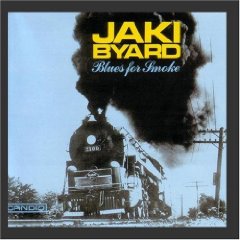
This piece appears on Out Front also, but this version is a killer solo performance on Blues for Smoke, Jakis first record date. Its an excerpt from a lengthy piece by Jaki that goes through a lot of piano history. I know I've adopted that all-encompassing aspect of his playing. Jaki was comfortable in many styles, and was totally committed to all of them. Anyway, this piece is very quick and the listener gets to hear Jakis phenomenal agility. His hands weren't large, but he was able to play sounds that pianists with big hands cannot even attempt to grasp.
Reviewer: Jason Moran
Jaki Byard: Giant Steps
Recorded: Englewood Cliffs, NJ, March 14, 1961
Rating: 100/100 (learn more)
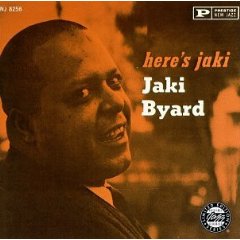
I love this arrangement of Giant Steps. The pace is nice and easy. The thing to listen to is how Jaki animates his phrases with very quick crescendos and decrescendos. Also his ease with jumping into some very big block chords. Then in the last 30 seconds of the performance, he goes into double time, and his fingers are just flying through the melody. It's ridiculous. He taught me an arrangement of Giant Steps that is in 3/4, and extremely difficult, equivalent to a Brahms piano exercise.
Reviewer: Jason Moran
Jaki Byard: Garnerin' A Bit
Recorded: Englewood Cliffs, NJ, March 14, 1961
Rating: 100/100 (learn more)
This is Jaki giving tribute to one of his favorite pianists, Errol Garner. His other favorite was Earl Hines, as they have two amazing records together, as well as some great Youtube clips online. Anyway, back to Garnerin: Jaki uses that laid-back feel of Errol's on this track, even down to the quick, sparse block chords during the first chorus of his solo. It's so laid back. He even has the four-on-the-floor in the left hand, a trademark of Garner's. It's so authentic, and so genuine. And after that opening tribute chorus, Jaki gets back to what he does, big phrases and strong ideas that are here and there, but never where they "should" be. It's extremely "soulful ."
Reviewer: Jason Moran
Rahsaan Roland Kirk: From Bechet, Byas, and Fats
Track
From Bechet, Byas and Fats
Artist
Rahsaan Roland Kirk (tenor sax)
CD
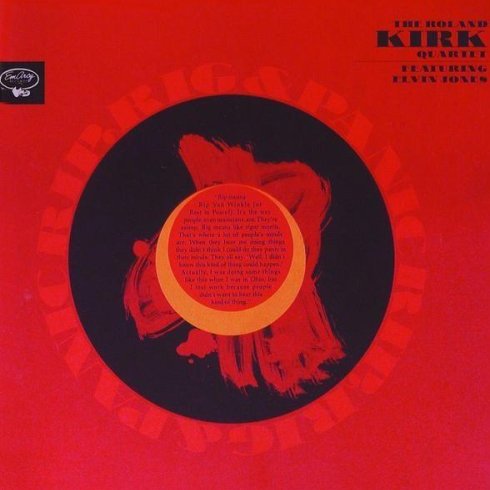
Rip, Rig, and Panic (EmArcy 832 164-2)
Musicians:
Rahsaan Roland Kirk (tenor sax), Jaki Byard (piano), Richard Davis (bass), Alan Dawson (drums).
Composed by Rahsaan Roland Kirk
.Recorded: Englewood Cliffs, N.J., January 13, 1965
Rating: 100/100 (learn more)
Jaki supplies strong comping throughout this record, Rahsaan Roland Kirks fantastic Rip, Rig and Panic. On this track, I think the most astonishing thing is the ending. The tempo begins to slow, and Jaki continues playing his stride piano phrases, altering it with the tempo. As if the record was slowing down, Jaki slowed down, and it feels like a time warp.
Reviewer: Jason Moran
Jaki Byard: Twelve
Musicians:
Jaki Byard (piano), Joe Farrell (tenor saxophone), George Tucker (bass), Alan Dawson (drums).
Composed by Jaki Byard
.Recorded: live, "Lennie's-on-the-Turnpike,West Peabody, Mass., April 15, 1965
Rating: 100/100 (learn more)
Twelve appears on the great live recording, Live at Lennie's on the Turnpike. Joe Farrell is amazing in this group. Heres Jaki with his true rhythm section, especially with Alan Dawson on drums. This is a power track; they really muscle through this three-part blues. What Jaki plays during his solo is quintessential Jaki, full of enthusiasm, rhythm, virtuosity, etc. I love the large leaps he makes in his lines, jumping intervals as a frog jumps lily-pads. I love the yelling he does on this track.
Reviewer: Jason Moran
Jaki Byard: Blues au Gratin
Recorded: New York, December 27, 1972
Rating: 100/100 (learn more)
I have my students listen to this track. The humor in Jaki's music is always apparent, but he was not above putting a joke in his music. I remember seeing he and Greg Osby play a duet concert at the Brooklyn Museum, and as Jaki was taking a solo, an airplane flew overhead. He stopped, and stared at the airplane until it was out of sight and out of earshot. then he continued. He had the most wonderful laugh. Anyway, he really deconstructs this blues. I totally come out of his style of presentation. He lets his left hand really fly freely, before jumping into some heavy stride, before launching into a Yankee Doodle Dandy quote. The bit at the end sounds like Sam Rivers playing piano. He and Sam lived together for a while in Boston, and you can hear the similarity in their contrapuntal approach to the piano.
Reviewer: Jason Moran
Jaki Byard: Willow Weep For Me
Recorded: Paris, July 29, 1971
Rating: 100/100 (learn more)
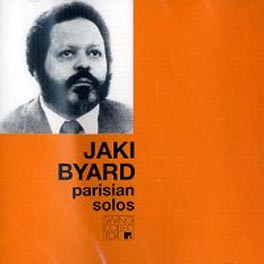
This solo piano version somewhat references the Art Tatum version. When Jaki hits his solo, it's so well paced and beautiful, it makes me want to go to the piano. He has a way of giving me everything I want to hear in a song when he's at the piano. I love the ending of this with the tremolo in the left hand; it's as if a ghost is still playing the bass line. This is a great way for one to approach solo piano. It's difficult, but it's a form that I am blessed to say that I learned directly from Jaki.
Reviewer: Jason Moran
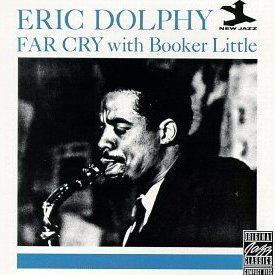
Eric Dolphy: Bird's Mother
Musicians:
Eric Dolphy (alto sax, flute), Booker Little (trumpet), Jaki Byard (piano), Ron Carter (bass), Roy Haynes (drums).
Composed by Eric Dolphy
.Recorded: Englewood Cliffs, N.J., December 21, 1960
Rating: 100/100 (learn more)
Far Cry is from a special record, Far Cry, by Eric Dolphy and Booker Little. The first time I played this tune, I was in high school. I remember listening to Jaki's comping on the melody and realizing that there were so many ways to accompany someone. Jaki's solo moves so effortlessly and rumbles through the changes with more shocks of sound than actual phrases. I remember him saying that he and Eric Dolphy liked to talk in large intervals, like 22nds and 18ths, rather than 4ths and 3rds. They really had a special chemistry, and this is special music. Also, for a hip-hop head, a rapper, Del The Funky Homosapien, sampled a phrase in the bowed bass solo by Ron Carter.
Reviewer: Jason Moran
Jaki Byard: To Bob Vatel of Paris
Recorded: New York, December 27, 1972
Rating: 100/100 (learn more)
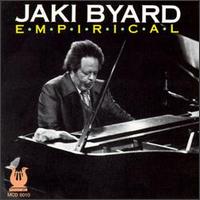
This version of To Bob Vatel Of Paris, from Empirical, is a favorite piece in my repertoire. I'm not sure who Bob Vatel is, but this is a lovely one on which to hear the unadulterated contemporary stride master. Jaki said his father sat him by the radio one day and said, I want you to play like this guy. "This guy" was Teddy Wilson. Jaki is big on history, and it's always evident in his sound. I love how his hands seem to roll through the phrases. Another piano student of Jakis, Eric Lewis, really has taken Jaki's techniques to new places. Jaki always talked about ways to make a song interesting, and one of the ways to do this was to modulate the piece. Jaki does this here before segueing into Blues for Jennie, a very slow blues. Then he returns to Bob Vatel briefly. The main thing I remember about Jaki and his music was that he always brought his joy to it. He wouldn't play it if he didn't enjoy it. And if he didn't enjoy it, he would let you know verbally.
Reviewer: Jason Moran
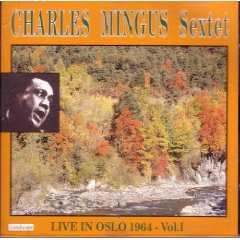
Charles Mingus Sextet: Fables of Faubus
Track
Fables of Faubus
Group
Charles Mingus Sextet
CD
Live In Oslo 1964, Vol. 1 (Landscape (F) LS2 913)
Musicians:
Charles Mingus (bass, composer), Jaki Byard (piano), Eric Dolphy (alto sax), Clifford Jordan (tenor sax), Johnny Coles (trumpet), Dannie Richmond (drums).
Composed by Charles Mingus
.Recorded: live in Oslo, April 12, 1964
Rating: 100/100 (learn more)
When Jaki played with Charles Mingus group in 1964, Mingus gave him a long, unaccompanied solo on Fables of Faubus,, and Jaki liked to interpolate James Weldon Johnsons Lift Every Voice and Sing (The Negro National Anthem) within it. Anyway, what is profound about Jaki's rendition of Lift Evry Voice here is that he was performing the song in the mid-sixties in Europe. Protest music. Jaki made a big deal about segregation, and for good reason. Once segregation was abolished, he was so happy that he could sit anywhere he pleased. We talked about this during our lessons. It was clear that Jaki was politically motivated to make statements through his music. My band, as do many other bands, performs that song as a statement of the future. Its still neededas was widely publicized recently, Professor Henry Louis Gates, the African-American Harvard professor, one of the most distinguished scholars in the United States, was arrested for "breaking into his own home.
Reviewer: Jason Moran
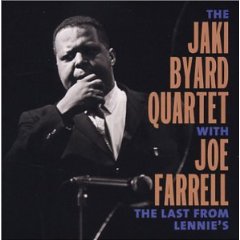
Jaki Byard: Dolphy #1
Musicians:
Jaki Byard (piano), Joe Farrell (tenor sax), George Tucker (bass), Alan Dawson (drums).
Composed by Jaki Byard
.Recorded: live, Lennie's-on-the-Turnpike, West Peabody, Mass., April 15, 1965
Rating: 100/100 (learn more)
This is taken from the Last at Lennie's live recording. This is also a blues, but I think Jaki's solo is magnificent. He's shouting directions to the band. But the angularity and touch of his playing is rarely as expressive as this. This is totally new stuff, even by today's standards. Many of his ideas truly go against the grain of standard jazz practice, in the same way Monk did, and as Cecil Taylor still does. But what is never in question with Jaki is just how comfortable at the piano he is. This is something I know each musician hopes to attain. This recording documents one of his best groups.
Reviewer: Jason Moran