THE DOZENS: JASON MORAN SELECTS 12 ESSENTIAL MUHAL RICHARD ABRAMS TRACKS by Ted Panken (editor)
Asked to select a musician to analyze for the "Musician Dozens" column, pianist Jason Moran did not hesitate to choose Muhal Richard Abrams. He was not an obvious choice. Now 78, Abrams, boasts a sizable discography, spanning 40 years of musical production, that showcases his pianistic virtuosity and compositional ingenuity, and is widely acknowledged for his founding father role in the Association for the Advancement of Creative Musicians. Within that Chicago musicians collective, Abrams mentored consequential composer-instrumentalist-improvisers like Roscoe Mitchell, Anthony Braxton, Henry Threadgill, Wadada Leo Smith, Joseph Jarman, Leroy Jenkins, and George Lewis, and helped to spawn an infrastructure in which they could assimilate and process in a critical an enormous body of music from a broad spectrum of sources, and draw on the organization's manpower to workshop and develop their ideas. Yet Abrams remains almost an underground musician, barely visible on the radar screen of the jazz public.
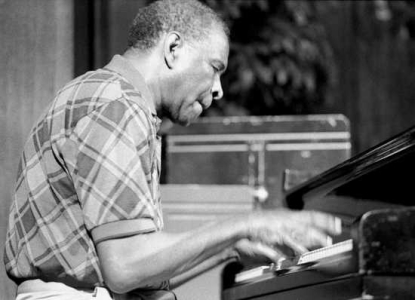
Muhal Richard Abrams, by Michael Wilderman
Like his one-time employers Greg Osby and Steve Coleman, Moran, 33, knows better. Each has been inspired by Abrams' predisposition to do research and development on an enormous range of raw materials in constructing his tonal personality. As I wrote last year in All About Jazz, "In Abrams' singular universe, elemental blues themes and warp speed postbop structures with challenging intervals coexist comfortably with fully-scored symphonic works, string quartets, saxophone quartets, solo and duo piano music, and speech-sound collage structures."
Abrams developed his determination to follow his own muse on the South Side of Chicago during the years after World War Two, when African-Americans were migrating en masse from Mississippi, Louisiana and Alabama to Chicago for factory, railroad and stockyard jobs. "You were expected to do whatever it is that you felt you wanted to do, and nobody said a word," he told me of the ethos that governed his peer group. "The jam sessions were like that. We played bebop and kept up with the geniuses like Bird. But I was never that interested in copying something and then using it for myself. I was interested in copying it in order to analyze it. Then I would decide how I would use or do that same thing. Chicago was full of musicians who distinguished themselves as individuals."
Out of Houston, Moran graduated from Manhattan School of Music, where the iconoclastic pianist Jaki Byard was his mentor, in 1997, and joined Greg Osby, then a Blue Note artist. In 1999, he launched his own succession of seven Blue Note dates on which he's expressed his own capacious interests. As I recently wrote in Down Beat: "The tag 'postmodern' seems unavoidable for Moran, a gently sardonic ironist in the manner of African-American artists like Robert Colescott, the painter, and Adrian Piper, the conceptual New Imagist—James P. Johnson, Afrika Bambaata, Muhal Richard Abrams and Albert King serve as equally valuable raw materials."
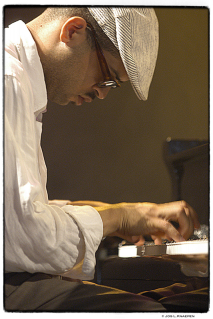
On Moran's most recent release, Artist In Residence, he offers works from three commissioned pieces, including "Break Down" and "Artists Ought To Be Writing," composed in direct response to a Piper work, on which he plays off of her sampled voice. On his recent multi-media Duke University commission, IN MY MIND: Monk at Town Hall 1959, he uses the repertoire contained on the Riverside Records release of that iconic concert as a springboard to contextualize Monk within the stream of Afro-American history. In a project last winter at New York's the Stone, he played solo piano to the lyrics of gangster rapper Ghostface Killah. The wind quintet Imani Winds will premier his first classical composition in October. His core ensemble, Bandwagon (bassist Tarus Mateen and drummer Nasheet Waits) appears on a forthcoming release with blues singer Otis Taylor; he'll augment the group with guitarist Bill Frisell to perform another commissioned piece—in response to traveling exhibit, Gee's Bend Quilts—in December.
A point of aesthetic intersection for Abrams and Moran is their abiding love for the blues and for pre-bebop piano styles. Another is their commitment to experimentalism as a means of navigating the world.
"As a teenager or in my early 20s, I didn't believe it when I heard musicians talk about telling a story," Moran told Down Beat. "I also wonder what chords and what sounds make me real. Does my band also make me real? Which songs do we play that really tell our narrative? Looking at songs, even song titles or song composers, expresses where I am, or who I am. James Weldon Johnson tells me who I am. Albert King tells me who I am. There's a great interview with Monk and Hall Overton from the New School, where Monk says, 'I want to make music that is good for me to play, and I want my audience to enjoy it, and I don't want any criticism from the other musicians.' That sets up this place where we sit in current jazz piano, a place where you are able to tell these narratives, which are your personal ones. Somebody might say they're open for criticism, but it's open more for discussion. It's trying to find that place where you can tell your story freely. Black people weren't able to tell their story here, and some are still coming to grips with how to tell that story."
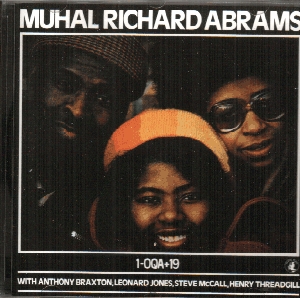
Muhal Richard Abrams: Charlie in the Parker
Track
Charlie in the Parker
Artist
Muhal Richard Abrams (piano, synthesizer, voice)
CD
1-OQA+19 (Black Saint 120017)
Musicians:
Muhal Richard Abrams (piano, synthesizer, voice), Henry Threadgill (alto sax), Leonard Jones (bass), Steve McCall (drums).
Composed by Muhal Richard Abrams
.Recorded: New York, December 1977
Rating: 100/100 (learn more)
This piece features what I call a pyrotechnical melody. It is impressive that everyone is so synchronized, but still feels loose. During the solos, each musician moves through the melody at their own pace, always referencing itkind of like what Thelonious Monk was prone to do, or any good soloist. The performance feels like a free version of Dixieland group improvisation. Muhal shifts back and forth between comping and soloing brilliantly. The energy in this piece never wanes. This in-your-face performance is breathtaking.
Reviewer: Jason Moran
Muhal Richard Abrams: C.C.'s World
Recorded: New York, January 1986
Rating: 100/100 (learn more)
Upon first listening to this, one might think it was a beautiful improvisation. Muhal improvises on the melody for the first four minutes, then spends the last three minutes playing the melody. In this piece, his lush voicings are simply perfect. A player like Muhal constantly defies your expectations. At one moment he can play as sensitive as Herbie Hancock, at another as densely as Cecil Taylor, but he always maintains his identity.
Reviewer: Jason Moran
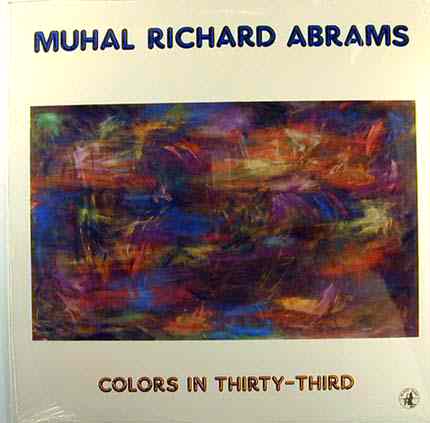
Muhal Richard Abrams: Colors in Thirty-Third
Track
Colors in Thirty-third
Artist
Muhal Richard Abrams (piano)
CD
Colors in Thirty-third (Black Saint BSR0091)
Musicians:
Muhal Richard Abrams (piano), John Blake (violin), John Purcell (soprano sax), Dave Holland (cello), Fred Hopkins (bass), Andrew Cyrille (drums).
Composed by Muhal Richard Abrams
.Recorded: New York, December 19, 1986
Rating: 100/100 (learn more)
Muhal is the best at composing complex, snake-like melodies. The melodies turn when you least expect. The last phrase of the melody creates a centripetal feeling as it repeats itself incessantly before finally releasing into the solos. Muhal created the types of musical phrases M-Base has become known for. What is also brilliant here is how the soloists move into each other in surprising ways.
Reviewer: Jason Moran
Muhal Richard Abrams: Time Into Space Into Time
Track
Time into Space into Time
Artist
Muhal Richard Abrams (piano)
CD
Roots of Blue (RPR Records, RPR 001)
Recorded: New York, January 1986
Rating: 100/100 (learn more)
In the vein of other Muhal compositions like "Charlie in the Parker," this piece has a melody that is injected with jarring inserts of harmony. The melody is technically challenging as well. What I love about how Muhal plays is how he continually refers back to the melody. The listener listens to each idea develop from its root to the newest bud.
Reviewer: Jason Moran
Muhal Richard Abrams: J.G. (Dedicated to Johnny Griffin)
Track
J.G. (Dedicated to Johnny Griffin)
Artist
Muhal Richard Abrams (piano)
CD
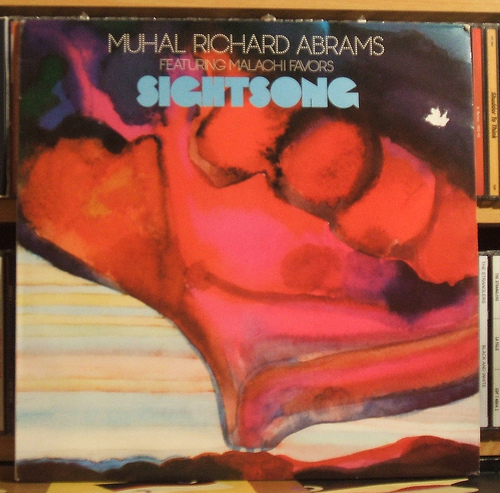
Sightsong (Black Saint BSR0003)
Musicians:
Muhal Richard Abrams (piano), Malachi Favors Maghostut (bass).
Composed by Muhal Richard Abrams
.Recorded: New York, October 13-14, 1975
Rating: 100/100 (learn more)
This melody is recognizable in its feel, but it loops you around before bookending itself with a Monk-like phrase. Here you get to hear Muhals drummer-like feel. I could imagine his right hand sounding like the right hand of a drummer playing the ride cymbal.
Reviewer: Jason Moran
Muhal Richard Abrams: Down at Pepper's
Track
Down at Pepper's
Artist
Muhal Richard Abrams (piano)
CD
View From Within (Black Saint BSR0081)
Musicians:
Muhal Richard Abrams (piano), Stanton Davis (trumpet), John Purcell (alto sax), Marty Ehrlich (tenor sax), Warren Smith (vibes), Rick Rozie (bass), Thurman Barker (drums).
Composed by Muhal Richard Abrams
.Recorded: New York, September 22 & 27, 1984
Rating: 100/100 (learn more)
A classic Muhal opening phrase that lands in a South Side Chicago blues. Muhal was the one that showed me how to marry the contemporary aesthetic with the roots of jazz, the blues. This blues is so authentic that on Muhals solos, you can hear a broken piano string. Also, Muhal does the classic piano rolls that blues pianists do. My blues piano playing cousin from Chicago taught me the same roll on the piano, what he called The Tickle.
Reviewer: Jason Moran
Muhal Richard Abrams: Over the Same Over
Musicians:
Muhal Richard Abrams (piano), Eddie Allen (trumpet), Craig Harris (trombone), Aaron Stewart (tenor sax, soprano sax), Bryan Carrott (vibes), Brad Jones (bass), Reggie Nicholson (drums).
Composed by Muhal Richard Abrams
.Recorded: New York, April 26, 27 & 29, 1995
Rating: 100/100 (learn more)
This piece moves a lot of different places, but over a backbeat. What Muhal wrote makes the backbeat feel in place, but also out of place. Also, these kinds of backgrounds sound like the James Brown horn section, or the Steve Coleman type of rhythmic chants. Its engaging. Also, at the end of the piece is Muhal on synthesizer, digitizing the sound that the band has previously played on. Its a true time warp.
Reviewer: Jason Moran
Muhal Richard Abrams: Du King (Dedicated to Duke Ellington)
Track
Du King (Dedicated to Duke Ellington)
Group
Muhal Richard Abrams Orchestra
CD
Blues Forever (Black Saint BSR0061)
Musicians:
Muhal Richard Abrams (piano), Bakida Carroll (trumpet), Vincent Chancey (French horn), Craig Harris (trombone), Eugene Ghee (tenor sax), Jimmy Vass (alto sax), Wallace MacMillan (baritone sax, flute), Howard Johnson (baritone sax, tuba), Jean-Paul Bourelly (guitar), Michael Logan (bass), Andrew Cyrille (drums).
Composed by Muhal Richard Abrams
.Recorded: Milan, July 20, 21 & 27, 1981
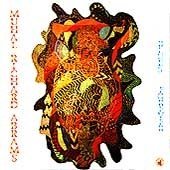
Rating: 100/100 (learn more)
This is a great take on some of Duke Ellingtons early '20s and '30s music. The density of the horns combined with the jutting in and out of the band makes this a true early jazz piece. It sounds nothing like the '20s or '30s, but contains the elements. It also doesnt wear its welcome outits only two minutes long.
Reviewer: Jason Moran
Muhal Richard Abrams: Imagine
Rating: 100/100 (learn more)
Muhal performing solo on synthesizer. Its a mind-trip to hear some of the handclap sounds that are so closely associated with hip-hop music exist in this piece. This is a great experiment that, to one degree, dehumanizes Muhals music, but at the same time retains its human element. Also the fake record scratching sounds and raygun-shots are married with Muhals sense of harmony. It is truly Imagined.
Reviewer: Jason Moran
Muhal Richard Abrams: Unity (Dedicated to the A.A.C.M.)
Track
Unity (Dedicated to the A.A.C.M)
Artist
Muhal Richard Abrams (piano)
CD
Sightsong (Black Saint BSR0003)
Musicians:
Muhal Richard Abrams (piano), Malachi Favors Maghostut (bass).
Recorded: New York, October 13-14, 1975
Rating: 100/100 (learn more)
A great duo trip. Muhal pulls a lot out of the instrument on this one. The tumultuous duet gives the feeling that there are four to six musicians, but there are only two.
Reviewer: Jason Moran
Muhal Richard Abrams: Laja
Musicians:
Muhal Richard Abrams (piano), Stanton Davis (trumpet), John Purcell (alto sax), Marty Ehrlich (alto sax), Warren Smith (vibes), Rick Rozie (bass), Thurman Barker (drums), Ray Mantilla (bongo, conga, percussion).
Recorded: New York, September 22 & 27, 1984
Rating: 90/100 (learn more)
Utilizing the rhythm and feel of salsa music, you get a feel of how Muhal hears music. He hears the rhythm and then allows his style of harmonic writing to infiltrate the rhythm. I remember him telling me once the innovations in music are predominantly through rhythm. I love this. If this piece had different notes, youd think it was Tito Puente.
Reviewer: Jason Moran
Muhal Richard Abrams: Sightsong
Musicians:
Muhal Richard Abrams (piano), Malachi Favors Maghostut (bass).
Composed by Muhal Richard Abrams
.Recorded: New York, October 13-14, 1975
Rating: 100/100 (learn more)
This duet puts Muhal in direct sonic context with other Chicago pianists: Jodie Christian, Herbie Hancock and Andrew Hill. His playing here is simply gorgeous. Characteristics such as the clarity of his runs, his patience, the use of the sustain pedal, the intensity, the emotional sensitivity, and the final phrase that rings out on the piano: all make this piece a bona fide masterpiece.
Reviewer: Jason Moran
Add your comments here
Check out more 'Dozens' here