THE DOZENS: AARON PARKS SELECTS 12 ESSENTIAL PAUL BLEY TRACKS by Ted Panken (editor)
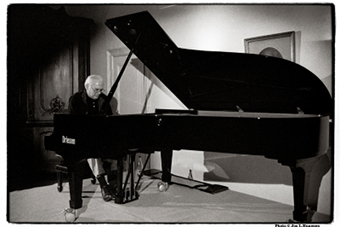
Its difficult to write an introduction about Paul Bley, remarked pianist Aaron Parks. Hes a chameleon, and he is constantly evolving and constantly changing. Its almost impossible to say anything that can encompass his entire career. Trying to say anything about him at all, aside from just track-by-track analysis, seems a bit of a hopeless endeavor.
Now 25 years old, Parks has been part of the jazz conversation since 2002, when he joined Terence Blanchard for what turned out to be a five-year run. During those years, he imprinted himself as a major figure amongst New Yorks international community of 35-and-under improvisers, and on Parks leader debut, Invisible Cinema [Blue Note], you can hear the raw materials that are the lingua franca of that cohortamong them guitarist Mike Moreno, bassist Matt Penman, and drummer Eric Harland, his partners on the 10-song recital. As implied by the title, the notes and tones encode a narrative both palpable and personal, told with with various metric structures, rich melodic themes drawn from a multi-stylistic palette of reference, evocative voicings, and uniformly strongoften virtuosicsolo expression.
Maybe this is a failing of mine, but I tend to think of people as pure individuals, without much context, Parks said, elaborating on the conundrum of pinpointing Bleys qualities. As Duke Ellington said, 'There are two kinds of music. Good music, and the other kind.' Paul Bley isnt even a jazz musician to me. Hes just something other than that.
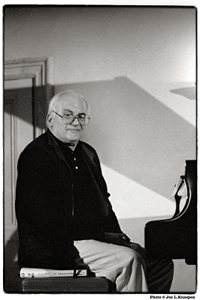
Fair enough, but when Parks was coming up, he did study within a certain pedagogical framework. Asked whether listening to Bley helped free him of that mindset, he replied affirmatively.
Bley was something of a revolutionary from my perspective, somebody who wasnt content simply to play by the rules, although its evident that he knows them, he said. If you listen to his early recordings, he can play bebop and straight-ahead, really swinging stuff as well. But it seems pretty obvious that he decided that he didnt want to be limited.
What was Bley rebelling against?
I've heard some people speak about his early recordings and dismiss him as being just a white version of Bud Powell, but that seems inaccurate to me. Bley is his own man. His time feel is different.
A lot of what he did was the same thing that Ornette Coleman was doing, for sure. Often, he was just liberating melody from the constraints of harmony. Hes all about melody. His melodies unfolded naturally, they went wherever they wanted, even if there was no theoretical reason why they should go there. They had their own logic that resists analysis. When hes playing chords, it seems much more like the chords exist as a collection of melodies rather than on a theoretical harmonic basis. Now, his earlier stuff shows that hes comfortable playing from the perspective of just harmony. But from a lot of his solo piano work, for example, it seems to me he thinks in a much more contrapuntal way. Maybe he would not say so, but this is what I hear some of the time. Keith Jarrett got more into that, and Brad Mehldau and others have delved much directly into that counterpoint. But I think that Bley was doing it almost subconsciously.
Paul Bley allows himself to truly express emotions when he plays the piano. I call him a poet. His melodies really seem to come from the heart, and love seems to be such a huge theme in his writing and his life and just everything I know about him. It seems thats one of his driving motivations. Its not just music for musics sake. Its music that has emotional content related to actual life away from the piano.

A native of Montreal and, like Parks, a professional musician from his teens, Bley himself was 25 when he met Coleman in LA, where he arrived in 1957 after a cross-country road trip that could have been a prototype for Kerouacs On The Road. He describes this transformational experience and many other anecdotes from his eventful life in Stopping Time: Paul Bley and the Transformation of Jazz. Although not customarly cited as a prime branch on the post Bud Powell influence tree with such icons as Bill Evans, Ahmad Jamal, Wynton Kelly, McCoy Tyner, Herbie Hancock, and Chick Corea, Bleys musical DNA is famously heard in the approach of Jarrett, among others. As Parks states explicitly and implicity throughout his incisive remarks, hes one of the true originals.
Sonny Rollins & Coleman Hawkins (with Paul Bley): All the Things You Are
Musicians:
Sonny Rollins (tenor sax), Coleman Hawkins (tenor sax), Paul Bley (piano), Roy McCurdy (drums), Bob Cranshaw (bass).
Composed by Jerome Kern and Oscar Hammerstein III
.Recorded: New York City, July 15, 1963

Rating: 99/100 (learn more)
The piano solo on this song was my first introduction to Paul Bley's music. When I heard it for the first time (7 years ago or so), it basically changed my life. Many people have spoken about the originality and historical importance of this solo, analyzing it in detail and discussing its far-reaching influence; instead of trying to do something like that, I'll just talk briefly about what it has meant to me personally and why I love it so much.
Like many young musicians today, I came up through the jazz education system. I was a diligent student, so I had learned a fair amount of music theory and had a pretty solid understanding of which notes were "correct" for me to play on one chord progression or another. The three choruses that Bley plays here (sandwiched between a more traditional yet beautifully lyrical solo by Coleman Hawkins and a perhaps slightly self-conscious solo by Sonny Rollins) showed the limitation of those theoretical conceptions, and represented a radically different approach to improvisation, one not about right or wrong. It was a paradigm-shifting moment for me, one which caused me to reevaluate my musical priorities.
In this solo, Bley's melodies roam freely in and out of the written changes, each line unfolding in its own curious way, pursuing its own muse. Yet hes not just playing free; even when he's not using the prescribed chord-scales, he always knows exactly where he is in the form of the song, and his ideas are incredibly coherentsometimes motivic, sometimes gestural, sometimes playful, always imaginative. I find this solo to be one of the most strangely beautiful moments in the history of recorded jazz, so I really don't want to spoil it by attempting to use any more words to describe what he's doing here. Just listen.
Reviewer: Aaron Parks
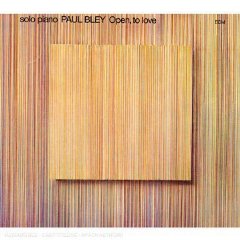
Paul Bley: Closer
Recorded: Arne Bendiksen Studio, Oslo, Norway September 11, 1972
Rating: 100/100 (learn more)
A masterpiece. Bley starts by creating these crystalline sound structures which hang uncertainly in the air and gradually fade. Some might say that he's using a lot of space and silence, but it seems more precise to say that he's playing with duration and decay. Later in the track, a number of unexpected and beautiful things happen: a singing baritone melody emerges in the left hand; a shimmeringly watery interlude follows; then the rhythm slowly grows more insistent and is punctuated by some Henry Cowell-esque extended piano techniques; next, the bottom drops out and there is a disorienting passage where his left and right hands search for one another in the upper register; finally, the questioning melody from the beginning returns. To me, this is alchemy: improvisational solo piano music distilled to an essence.
Reviewer: Aaron Parks
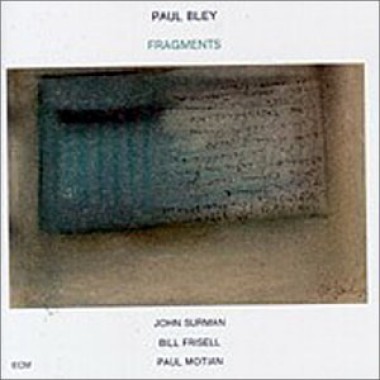
Paul Bley: Line Down
Musicians:
Paul Bley (piano), John Surman (reeds), Bill Frisell (guitar), Paul Motian (drums).
Recorded: Oslo, January 1986
Rating: 98/100 (learn more)
An intensely dramatic piece from the quartet of Paul Bley, John Surman, Bill Frisell, and Paul Motian. The individual solos here are of great, of course, but what really has me in awe is the unbelievably synergistic group dynamic. Listen to the comping by Bley and Frisell during Surman's solos, as well as to the way that Motian's drumming propels and connects everything. There are also a number of times when no one person is soloing, and everyone is working together collectively to build tension instead. The ending is especially haunting; I get chills every single time I hear it.
Reviewer: Aaron Parks
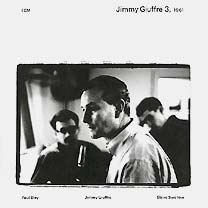
Jimmy Giuffre 3: Brief Hesitation
Track
Brief Hesitation
Group
Jimmy Giuffre 3
CD
1961 (ECM 1438/39)
Musicians:
Jimmy Giuffre (Woodwinds), Paul Bley (piano), Steve Swallow (bass).
Recorded: New York, March 3, 1961
Rating: 100/100 (learn more)
Here's a beautiful song from clarinetist Jimmy Giuffre's quietly revolutionary 1961 record Fusion (reissued on ECM a few years ago) with Steve Swallow and Bley. The absence of drums makes for a unique sonic environment that fosters a kind of chamber-jazz aesthetic. There's really deep listening going on here; pay particular attention to the incredibly intuitive counterpoint between Bley and Giuffre. Beautiful, subtle music.
Reviewer: Aaron Parks
Paul Bley: Floater
Recorded: New York, August 17, 1962

Rating: 97/100 (learn more)
First of all, I'm completely addicted to this melody, even though it only lasts 20 seconds. I love the way the the same basic musical idea is used in three different registers of the piano, with slight variations. And the solo is just incredible. So much rhythmic and melodic freedom, so much possibility. So far ahead of its time.
Reviewer: Aaron Parks
Paul Bley: Cold Fusion
Rating: 92/100 (learn more)
This is my favorite track from Bley's decidedly odd recording Synth Thesis," on which he plays both piano and synthesizer. Listen to how his piano playing echoes and counterbalances the weirdly detuned synth arpeggios. I think this is fantastic, full of the spirit of childhood and discovery that is so characteristic of his music. Also, it makes me giggle.
Reviewer: Aaron Parks
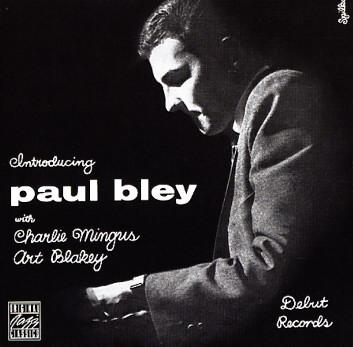
Paul Bley: Like Someone In Love
Musicians:
Paul Bley (piano), Charles Mingus (bass), Art Blakey (drums).
Composed by Jimmy Van Heusen and Johnny Burke
.Recorded: New York, November 30, 1953
Rating: 98/100 (learn more)
The intro here is gorgeous. I'm particularly enchanted by the descending chords 18 seconds in; it's one of those moments that I go back to again and again. It's insightful to hear him in this more straightahead context (with Charles Mingus and Art Blakey) earlier in his artistic trajectory. He was definitely using more of the bebop vocabulary at this point, but already in his own idiosyncratic way: check out the way he's using rhythmic displacement, especially during the first statement of the melody.
Reviewer: Aaron Parks
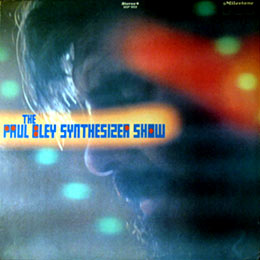
Paul Bley: The Archangel
Track
The Archangel
Artist
Paul Bley (ARP synthesizer, RMI electric piano)
CD
The Paul Bley Synthesizer Show (Milestone MSP9033)
Musicians:
Paul Bley (ARP synthesizer, RMI electric piano),
Erhard Youngstein (bass); Steve Haas (drums)
.Composed by Annette Peacock
.Recorded: New York, December 9, 1970
Rating: 97/100 (learn more)
Until recently, I hadn't been aware that Bley was one of the pioneers of the electronic synthesizer. Here's one of the recordings from the time when he was first exploring these other sounds. It's interesting to hear his musical choices when he is freed from the relatively quick decay of the piano, and suddenly has the ability to be lyrical in entirely new ways. Late in the track, he seems to metaphorically reference the title of the song (composed by the unique and uncategorizable Annette Peacock) by sending his synthesizer soaring into the uppermost frequencies, almost beyond the range of human hearing. I'm also a sucker for the tangible physicality of that old analog synth sound. Mmm...
Reviewer: Aaron Parks
Paul Bley: So Hard It Hurts
Rating: 96/100 (learn more)
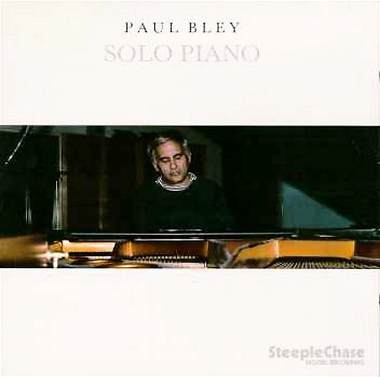
Here's a short solo piano track which feels a bit more jarring and urgent than some of the meditative solo work that Paul Bley is often more associated with. This brings to mind one of the most amazing things about Bley: he cannot be pigeonholed. He finds a way to discover something new each time he comes to the instrument, and he is therefore never a prisoner of habitual playing. On this track, he seems to be fascinated with the extreme low register of the piano, and his use of it is very effective.
Reviewer: Aaron Parks
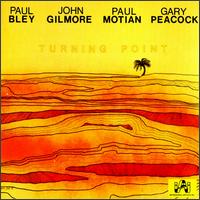
Paul Bley: King Korn
Musicians:
Paul Bley (piano), John Gilmore (tenor sax), Gary Peacock (bass), Paul Motian (drums).
Composed by Paul Bley
.Recorded: New York, March 9, 1964
Rating: 100/100 (learn more)
Another masterpiece. An amazing composition and performance, with so much nervous energy and a curious kind of stop-and-go momentum. It seems to me that this group (with John Gilmore, Gary Peacock, and Paul Motian) may have strongly influenced Keith Jarrett when he put together his "American Quartet" seven years later. Things to listen for: Bley's urgent abstract-blues solo, the kinetic interaction between Peacock and Motion, and Gilmore's transcendental birdsong-like phrasing.
Reviewer: Aaron Parks
Paul Bley: My Old Flame
Track
My Old Flame
Group
Paul Bley Trio
CD
Paul Bley (Fresh Sounds )
Recorded: New York, August 30, 1954
Rating: 99/100 (learn more)
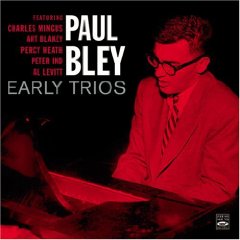
Here's a charmingly romantic ballad from very early in Bley's career. His sense of timing here is incredible. If you listen carefully, you can discover one of the secrets behind his lyrical phrasing: he's singing along. I think that at heart he might really be a singer, and the piano is just the instrument through which he finds himself best able to sing.
Reviewer: Aaron Parks
Paul Bley: Seven
Musicians:
Paul Bley (piano), John Surman (reeds), Bill Frisell (guitar), Paul Motian (drums).
Composed by Carla Bley
.Recorded: Oslo, January 1986
Rating: 100/100 (learn more)
A profoundly beautiful composition by Carla Bley, brought to life patiently and selflessly by Paul Bley, John Surman, Bill Frisell, and Paul Motian. Listening to this feels a bit like entering a slow-motion dreamworld where the laws of physical reality (such as gravity) are flexible and open to creative reinterpretation. Sublime. It reminds me of a quote by Charles Mingus: "Making the simple complicated is commonplace; making the complicated simple, awesomely simple, that's creativity."
Reviewer: Aaron Parks