THE DOZENS: ESSENTIAL BIX BEIDERBECKE by Brendan Wolfe

Bix Beiderbecke (1903-1931) is, in the words of one critic, jazzs Number One Saint. He died a gin-soaked and pathetic death in a stuffy Queens apartment house, screaming that Mexicans under his bed were trying to kill him. Yet he will always be remembered as the "Young Man with a Horn" purity itself that corny white kid from Iowa whose baby-faced picture has come to define the Roaring Twenties.
Bix was more than a legend, though. He was the brilliant stylistic counterpart to his friend Louis Armstrong. Against Satchmos flamboyant virtuosity, Bix offered introverted lyricism. He kept his instrument close, bell pointed down, even while soloing. He rarely strayed beyond the middle range Bix was no Icarus and loved to experiment with new, modernist chord changes. Bix listened to Debussy, and Ravel is said to have listened to Bix.
Racial politics have intruded on too many discussions of Bix over the years, obscuring his music and his wide influence. Hoagy Carmichael, for instance, turned Bixian improvisations into Stardust. Bing Crosby copied Bixs phrasing, and Lester Young and Miles Davis both adopted his cool style. This is all in spite of the fact that Bix left behind only a couple hundred recordings. Here are a dozen of the most essential.
Bix Beiderbecke: Davenport Blues
Track
Davenport Blues
Group
Bix Beiderbecke and His Rhythm Jugglers
CD
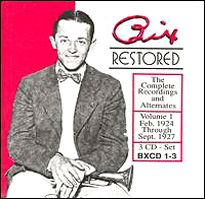
Bix Restored, Volume 1 (Origin Jazz Library BXCD 01-03 )
Musicians:
Bix Beiderbecke (cornet), Tommy Dorsey (trombone), Don Murray (clarinet), Paul Mertz (piano),
Tommy Gargano (drums)
.Recorded: Richmond, Indiana, January 26, 1925
Rating: 85/100 (learn more)
This is Bixs first recording under his own name and includes musicians from the Jean Goldkette Orchestra, an organization that had just given Bix the boot for his poor sight-reading skills. On this date, though, sight-reading wasnt even an option. Bix was composing the piece as he went along and his friends did their best just to keep up. Although Bixs long, laid-back solo boasts nothing of the martial precision that would mark his best years, his grasp of melody is perfect. Even while improvising, he lends the tune wonderful shape and clarity. Don Murray provides effective counterpoint and, unfortunately, Tommy Dorsey doesnt have much to do. Still, the dreamy swing of Bixs playing undoubtedly helped to shape the Sentimental Gentlemans future.
Reviewer: Brendan Wolfe
Jean Goldkette (with Bix Beiderbecke): My Pretty Girl
Track
My Pretty Girl
Group
Jean Goldkette Orchestra (with Bix Beiderbecke)
CD
Bix Restored, Volume 1 (Origin Jazz Library)
Musicians:
Bix Beiderbecke (cornet), Frankie Trumbauer (reeds), Joe Venuti (violin),
Fred Farrar, Ray Lodwig (trumpet), Bill Rank, Spiegle Willcox (trombone), Doc Ryker, Danny Polo (reeds), Eddy Sheasby (violin), Paul Mertz (piano), Howdy Quicksell (banjo), Steve Brown (bass), Chauncy Morehouse (drums)
.Recorded: New York, February 1, 1927
Rating: 90/100 (learn more)
Jean Goldkette had fired Bix for his poor reading skills, but later rehired him, forming the hottest white dance band of its day. After a nationwide tour, the Famous Fourteen squared off against Fletcher Hendersons post-Satchmo outfit in a legendary battle of the bands at New Yorks Roseland Ballroom. Hendersons cornetist Rex Stewart called the experience humiliating, and it was partly due to audience favorites like My Pretty Girl, which the band recorded a few months later. Bix retreats to the background as Polo on clarinet and Trumbauer on saxophone take a scorching lead, bowing out only briefly for Venutis two fiddle breaks. The action, meanwhile, is driven by Browns incomparable slap bass. You know, Steve was even better known to more people at that time than Bix was, saxophonist Doc Ryker remembered.
Reviewer: Brendan Wolfe
Frank Trumbauer & Bix Beiderbecke: Singin' the Blues
Track
Singin' the Blues
Group
Frank Trumbauer & His Orchestra (with Bix Beiderbecke)
CD
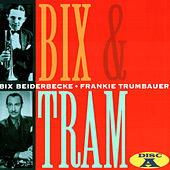
Bix & Tram (JSP Records 913)
Musicians:
Bix Beiderbecke (cornet), Frankie Trumbauer (C-melody saxophone), Jimmy Dorsey (clarinet, alto sax), Bill Rank (trombone), Eddie Lang (guitar),
Doc Ryker (alto sax), Paul Mertz (piano), Chauncey Morehouse (drums)
.Recorded: New York, February 4, 1927
Rating: 100/100 (learn more)
Bix needed Louis (at least in retrospect) to define his style; he needed Trumbauer just to get through the day. The straight-and-narrow saxman, known to his friends as Tram, was the source of personal and professional stability for Bix, and when the two finally hooked up in the studio, they produced a masterpiece. Its easy to forget that Trumbauers solo, which opens the number with unprecedented lyricism, was as important in its time as Bixs. Trumbauer always told a little story, Lester Young explained. It was not about dancing, in other words, or virtuosity; it was about feeling. When Bix chimes in, jazz changed forever. Here was jazzs first balladeer. His solo, though improvised, feels like a finished composition restrained, precise, and governed by melody instead of chord changes and tempo.
Reviewer: Brendan Wolfe
Frank Trumbauer & Bix Beiderbecke: Clarinet Marmalade
Track
Clarinet Marmalade
Group
Frank Trumbauer & His Orchestra (With Bix Beiderbecke)
CD
Bix & Tram (JSP Records 9133)
Musicians:
Frankie Trumbauer (C-melody saxophone), Bix Beiderbecke (cornet), Bill Rank (trombone), Jimmy Dorsey (clarinet, alto sax), Paul Mertz (piano), Chauncey Morehouse (drums),
Howdy Quicksell (banjo)
.Composed by Nick LaRocca, Eddie Edwards, Tony Sbarbaro and Larry Shields
.Recorded: New York, February 4, 1927
Rating: 87/100 (learn more)
Set to wax earlier on the same day as Singin the Blues, Clarinet Marmalade is notable for a few reasons: Bix, for all of his legendary cool, could run with the best of them. Here he blows at breakneck speed while remaining surefooted as a mountain goat (to quote Mezz Mezzrow), always sounding original, his tone nothing short of flawless. Note also a short interlude, just prior to Trams solo, that borrows from Bixs composition In a Mist. Bix wouldnt record the piano solo for seven more months, but it was clear that it was long in the works and that his ideas, at least in Clarinet Marmalade, were an important part of Bill Challis arrangements.
Reviewer: Brendan Wolfe
Frank Trumbauer & Bix Beiderbecke: I'm Coming Virginia
Track
I'm Coming Virginia
Group
Frank Trumbauer And His Orchestra (with Bix Beiderbecke)
CD
Bix Restored, Volume 1 (Origin Jazz Library)
Musicians:
Bix Beiderbecke (cornet), Frankie Trumbauer (C-melody saxophone), Bill Rank (trombone), Jimmy Dorsey (alto sax, clarinet), Eddie Lang (guitar),
Doc Ryker (alto sax), Itzy Riskin (piano), Chauncey Morehouse (drums)
.Recorded: New York, May 13, 1927
Rating: 98/100 (learn more)
In this, his longest solo, Bix is at the height of his powers. He eschews the gutbucket growls and half-valves that were just becoming popular with Duke Ellington and instead digs deep into the melody. In true Impressionist style, with all the manly restraint of Henry James, he suggests rather than declaims the tunes dark melancholy, taking Trumbauers solo the handoff is just perfect and gently refining it. His correlated phrases (Bixs term) build, one on top of the other, until Bix finally leaps up to a (relatively) high register and delivers what Richard Sudhalter rather dramatically described as Caravaggio-like shafts of light.
Reviewer: Brendan Wolfe
Frank Trumbauer & Bix Beiderbecke: Way Down Yonder in New Orleans
Track
Way Down Yonder in New Orleans
Group
Frank Trumbauer & His Orchestra (With Bix Beiderbecke)
CD
Bix & Tram (JSP Records 9133)
Musicians:
Frankie Trumbauer (C-melody saxophone), Bix Beiderbecke (cornet), Don Murray (clarinet), Bill Rank (trombone), Eddie Lang (guitar, banjo), Chauncey Morehouse (drums),
Doc Ryker (also sax), Irving Riskin (piano)
.Composed by Henry Creamer and J. Turner Layton
.Recorded: New York, May 13, 1927
Rating: 96/100 (learn more)
Compared to Im Coming, Virginia, Way Down Yonder in New Orleans is all light and Caravaggio. Its cheerful, down-tempo, even a bit wandering, taking its time to transition from Trams more languid sax to Bixs brighter cornet. A bit more than halfway through his solo, Bix scoots up to a C-sharp, the highest note he ever recorded. This is the exception that proves the rule: Bix, whose mangled fingerings were of his own devising, liked to augment his chords but not the range of his instrument. Think of him as the playwright who creates tension by confining all the action inside a single, cramped apartment.
Reviewer: Brendan Wolfe
Bix Beiderbecke: In a Mist
Track
In a Mist
Artist
Bix Beiderbecke (piano)
CD
Bix Beiderbecke, Volume 1: Singin' the Blues (Columbia 45450)
Recorded: New York, September 8, 1927

Rating: 85/100 (learn more)
The timing of In a Mist is off. Bix played the first take and it was too short; the second take ran long. It was not until Take 4 when Tram, ever the housemother, helpfully tapped him on the shoulder that he wrapped up in the allotted time. Unlike Goldilocks, however, he never got it just right. It still seems rushed. Bix had been working on these chords forever, combining the herky-jerky syncopations of jazz with flourishes reminiscent of Monets Giverny. Still, as progressive as In a Mist was, it comes off nowadays as a bit clunky. Bixs true aspirations may not have been Satchmo-hood but a post at the New York Philharmonic; if so, he had a ways to go.
Reviewer: Brendan Wolfe
Bix Beiderbecke: Royal Garden Blues
Track
Royal Garden Blues
Group
Bix Beiderbecke And His Gang
CD
Bix & Tram (JSP Records 9133)
Musicians:
Bix Beiderbecke (cornet), Bill Rank (trombone), Don Murray (clarinet), Adrian Rollini (bass saxophone), Frank Signorelli (piano), Chauncey Morehouse (drums).
Composed by Clarence Williams and Spencer Williams
.Recorded: New York, October 5, 1927
Rating: 93/100 (learn more)
When the Goldkette outfit disbanded, Adrian Rollini rounded up a few Old Reliables for a gig at the Club New Yorker, which promptly went out of business. Bix, meanwhile, decided to ditch Tram and record under his own name again. On Royal Garden Blues, a standard popularized by the Original Dixieland Jazz Band (and recorded by Bixs first band, the Wolverines), he leads the Gang with great confidence. Bixs close friend, the equally short-lived Don Murray, goes first, then the surprisingly nimble Rollini, who moans like a moose. Bill Rank swings and then wisely steps out of the way here comes Bix. Theres nothing fancy about his 12 bars, nothing French; they just arrive out of nowhere, effortless and astonishing.
Reviewer: Brendan Wolfe
Bix Beiderbecke: Sorry
Track
Sorry
Group
Bix Beiderbecke And His Gang
CD
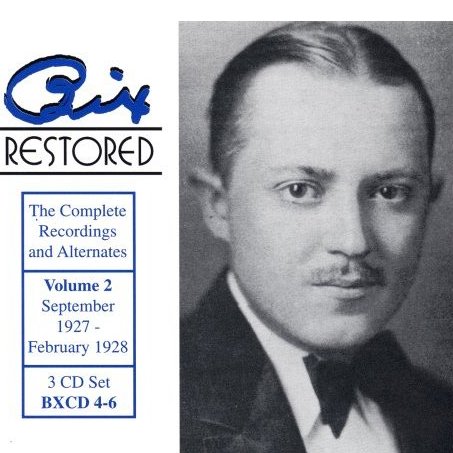
Bix Restored, Vol. 2 (Origin Jazz Library BXCD 04-06 )
Musicians:
Bix Beiderbecke (cornet), Bill Rank (trombone), Don Murray (clarinet), Adrian Rollini (bass saxophone), Frank Signorelli (piano), Chauncey Morehouse (drums).
Rating: 95/100 (learn more)
French biographer Jean Pierre Lion twice uses the word astonishing to describe Sorry. Bix himself boasted, I have never felt better on any recording date. And whos to argue? Although the tune may not have been Bixs fastest, it still manages to leave one breathless with its propulsive, toe-tapping hummability. An opening, grenade-burst staccato ignites Don Murrays 32-bar clarinet solo, and from there things only get better. When Bix finally enters, he pushes against the beat, rides above it, and then hangs back with a brilliant five-note off-the-beat run that defies notation.
Reviewer: Brendan Wolfe
Bix Beiderbecke: From Monday On
Track
From Monday On
Group
Paul Whiteman & His Orchestra (featuring Bix Beiderbecke)
CD
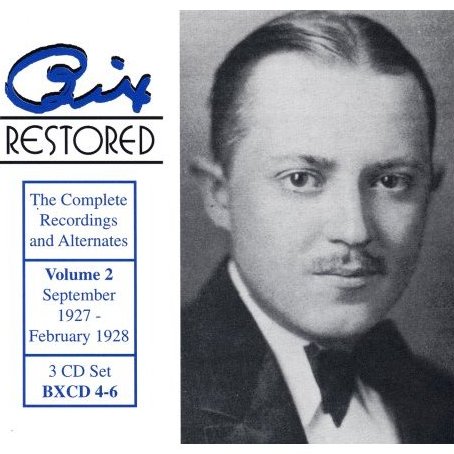
Bix Restored, Volume 2 (Origin Jazz Library BXCD 04-06)
Musicians:
Bix Beiderbecke (cornet),
and a band featuring Charles Margulis (trumpet), Bill Rank (trombone), Harry Barris (piano), Steve Brown (bass), Bing Crosby, Charles Gaylord, Austin Young, Jack Fulton, Al Rinker (vocals)
.Arranged by Matt Malneck. Composed by Harry Barris and Bing Crosby
.Recorded: Liederkranz Hall, New York, February 28, 1928
Rating: 92/100 (learn more)
Paul Whiteman was like a giant, mostly benign mothership that swallowed up available musicians like Bix and his buddies. However, his relentless touring and recording schedule quickly took a toll on Bixs health. The commercial pressure to record so many icky sweet tunes took its own toll, but that was mostly on later generations of critics. Bix just kept on improvising great solos, such as the one on From Monday On. (Granted, From Monday On, written by Bing Crosby and Harry Barris, isnt nearly as icky as much of the Whiteman material.) Bix recorded three extant takes over two sessions, and each of his performances is distinctive and memorable. Here, on Take 6, he cuts through Crosby and companys vocals like a swinging scythe.
Reviewer: Brendan Wolfe
Frank Trumbauer & Bix Beiderbecke: Borneo
Track
Borneo
Group
Frank Trumbauer & His Orchestra (With Bix Beiderbecke)
CD
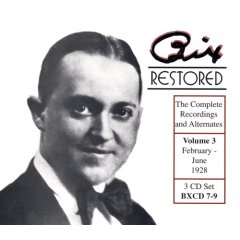
Bix Restored, Volume 3 (Origin Jazz Library BXCD 07-09)
Musicians:
Frankie Trumbauer (C-melody saxophone), Bix Beiderbecke (cornet), Bill Rank (trombone), Eddie Lang (guitar),
Charlie Margulis (trumpet), Harold Scrappy Lambert (vocals)
.Composed by Walter Donaldson
.Recorded: New York, April 10, 1928
Rating: 88/100 (learn more)
Bix and Tram were jazzs odd couple. Tram was all business; Bix, increasingly, was all drink. Tram insisted on playing from the charts; Bix, infuriatingly, was content to make it up as he went along. (Even after Bixs death, Trumbauer complained about how this caused him fits in the studio.) But team them up, even on silly novelty tunes like Borneo, and the tension of their friendship yielded great results. Here they record, for the first time, one of their renowned chase choruses, with Bix improvising a statement and Tram fashioning a response. At the end, their instruments converge in a single moment of dissonance that feels both humorous and wryly appropriate.
Reviewer: Brendan Wolfe
Hoagy Carmichael & Bix Beiderbecke: Barnacle Bill the Sailor
Track
Barnacle Bill the Sailor
Group
Hoagy Carmichael And His Orchestra (With Bix Beiderbecke)
CD
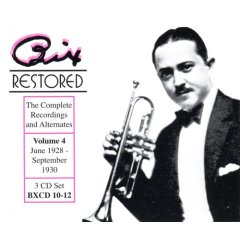
Bix Restored, Volume 4 (Origin Jazz Library BXCD 10-12 )
Musicians:
Hoagy Carmichael (pipe organ, vocals), Bix Beiderbecke (cornet), Bubber Miley (trumpet), Tommy Dorsey (trombone), Benny Goodman (clarinet), Joe Venuti (violin), Eddie Lang (guitar), Gene Krupa (drums).
Recorded: Liederkranz Hall, New York, May 21, 1930
Rating: 80/100 (learn more)
Records hardly get stranger than this. An integrated, all-star cast convenes to record a tune most of them thought was beyond stupid. In fact, Bix later told a friend he had had no idea the side would even be released. But release it RCA-Victor did a Depression was on, after all despite the fact that the musicians, led by trickster Joe Venuti, happily inserted profanity into the chorus. Bix, already a veteran of rehab, had been a stranger to the studio since fainting during a session the previous Fall. His 20-bar solo begins triumphantly and then ends, like his life soon would, a total mess. That Gene Krupa and Benny Goodman would take over for a turn that is tight and remarkably accomplished well, that just makes sense.
Reviewer: Brendan Wolfe
Add your comments here