THE DOZENS: TWELVE ESSENTIAL THELONIOUS MONK PERFORMANCES by Steve Greenlee
The pianist Thelonious Monk (1917-1982) was bebops mad genius. He and a handful of others created the jazz form, and he stayed trued to it for all his years. He is considered one of jazzs greatest composers, yet he wrote only about 70 tunes, and recorded them over and over. He incorporated a few standards into his vernacular, but overwhelming he preferred to perform his own compositions. His angular, sometimes jarring phrasings were polarizing some people found them fresh and inventive, while others thought they were the mark of a less-than-proficient pianist. Beyond that, he was a bizarre presence on the stage shuffling his feet and splaying his legs while playing, getting up from the bench and dancing while his bandmates soloed.
Today, of course, we recognize that Thelonious Sphere Monk was one of the most influential musicians in the history of jazz. He left us with a catalog of songs that are accepted as jazz standards and a bevy of recordings revered as the genres most important documents. Here are a dozen of the most essential.
Thelonious Monk: Straight, No Chaser (1951 version)
Track
Straight, No Chaser
Artist
Thelonious Monk (piano)
CD
Genius of Modern Music, Volume Two (Blue Note 7243 5 32139 2 3)
Musicians:
Thelonious Monk (piano), Sahib Shihab (alto sax), Milt Jackson (vibes), Al McKibbon (bass), Art Blakey (drums).
Composed by Thelonious Monk
.Recorded: New York, July 23, 1951
Rating: 90/100 (learn more)
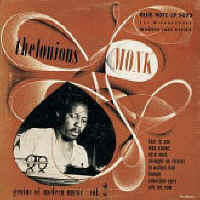
One of Monks earliest recordings, made at a time when there were fewer expectations of the eccentric pianist. (The title Genius of Modern Music was bestowed years later, when the collections of singles were compiled into two albums.) Art Blakey introduces the piece in his own way, smacking out a series of rim shots, before Sahib Shihab and Milt Jackson converse in unison. Monk plays his solo in a straight-ahead manner his angularity would intensify a decade later and then Shihab and Jackson take short, impressive solos. Its a classic piece of bop. Still, to be fair, the entirety of the two volumes of Genius of Modern Music is a must-have for any Monk fan.
Reviewer: Steve Greenlee
Miles Davis: Bemsha Swing
Track
Bemsha Swing
Group
Miles Davis (with Thelonious Monk)
CD
Miles Davis and the Modern Jazz Giants (Prestige OJCCD-347-2)
Musicians:
Miles Davis (trumpet), Milt Jackson (vibes), Percy Heath (bass), Kenny Clarke (drums), Thelonious Monk (piano).
Recorded: Hackensack, N.J., December 24, 1954
Rating: 97/100 (learn more)
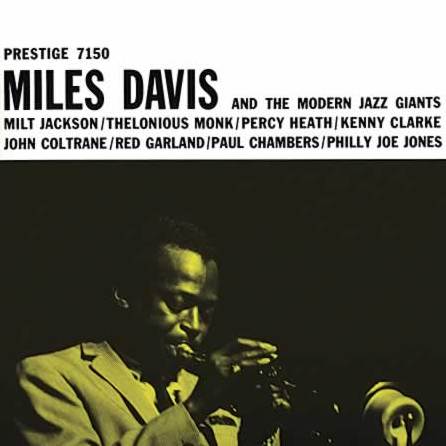
Miles Daviss Christmas Eve 1954 session was the one where, legend had it, Miles instructed Monk to lay out while the trumpeter soloed. Its hard to believe really, if Miles was offended by Monks playing, why would he hire him for the date? But thats not the point. This may be Miless record, but Bemsha Swing is Monks song (well, Monks and Denzil Bests). Monk comps like a yeoman while the others solo, but when it comes his turn to solo he turns in a beauty faithful to the composition, faithful to Miless desires, but Monkish all the way in its off-kilter rhythmic feel and contrapuntal notes. A rare, wonderful glimpse at Monk as sideman.
Reviewer: Steve Greenlee
Thelonious Monk: Caravan
Track
Caravan
Artist
Thelonious Monk (piano)
CD
Thelonious Monk Plays Duke Ellington (Riverside OJCCD-024-2)
Musicians:
Thelonious Monk (piano), Oscar Pettiford (bass), Kenny Clarke (drums).
Composed by Duke Ellington, Juan Tizol & Irving Mills
.Recorded: New Jersey, July 1955
Rating: 90/100 (learn more)
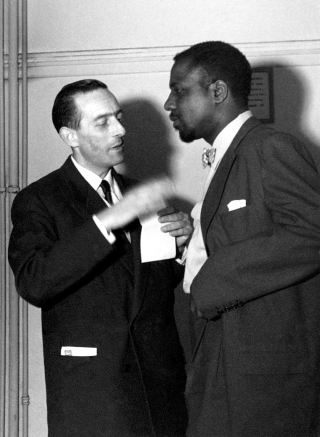
Charles Delaunay and Thelonious Monk, 1954
Photo by Marcel Fleiss
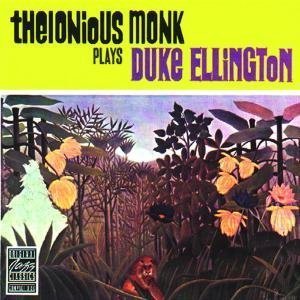
Plays Duke Ellington is an album that has never sat well with critics. One suspects thats because people were left wondering why the second-greatest composer in the history of jazz bothered to record an album of tunes by the greatest composer in the history of jazz. But that fails to do justice to the album on its own merits. Considered in that light, this is a wonderfully jarring collection of fresh treatments and maybe the finest record of Ellington covers. On Caravan, the melody is there all right, and Monk doesnt dare violate the songs integrity, but he does find ways to add his imprimatur. Caravan is the final track on the disc, and its the perfect other bookend to his wink-and-a-nod treatment of the opener, It Dont Mean a Thing (If It Aint Got That Swing).
Reviewer: Steve Greenlee
Thelonious Monk: Brilliant Corners (1956 version)
Musicians:
Thelonious Monk (piano), Sonny Rollins (tenor sax), Ernie Henry (alto sax), Oscar Pettiford (bass), Max Roach (drums).
Composed by Thelonious Monk
.Recorded: New York, October 15, 1956
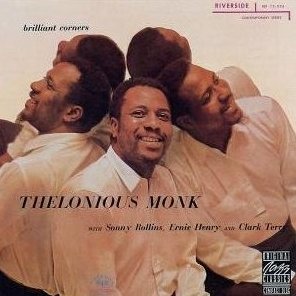
Rating: 95/100 (learn more)
Brilliant Corners is the most complex work in the 70-song Monk canon. It speeds up, it slows down, it shifts course abruptly the musicians must have strained a few muscles trying to keep up with what was going on in Monks head. The rhythmic construction was so challenging that it took the band members 25 takes to get what they needed and even then they never recorded it to Monks satisfaction. What we hear on the album is a patchwork spliced together from the various takes. Its a gorgeously flawed work while it may have been difficult to create, it is easy to listen to.
Reviewer: Steve Greenlee
Thelonious Monk: Well, You Needn't (1957)
Musicians:
Thelonious Monk (piano), John Coltrane (tenor sax), Coleman Hawkins (tenor sax), Gigi Gryce (alto sax), Ray Copeland (trumpet), Wilbur Ware (bass), Art Blakey (drums).
Recorded: New York, June 26, 1957
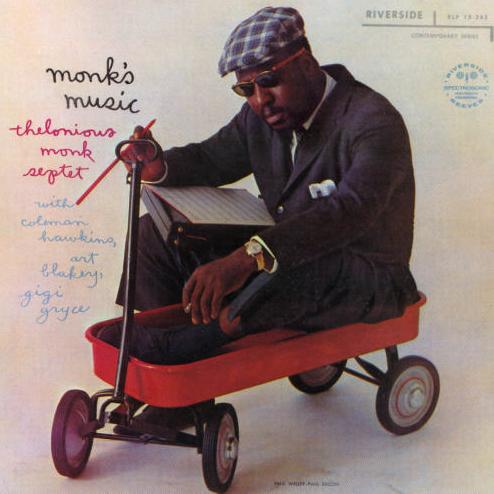
Rating: 98/100 (learn more)
Anytime you can get tenor sax giants Coleman Hawkins and John Coltrane in a room together, the result is bound to be explosive. Add Monk and his bebop classic Well, You Neednt to the mix, and youve got some military-grade dynamite. Coltranes and Hawkins solos are separated by several minutes, but that does nothing to lessen their impact. Monks composition gives the musicians all the framework they need to blow the roof off the studio. And lets not forget the pianist himself. He saves his own solo for last and throws in unexpected notes, pauses and runs. This reading of Well, You Neednt is the bomb.
Reviewer: Steve Greenlee
Thelonious Monk: Ruby, My Dear (with John Coltrane)
Track
Ruby, My Dear
Group
Thelonious Monk Quartet (with John Coltrane)
CD
Thelonious Monk With John Coltrane: The Complete 1957 Riverside Recordings (Riverside RCD2-30027-2)
Musicians:
Thelonious Monk (piano), John Coltrane (tenor sax), Wilbur Ware (bass), Shadow Wilson (drums).
Composed by Thelonious Monk
.Recorded: New York, July 1957
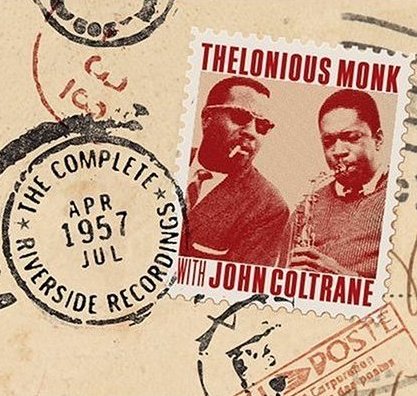
Rating: 99/100 (learn more)
Choosing just one version of Ruby, My Dear as Monks finest is no easy task. This one stands out for Monks strong comping behind John Coltrane, who states the theme and then launches into a romantic solo that strays farther and farther from the melody before coming back around to join it. Monk plays with restraint, never giving in to the urge to splash his perverse tendencies onto Coltranes canvas. When he does finally solo, it is with a reverence for his own composition. This two-disc set also includes a version of Ruby, My Dear from a few weeks earlier that featured Coleman Hawkins on tenor sax, with similarly satisfying results. Also worth hunting down: a sweet, unaccompanied version on the Columbia album Solo Monk and an 11-minute version that Monks quintet recorded at the 1963 Newport Jazz Festival.
Reviewer: Steve Greenlee
Thelonious Monk: Crepuscule With Nellie (Carnegie Hall, 1957)
Track
Crepuscule With Nellie
Group
Thelonious Monk Quartet (with John Coltrane)
CD
Thelonious Monk Quartet With John Coltrane at Carnegie Hall (Blue Note 0946 3 35173 2 5)
Musicians:
Thelonious Monk (piano), John Coltrane (tenor sax), Ahmed Abdul-Malik (bass), Shadow Wilson (drums).
Composed by Thelonious Monk
.Recorded: New York, November 29, 1957
Rating: 97/100 (learn more)
The tapes from this 1957 Voice of America recording at Carnegie Hall were discovered only in 2005, and they contain the most dynamic meeting between Monk and John Coltrane. In fact, once Blue Note put out the album later that year, it immediately ranked among Monks most important and most impressive works. Crepuscule With Nellie, a gorgeous melody for the pianists wife, is given a patient, expressive reading. Monk spends the first two minutes carving out the theme alone, and the rest of the band joins in for the next round. Its Coltranes turn to play the melody straight while Monk adds a few flourishes around the edges. After 4 minutes its over, and theres more proof to the old adage that less is more.
Reviewer: Steve Greenlee
Thelonious Monk: Theres Danger in Your Eyes, Cherie
Track
Theres Danger in Your Eyes, Cherie
Artist
Thelonious Monk (piano)
CD
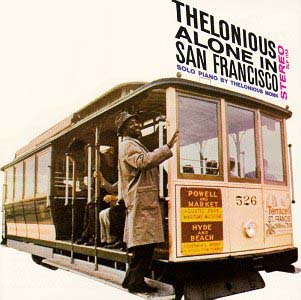
Alone in San Francisco (Riverside OJCCD-231-2)
Recorded: San Francisco, October 1959
Rating: 93/100 (learn more)
Sort of a sequel to Thelonious Himself (1957), Alone in San Francisco was recorded in an empty hall between gigs at the Black Hawk. The trip to the West Coast elicited what may be Monks most beautiful work ever put to record. The album is a mix of originals and standards, and its loveliest tune is the lesser-known standard Theres Danger in Your Eyes, Cherie, which was a favorite of Monks. The melody is pretty enough, and then the pianist makes it his own with a dash of this and a sprinkling of that there. Best of all, the CD includes two takes.
Reviewer: Steve Greenlee
Thelonious Monk: Blue Monk (1964 live version)
Track
Blue Monk
Artist
Thelonious Monk (piano)
CD
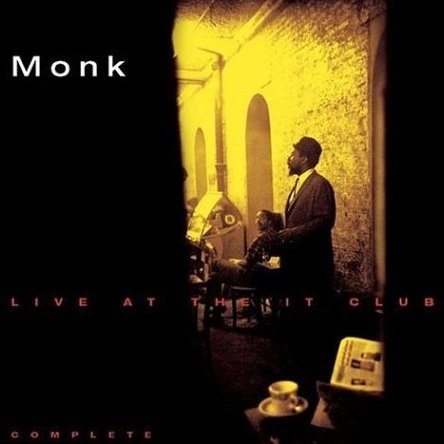
Live at the It Club Complete (Columbia/Legacy C2K 65288)
Musicians:
Thelonious Monk (piano), Charlie Rouse (tenor sax), Larry Gales (bass), Ben Riley (drums).
Composed by Thelonious Monk
.Recorded: Los Angeles, October 31, 1964
Rating: 100/100 (learn more)
Ask me, and Ill tell you Live at the It Club is Monks best record. The latest two-disc version restores virtually everything recorded over two nights at the L.A. spot, and I dare anyone to find a 15-second stretch that doesnt inspire. Naming just one highlight is an impossible task, so why not start at the beginning, with an 11-minute take of Blue Monk, which happens to be one of my favorite pieces to play on my own piano. Monks oeuvre is so small that he recorded a handful of compositions over and over, and yet he still found new things to say each time through. Here his explorations are deep and wide, and he brings out the best in his bandmates, which is the most we can ask of any leader.
Reviewer: Steve Greenlee
Thelonious Monk: Bright Mississippi
Track
Bright Mississippi
Artist
Thelonious Monk (piano)
CD
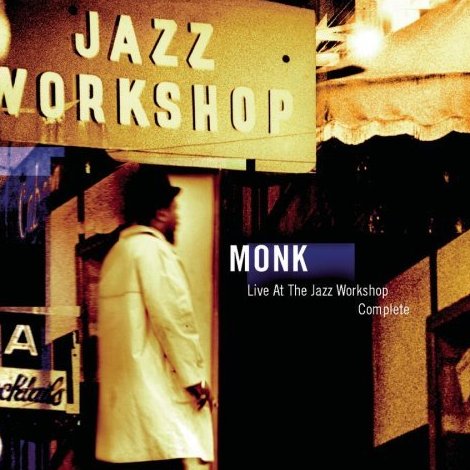
Live at the Jazz Workshop Complete (Columbia/Legacy C2K 65189)
Musicians:
Thelonious Monk (piano), Charlie Rouse (tenor sax), Larry Gales (bass), Ben Riley (drums).
Recorded: San Francisco, November 4, 1964
Rating: 91/100 (learn more)
One of the most fun tunes Monk wrote, Bright Mississippi is based on the melody and chord changes of Sweet Georgia Brown. The eight-minute version Monks quartet recorded at San Franciscos Jazz Workshop is an upbeat romp. Charlie Rouse, an underrated saxophonist who lived in Monks shadow, casts out a terrific, weaving solo before Monk gives up his own, smartly using both space and contrast. Larry Gales musters a long bass solo that never grows tiring, and Ben Riley brings it home with a drum solo that plays off Galess plucking. Nightclub jazz at its finest.
Reviewer: Steve Greenlee
Thelonious Monk: 'Round Midnight (1957 solo version)
Recorded: New York, April 1957
Rating: 99/100 (learn more)
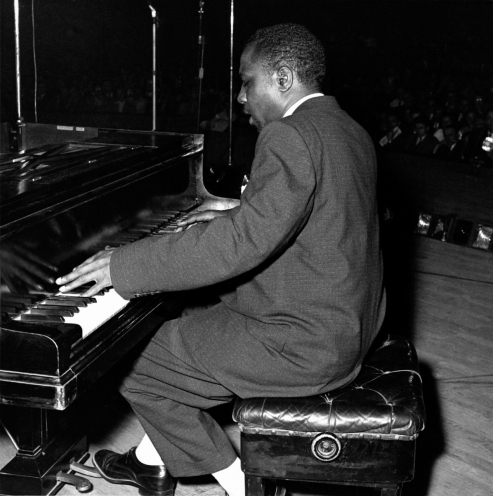
Thelonious Monk at Salle Pleyel (1954)
Photo by Marcel Fleiss
To truly appreciate Monk's most famous and most revered composition, "'Round Midnight," one must hear one of his solo recordings of it. This one is painfully beautiful, as Monk plays it softly and without a lot of fancy tricks or spiked notes. The CD Thelonious Himself includes one heck of a bonus track, too: 22 minutes of Monk working on the tune, trying to find the right groove and exploring its nooks and crannies. Another (better-recorded) version of the tune came 11 years later and can be found on the two-CD Sony release Monk Alone. It's a totally different beast. Less introspective and more powerful, Monk jabs the keys with a vengeance, as though telling the listener in no uncertain terms that this four-minute gem is an important piece of music.
Reviewer: Steve Greenlee
Thelonious Monk: Monk's Mood (1957 recording)
Musicians:
Thelonious Monk (piano), John Coltrane (tenor sax), Wilbur Ware (bass).
Composed by Thelonious Monk
.Recorded: New York, April 1957
Rating: 100/100 (learn more)
The final tune on Thelonious Himself is in fact not just Thelonious himself, and its akin to a fine dessert after a big meal. Monks Mood is a beautifully melancholy theme, and here it gets the most perfect treatment its author ever gave it. Monk plays unaccompanied for 2 minutes before Wilbur Ware plucks a few notes and John Coltrane arrives with a tender, passionate solo. Throughout, Monks touch is heartbreaking, and the simpatico relationship between him and Coltrane is amazing. This ranks among the most wonderful eight minutes anyone could experience.
Reviewer: Steve Greenlee