THE DOZENS: TWELVE ESSENTIAL 'THIRD STREAM' PERFORMANCES
by Alan Kurtz
A few years after longtime Metropolitan Opera French hornist Gunther Schuller assisted in Miles Davis's Birth of the Cool (1950), he coined the term Third Stream to describe the confluence of jazz with "the compositional procedures and techniques acquired in Western music during 700 years of development."
An articulate, tireless spokesman, Schuller did his best to explain this concept, but potential consumers were generally mystified. Too often, Third Stream got defined not for what it was, but for what it wasn't: NOT jazzmen performing classical works straight, such as Benny Goodman doing Mozart or Wynton Marsalis playing Haydn; NOT contemporary concert music commissioned by jazzmen, such as Bartk's Contrasts or Stravinsky's Ebony Concerto; NOT jazzily rearranged classical pieces; NOT jazz with strings. Third Stream was NOT so many things, there wasn't much left for it to be. A decade after its birth, Joe Zawinul released an album titled The Rise & Fall of the Third Stream (1965).
While Third Stream never became an onrushing torrent, its obit was premature. Having trickled into the 21st century, it has hydrated half a century's worth of ambitiously creative music. We invite you to take a dip and decide for yourself. Is Third Stream cool or not?
Stan Kenton: Trajectories
Musicians:
Stan Kenton (piano), Buddy Childers (trumpet), Maynard Ferguson (trumpet), Shorty Rogers (trumpet), Milt Bernhart (trombone), Bill Russo (trombone), Bud Shank (alto sax, flute), Art Pepper (alto sax), Bob Cooper (tenor sax), Laurindo Almeida (guitar), Don Bagley (bass), Shelly Manne (drums),
Chico Alvarez, Don Paladino (trumpet); Harry Betts, Bob Fitzpatrick, Bart Varsalona (trombone); John Graas, Lloyd Otto (French horn); Gene Englund (tuba), Bart Caldarell (tenor sax, baritone saxes), Bob Gioga (baritone sax, bass clarinet), and a 16-piece string section
.Composed by Franklyn Marks
.Recorded: Hollywood, CA, February 5, 1950
Rating: 91/100 (learn more)
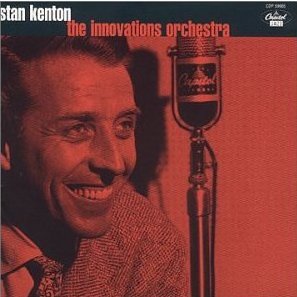
As usual, Stan Kenton was ahead of the curve. His Innovations in Modern Music Orchestra was an icebreaker, intrepidly forging an uncharted Third Stream long before Gunther Schuller named it. Here, composer Franklyn Marks shrewdly overcomes the inherent viscosity of strings by tracing pizzicato swirls across the clear night sky. Shelly Manne once famously griped that getting the Kenton band to swing was as strenuous as chopping wood, but the built-in momentum of "Trajectories" eases his woodchopper's chore. While the brass, alas, are vintage mid-century crime jazz, this pioneering expedition is among the friskiest voyages of discovery since Darwin's Beagle.
Reviewer: Alan Kurtz
Shelly Manne: Pas de Trois
Track
Pas de Trois
Artist
Shelly Manne (drums)
CD
"The Three" and "The Two" (Contemporary OJCCD-172-2)
Musicians:
Shelly Manne (drums), Jimmy Giuffre (clarinet, tenor sax), Shorty Rogers (trumpet, flugelhorn).
Composed by Jimmy Giuffre
.Recorded: Hollywood, CA, September 10, 1954
Rating: 93/100 (learn more)
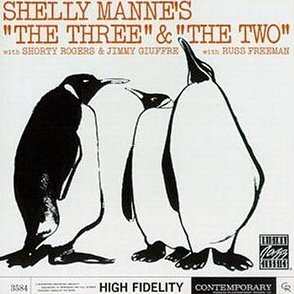
Concurrent sentences under warden Stan Kenton left Shelly Manne and Shorty Rogers, like career criminals acquiring new tricks of the trade in prison, hardened musical adventurers. By contrast, Jimmy Giuffre's "Four Brothers" sojourn with Woody Herman scarcely foretold his subsequent avant-gardism. Only after falling under the sway of composer/mystic Dr. Wesley La Violette did Giuffre grow cerebral, rigorously applying formal compositional devices to chamber jazz. While much mid-'50s West Coast jazz was contrapuntal, Giuffre's "Pas de Trois" takes full advantage of Manne's melodicism, integrating his drums into an extraordinary tripartite fugue. Abstract, controlled, fascinatingThird Stream for three, please.
Reviewer: Alan Kurtz
John Lewis: Three Little Feelings
Track
Three Little Feelings
Group
John Lewis
CD
The Birth of the Third Stream (Columbia/Legacy CK 64929)
Musicians:
Miles Davis (trumpet, flugelhorn), Bernie Glow (trumpet), Joe Wilder (trumpet), J.J. Johnson (trombone), Urbie Green (trombone), Bill Barber (tuba), Milt Hinton (bass), Osie Johnson (drums),
Arthur Strutter, John Ware, Melvin Broiles, Carmon Fornarotto (trumpet); John Clark (trombones), Jimmy Buffington, Joseph Singer, Ray Alonge, Arthur Sussman (French horn); John Swallow, Ronald Ricketts (baritone horn), Richard Horowitz (tympani)
.Composed by John Lewis. Conducted by Gunther Schuller
.Recorded: New York, June 20, 1956
Rating: 95/100 (learn more)
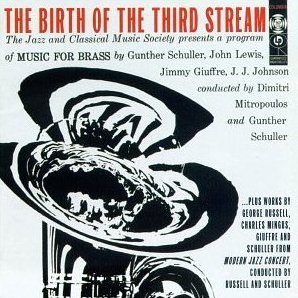
This track both connects and disconnects Birth of the Cool and Third Stream. BOTC holdovers include Miles, J.J., Barber, Lewis and Schuller. But whereas BOTC was an arrangers/improvisers band, Third Stream is a composers/soloists orchestraeven, as here, sans strings. "Three Little Feelings" beefs up the brass, but don't expect Kentonesque overkill from John Lewis, who always understood that a well-placed arrow is just as effective as cannon fire, and far more economical. Miles and J.J. solo sensitively, yet the ultimate triumph is composer Lewis's ability to avoid bombast and reveal the luxuriant beauty of 17 brass instruments.
Reviewer: Alan Kurtz
John Lewis: Sketch
Track
Sketch
Group
Modern Jazz Quartet & Beaux Arts String Quartet
CD
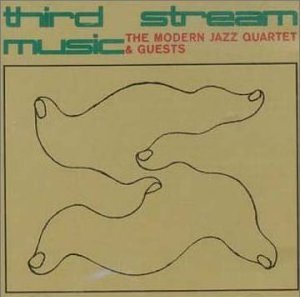
Third Stream Music (Wounded Bird Records WOU 1345)
Musicians:
John Lewis (piano), Milt Jackson (vibes), Percy Heath (bass), Connie Kay (drums),
Gerald Tarack (violin), Alan Martin (violins), Carl Eberl (viola), Joe Tekula (cello)
.Composed and conducted by John Lewis
.Recorded: New York, September 23, 1959
Rating: 90/100 (learn more)
MJQ + string quartet = one felicitous match. Whereas many jazz groups would simply overwhelm such a settingcan you imagine, for instance, Art Blakey's Jazz Messengers with string quartet?the MJQ's genteel nuances are, if anything, rudely interrupted by the strings' first entrance. But the parties quickly reach such amicable rapprochement that we wish this 5-minute "Sketch" had been developed into a full-fledged painting. Come to think of it, the following year the MJQ & Orchestra recorded Third Stream's one-hit wonder, "England's Carol." So maybe "Sketch," blending modern jazz and rococo elegance, grew into a mural after all.
Reviewer: Alan Kurtz
Charles Mingus: Half-Mast Inhibition
Musicians:
Charles Mingus (bass), Marcus Belgrave (trumpet), Ted Curson (trumpet), Clark Terry (trumpet), Eddie Bert (trombone), Slide Hampton (trombone), Jimmy Knepper (trombone), Eric Dolphy (flute, alto sax, bass clarinet), Bill Barron (tenor sax), Yusef Lateef (tenor sax,flute), Danny Bank (baritone sax), Sir Roland Hanna (piano), Dannie Richmond (drums), Max Roach (percussion),
Hobart Dotson, Richard Williams (trumpet); Charles Greenlee (trombone), Don Butterfield (tuba), Harry Schulmann (oboe), Robert Di Domenica (flute), Charles McCracken, (cello), Sticks Evans, George Scott (percussion)
.Composed by Charles Mingus. Conducted by Gunther Schuller
.Recorded: New York, May 24, 1960
Rating: 96/100 (learn more)
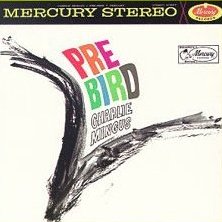
Mingus began "Half-Mast Inhibition" at age 18, but left it unfinished for 20 years. As tempting as it might be to call this the first Third Stream composition, it's unclear how much was written in 1940 and how much the mature Mingus added later. What is clear is that this is a wellspring of orchestral complexity and compositional fecundity, presaging The Black Saint And The Sinner Lady (1963). Uncharacteristically for Mingus, "Half-Mast Inhibition" is entirely written: no head arrangements, no improvisation. Yet from first note to last, only Mingus could've poured forth this disturbing, dissociative Third Stream of consciousness.
Reviewer: Alan Kurtz
Gunther Schuller (featuring Ornette Coleman): Abstraction
Track
Abstraction
Group
Gunther Schuller (featuring Ornette Coleman)
CD
John Lewis: Golden Striker / Jazz Abstractions (Collectables COL-CD-6252)
Musicians:
Ornette Coleman (alto sax), Scott LaFaro (bass), Jim Hall (guitar),
Charles Libove, Roland Vamos (violins), Harry Zaratzian, Alfred Brown (violas), Joseph Tekula (cello), Alvin Brehm (bass), Sticks Evans (drums)
.Composed and conducted by Gunther Schuller
.Recorded: New York, December 19, 1960
Rating: 96/100 (learn more)
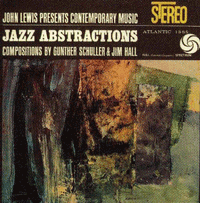
"Abstraction," explained its composer, combines "the most advanced [circa 1960] stylistic manifestations of both jazz and classical music," particularly investigating the "many parallels between the playing of Ornette Coleman and serial music." The piece is structurally ingenious, employing an "ABA form, in which B is a solo cadenza by Ornette, and the second A is an exact retrograde of the first A" (in other words, a mirror image). "Abstraction" occasionally sounds like a radio picking up two stations simultaneously, one jazz and another 12-tone. But soon we realize that, amazed as Alice, we've slipped Through the Looking-Glass. Curiouser and curiouser!
Reviewer: Alan Kurtz
Jim Hall: Piece for Guitar & Strings
Track
Piece for Guitar & Strings
Artist
Jim Hall (guitar)
CD
John Lewis: Golden Striker / Jazz Abstractions (Collectables COL-CD-6252)
Musicians:
Jim Hall (guitar), Scott LaFaro (bass),
Charles Libove, Roland Vamos (violins), Harry Zaratzian, Alfred Brown (violas), Joseph Tekula (cello)
.Composed by Jim Hall. Conducted by Gunther Schuller
.Recorded: New York, December 19, 1960
Rating: 95/100 (learn more)
Jim Hall's pre-1960 written output had been, as was the guitarist himself, modest. Hall the composer came out of left fieldor, at least, out of Cleveland, where he matriculated at the Institute of Music. His bluesy playing is no surprise, since that was always Hall's forte. Nor is it unexpected that he incorporates folk jazz, which he'd explored as Jimmy Giuffre's sideman. What's revelatory about Hall's Opus #1 is his uncanny writing for strings, rendering those hoary Stradivari tinderboxes as funky as fiddles at a hoedown. Like the MJQ's "England's Carol," this proves Third Stream can be fun.
Reviewer: Alan Kurtz
Stan Getz: I'm Late, I'm Late
Musicians:
Stan Getz (tenor sax),
Beaux Arts String Ensemble: Gerald Tarack, Alan Martin (violins), Jacob Glick (viola), Bruce Rogers (cello), John Neves (bass), Roy Haynes (drums), unknown piano and woodwind section
.Composed by Eddie Sauter. Conducted by Hershey Kay
.Recorded: New York, July 14, 1961
Rating: 98/100 (learn more)
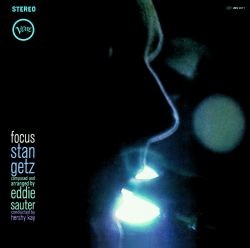
In 1961, Focus session hadn't acquired today's weasel connotations, but instead described the recording of Eddie Sauter's suite for tenor sax and orchestra. Its sprightly opening reminds highbrows of Bartks Music for Strings, Percussion and Celesta (1936), and to us lowbrows suggests the White Rabbit in Disney's Alice in Wonderland (1951). Stan Getz's completely improvised playing on two 4-minute takes proved so remarkable, they were spliced to form a continuous 8-minute track. The violins/viola ensembles are ragged in spots, and Stan's reed balks twice, but Roy Haynes's drumming is superb, and Getz is, as usual, sublime. A very important date.
Reviewer: Alan Kurtz
Ran Blake: Wende
Recorded: Boston, MA, August 20, 1976
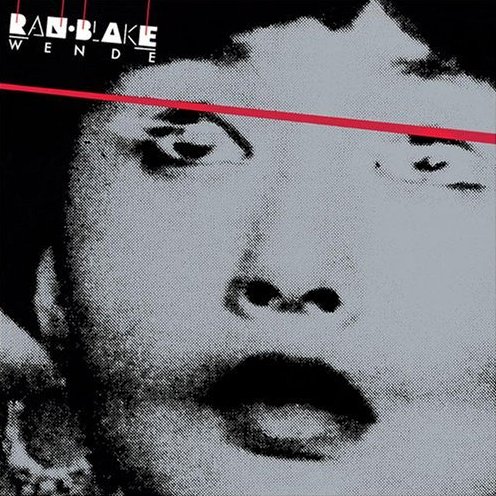
Rating: 90/100 (learn more)
Jazz's unaccompanied piano tradition goes back to Scott Joplin and Jelly Roll Morton. At the other end of this tradition, following such modernists as Monk and Cecil Taylor, sits Ran Blake. To appreciate Blake, however, we must also reckon with mid-20th century European composers Messiaen and Boulez, whose music, explained their colleague Stockhausen, "consists of separately formed particles." The aggressively propelled particles of "Wende" ricochet around Ran Blake's acoustical accelerator with the exuberance of subatomic bumper cars, showing how thoroughly he has internalized post-Schoenberg serialism. If you've ever wondered what jazz pointillism might sound like (and who hasn't?), here 'tis.
Reviewer: Alan Kurtz
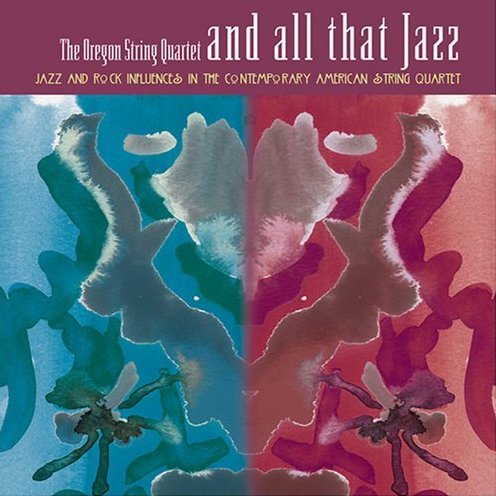
David Baker: Calypso (from Sonata for Jazz Violin and String Quartet)
Track
Calypso (third movement from Sonata for Jazz Violin and String Quartet)
Group
David Baker
CD
The Oregon String Quartet and All That Jazz: Jazz and Rock Influences in the Contemporary American String Quartet (Koch International Classics KCH 7672)
Musicians:
Diane Monroe (jazz violin), Kathryn Lucktenberg, Fritz Gearhart (violins), Leslie Straka (viola), Steven Pologe (cello)
.Composed by David Baker
.Recorded: Eugene, Oregon, 2006
Rating: 95/100 (learn more)
About the time African-Americans originated jazz, Afro-Caribbean musicians invented calypso, likewise testing the limits of free expression in a segregated society. David Baker's "Calypso" (1987) features violinist Diane Monroe, whose jazz bona fides are longstanding. More surprisingly is the jazz facility of four University of Oregon School of Music faculty members, in particular Steven Pologe, strumming his cello with the lan of a Trinidadian street guitarist at Carnival. Whether Bakerhimself a cellist and former jazzmanhas improved conventional notation, or classical string players have newly developed jazz chops, the result is an uplifting celebration of music as universal language.
Reviewer: Alan Kurtz
Yusef Lateef: Transmutation
Track
Transmutation (second movement from The African-American Epic Suite)
Artist
Yusef Lateef (flutes, tenor sax, algaita, shannie)
CD
The African-American Epic Suite (ACT WDR 892 142)
Musicians:
Yusef Lateef (flutes, tenor sax, algaita, shannie),
Adam Rudolph (bells, cymbals, gongs, hand drums, tablas, didjeridoo, whistles, percussion), Ralph Jones (flutes, bass clarinet, soprano & tenor saxes, hichiriki), Federico Ramos (acoustic guitar), Charles Moore (shofar, dumbek, conch shells), Klner Rundfunkorchester (Cologne Radio Orchestra) directed by David de Villiers
.Composed by Yusef Lateef
.Recorded: Cologne, Germany, October-November 1993
Rating: 97/100 (learn more)
In the context of Yusef Lateef's African-American Epic Suite, "Transmutation" refers to the metamorphosis of blacks abducted to the New World. No longer Africans, never to be fully accepted as Americans, they become an uneasy hybrid: African Americans. Third Stream seems readymade for such drama, being neither European classical nor American jazz, but their amalgamation. Lateef emphasizes this cultural disparity by pitting "primitive" instruments, including drums, whistles and conch shells, against a more "sophisticated" German symphony orchestra, with stunning effect. Like the bowels of a slave ship, this music is not for the fainthearted. It is provocative, disquieting and powerfully moving.
Reviewer: Alan Kurtz
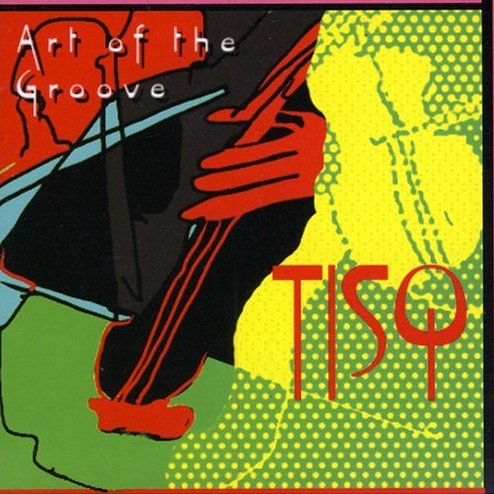
Turtle Island String Quartet: Blue Rondo la Turk
Track
Blue Rondo la Turk
Group
Turtle Island String Quartet
CD
Art of the Groove (Koch International 7500)
Musicians:
David Balakrishnan, Evan Price (violin); Danny Seidenberg (viola), Mark Summer (cello)
.Composed by Dave Brubeck
.Recorded: Los Angeles, April 1999
Rating: 95/100 (learn more)
Merely referencing Mozart's "Rondo Alla Turca" didn't make Dave Brubeck's "Blue Rondo la Turk" (1959) Third Stream. Instead of combining jazz and classical elements, "Blue Rondo" simply wedged 4/4 blues solos between a bravura 9/8 enclosure. Recognizing that a sandwich is not a salad, the TISQ here mixes ingredients much more tastily. The piece's overall form is unchanged, but when played by string quartet instead of jazz quartet, time-signature shifts are less abrupt, more organic. Third Stream boosters have long dreamt that string players would someday learn to swing. Turtle Island la Turk is our dream come true.
Reviewer: Alan Kurtz
Click here for comments and discussion on Twelve Essential Third Stream Performances