In conversation with danilo prez
By Tomas Pea
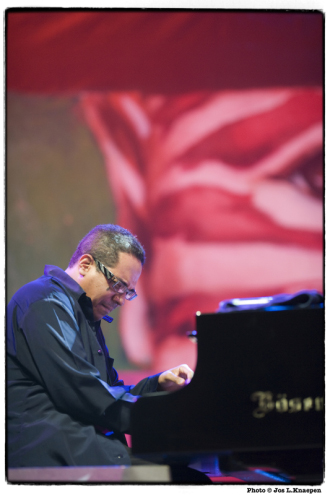
Danilo Prez was born in Panama in 1966. He began his musical career at the age of three under the tutelage of his father, a professional bandleader and vocalist. By the age of ten, he was studying the European classical piano repertoire at the National Conservatory in Panama, eventually transferring to the Berklee College of Music to study jazz. He has performed and/or recorded with a wide range of great musicians: Jon Hendricks, Terence Blanchard, Paquito D' Rivera, Wayne Shorter, Steve Lacy, Jack DeJohnette, Charlie Haden, Michael Brecker, Joe Lovano, Tito Puente, Wynton Marsalis, Billy Cobham, John Patitucci, Tom Harrell, Gary Burton, and Roy Haynes, among them. A resident of Boston, Prez is currently on the faculties of the Berklee College of Music and the New England Conservatory of Music.
Prez spoke with us about the making of his recent album on the Verve label, Across the Crystal Seaa collaboration with the renowned arranger/conductor Claus Ogerman. In addition, Danilo spoke about the Panama Jazz Festival, and his feelings about the power of music.
Congratulations on the release of Across the Crystal Sea. Its an exquisite recording.
Thank you very much.
I did a double take when I first heard it. Its really different from anything you've done before. Now that the project is behind you and the album's been released, what are your thoughts?
I'm still reeling from the fact that everything went so fast; we [his trio] recorded everything in a day and a half!
I understand that it was producer Tommy LiPuma's idea to pair you with arranger/conductor Claus Ogerman for this orchestral project. Apparently, LiPuma was inspired by Symbiosis, the 1965 collaboration between Ogerman and Bill Evans.
Claus is familiar with my past work, but it was Tommy who recommended me for the project. Its wonderful to have had the opportunity to work with such a great master. For me, it has been a dream come true.
The recording was a bi-coastal project. Your trio recorded in New York, and the orchestra was recorded later, in Los Angeles.
Exactly. The challenge for (the trio) was to imagine the music without an orchestra.
Obviously, Claus had a very clear vision of what he wanted to accomplish.
I felt like we were on a baseball team I was the pitcher and Claus was the coach!
As part of Wayne Shorters group, you're accustomed to playing 'in the moment.' But working with Claus was an entirely new experience for you. Were you in or out of your comfort zone?
If anything, playing with Wayne has taught me not to be in a comfort zone. Initially I had some concerns, because I didnt see the music until a few days before the sessions. But playing with Wayne has given me all the tools I need.
Many of Clauss themes are based on classical compositions: 'If I Forget You' came from a Rachmaninoff piece; 'The Purple Condor' from Manuel de Falla; and 'Saga of Rita Joe' from Massenet. No doubt each tune represented its own unique set of challenges. Lets begin with 'If I Forget You.'
I found it very challenging to create a feeling of rubato in the introduction. Also, there is another segment that's straight ahead, which was really problematic for the trio [w/ drummer Lewis Nash and bassist Christian McBride].
How about 'The Purple Condor'?
That was perhaps the most challenging tune of all, simply because I had to pull off 100 bars of variations and improvisation with no guidelines to speak of. It was completely free form. I could have done anything I wanted to, but somehow we succeeded in recording the tune in just one take. It just happened!
Last but not least, the 'Saga of Rita Joe.'
Thats a very interesting composition, because it didnt contain the normal inversions you find in a straight ahead situation. Also, the way the harmony moved was very deceiving, so I had to play in-between the lines, and travel around the colors and harmonies without overstepping my boundaries, or taking too much control. Clauss music contains a lot of 'colors,' so the challenge is to find a way to become part of his landscape.
How difficult was it for the trio as a whole?
We didnt have a lot of time to rehearse. But looking back, I think it was part of Clauss master plan for us to react to the music without overplaying. Christian McBride and Lewis Nash are tremendous professionals and I really enjoy working with them. They instinctively know what to do. They are great in the studio, and they have an amazing attitude. Percussionist Luisito Quintero added a very unique flavor to the recording, as well. The challenge for him was not to overplay, and he did an amazing job.
Vocalist Cassandra Wilson brings a lot to the table, also. I understand that she recorded her tunes in one take.
Yes, with the exception of a few minor changes. Cassandras voice has such depth and resonance. She reminds me of Shirley Horn, and she sings like an actress.
Some critics feel that Across the Crystal Sea is the best 'jazz and strings' recording ever made. Others feel that the trio was overpowered by the orchestra, and that the arrangements do not leave ample room for improvisation.
If I were able to do things differently, I would have recorded with the orchestra. But that doesnt take away from the beautiful solos; the interplay between the members of the rhythm section; the percussion, and the outward presentation of the orchestra. In order to appreciate it, you have to listen to it more than once. Most people miss the nuances on the first listen.
True. It took me three or four listens before I really heard it.
One of the things I noticed about this recording, is that it received an artistic reactionmeaning that some people really like it, and others trashed it in a really negative way. But I love that. It would have been worse if there had been no reaction at all. I believe that music should not have an 'immigration office,' and that it should be in a constant state of evolution and change. Part of my process is putting myself in situations that are very challenging. Its how I learn things that I have never done before. I believe that a true improviser is someone who puts himself (or herself) in an uncomfortable situation where you are forced to react.
John Coltrane constantly put himself in situations where he was forced to react. He received a lot of criticism for it, but he never stopped searching.
Maybe ten years ago I would have reacted differently, but nowadays when someone says 'I dont get it,' or 'I had to listen to it three or four times before I got it,' I appreciate it.
Is there a tour in the works?
We talked about it, but Claus does not like to travel.
Lets switch gears, and talk about a subject that is very near and dear to your heart: the Panama Jazz Festival, which you founded and direct. Tell me about the festivals beginnings, and where it stands today.
I created the Panama Jazz Festival with the idea of bringing education to Panama. In addition, two years ago I started a foundation to follow up on my ideas, and expand the festivals possibilities. Today, the festival is a fundraising event for the foundation, and an educational convention. The profits from the fundraiser pay for scholarships, instruments, and a variety of programs. Through the foundation, we have been able to bring in the Berklee College of Music, the New England Conservatory, and the Conservatory of Puerto Rico. Today, I am happy to tell you that we have three children studying music at the Conservatory of Puerto Rico, two at the New England Conservatory, and three at the Berklee College of Music. The festival is also a cultural center for kids in need. We are using music as tool to change society.
How long has the festival been in existence?
Six years.
Congratulations. You should be very proud of the work you have done thus far.
I am happy to announce that pianist Chucho Valdes will be participating in the festival this year. I am blessed to have received so much support from fellow musicians such as John Patitucci, Brian Blades and many others, who teach master classes free of charge. This year we are even introducing yoga classes.
Its more than just music and education; there is a spiritual element as well.
It's about reforming society through musicby teaching values like teamwork, discipline, compromise, responsibility, and respect. We're using music to create social change, to teach, and to give opportunities to kids who really need help. Another beautiful thing is the synergy between the government agencies, private entities, and the volunteers. I have people coming from as far away as Argentina, Venezuela, Cuba, Colombia, and Costa Rica to help out.
What kind of music you listen to when you're not 'on the job?'
Right now, I am listening to Dizzy Gillespies Things to Come, and a Norwegian vocalist called Sidsel Endresen; her sound just kills me. Also, a wonderful Italian classical pianist, Arturo Benedetti Michelangeli; African music; Cuban music; and music from my country. I have a flamenco project coming up, so I have been listening to a bunch of flamenco artists as well. I am pretty open to all kinds of music.
Thats fairly obvious!
(Laughs) One of the things I always tell people about Panama, is that the level of diversity is astounding. Part of it has to do with our history, but I also remember growing up listening to the radio. You would hear Vladimir Horowitz, followed by Arsenio Rodriguez, Papo Lucca, Marvin Gaye, and Weather Report. It was astounding!
It was like that in New York in the '70s and 80s. The late Frank Crocker used to play Coltrane, Eddie Palmieri, Marvin Gaye, and everything in between. Unlike today, it was about good music; there was no particular format.
We should continue that conversation, because controlling and dividing music by separating it into categories raises a lot of questions
It does, indeed. Do you have any closing thoughts or is there anything that you would like to add?
Yes, I want to talk about the power of music in our society. As you can see, the world is walking on a very fragile path. I believe that it is up to us to commit ourselves to communicating our values and send positive messages through our music. These are very exciting times. I invite my fellow musicians to join me in delivering the message.
This has certainly been an interesting and enlightening conversation. Thank you for speaking with Jazz.com and good luck with your new project and upcoming tour.
Thank you, Tomas.
DANILO PREZ'S WEB SITE: www.daniloperez.com
SUGGESTED LISTENING:
Danilo Prez Big Band Panama Suite (ArtistShare)
Danilo Prez Trio Live at the Jazz Showcase (ArtistShare)
Danilo Prez - Panamonk (Impulse!)
Tags:
December 28, 2008 · 1 comment

Great interview. Meanwhile, I wonder if you, or anybody else, know which Massenet composition inspired Ogerman to write The Saga of Rita Joe. Thank you.