Octojazzarian profile: buddy defranco
For the first time in jazzs brief century, many leading artists are staying active beyond their eighth decade. OctoJAZZarians is an on-going series celebrating these living legends, pioneers who were first-hand participants in the evolution of America's greatest art form.
Our subject this month is clarinetist Buddy DeFranco.
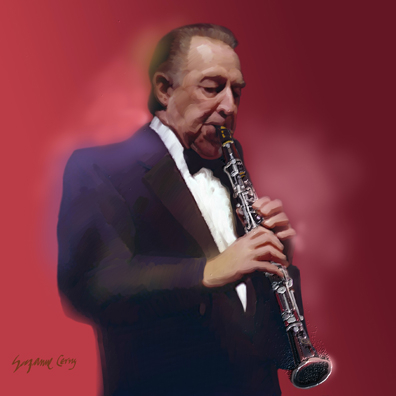
When I was coming up, the instrument of choice for young reed players was the clarinet. Imagine my surprise when I learned much later that it is among the most difficult to play. While its size makes it easier for small hands to hold, the keys are further apart for young fingers to reach and there are both holes to cover and keys to depress. I guess its like swinging a heavy bat before stepping to the plate. There have been no fewer than four clarinet players in my family, ranging in age from eight to adult. One musician told me that it's discouraging to see how many young players drop out after trying clarinet. The recently-retired, Guinness record-holding Stanley Drucker of the New York Philharmonic, like our subject Buddy DeFranco, virtually played nothing else.
Others have brought the clarinet back from oblivion. After the Swing Era, where the instrument was the defining sound think Benny Goodman, Artie Shaw, Woody Herman, and the Glenn Miller Reed section soundit fell into disuse as a solo instrument. There are more celebratory doublers now than in recent memory: Eddie Daniels, Paquito DRivera, Anat Cohen, Ken Peplowski, and, among the traditional players, Bob Wilber. Then theres Don Byron, who plays klezmer and contemporary jazz on the instrument.
Save for Wilber, who was a student of Sidney Bechet, all of the above give some kind of credit to Buddy DeFranco. DeFranco brought the clarinet kicking and screaming out of Swing, and gave it new life as a bebop instrument. For the 100th celebration of Benny Goodmans birth at Jazz at Lincoln Center, the spotlighted trio of DeFranco, Peplowski, and Wilber were featured in, but not limited to, playing music from the different eras in which the clarinet shone: Wilber, New Orleans; Peplowski, Swing; and DeFranco, Bop (see the jazz.com report on that concert). Goodman, the popular clarinet pioneer, played in all of those eras.
Like Drucker, DeFranco has played clarinet exclusively (excepting a brief episode on mandolin when he was five, and tenor saxof necessitymuch later.) Boniface Ferdinand Leonard DeFranco (b. 1923) remains extremely active. Backstage at the aforementioned J@LC concert, we made an appointment to do a phoner, which we missed due to double bookings. The resultant interviewswe needed twowere held in the spring of 2009.
By the time I was eight or nine I knew the mandolin was not for me, he said. I wanted to play the sax, but my father [a professional musician] knew some clarinet players who told him to start me out on that instrument. It was the late 1930s, and the Swing Era had already begun. You had to double, mostly sax and clarinet. After all was said and done I liked it better than saxophone.
Considering all that I have heard of the difficulty of getting around on the clarinet I asked if that was true.
Its very difficult,. he began. Its got so many tone holes that you have to close with your fingers and four different registers to contend with. That means four different fingerings for the notes." If that werent enough, there are different clarinets, each with their own playing methods
The Boehm Method was designed for the Albert System clarinet, DeFranco explained. The original clarinet had six holes and thirteen keys. Boehm [commonly mispronounced 'Bame'] invented a more upscale instrument, with seventeen keys.
DeFranco cleared something up for me. I thought that the different clarinets and their respective methods made for the sound: more or fewer holes and keys. Some play(ed) in the low-to-middle registers: Kenny Davern, Perry Robinson, Pee Wee Russell, Bechet. Others played more brightly, like Goodman, Shaw, Herman, and DeFranco. No, that depends on the instrument itself, the mouthpiece and the player, he said. I asked about the wood. Some clarinetists prefer rosewood these days. Most prefer grenadilla [from Africa]. Never ebony. Although its ebony appearance makes for the perfect sobriquet: "licorice stick." Most clarinetists I know think that corny. I tend to agree.
Rosewood clarinets were/are often one-piece affairs like DRiveras. In the old days, some were made out of metal and were used in schools, as they had to take a lot of punishment. Some starter clarinets these days are made of a plastic resin. Most clarinets come apart into different sectionsmouthpiece, barrel, upper and lower joints, and bell. The barrel in particular can have an effect on pitch, so some clarinetists use two or more interchangeably. DeFranco plays only Albert system, and his sound so distinctive that he need only play a couple of notes to be completely identifiable.
Clarinet playing does not come easily, DeFranco told me. You have to cover those holes completely or youll squeak, he said. You have to squeak for a year before you call yourself anything.
A Camden, New Jersey native, DeFranco moved with his family to South Philadelphia when he was three or four. I was a buddy of Joe Wilder, he said proudly (see Wilder's The OctoJAZZarians.) These two dapper and handsome young dudes went to the same music school. We played together frequently and occasionally on some gigs. Philly did not easily accept integrated groups at that time, but DeFranco was to learn a valuable lesson. South Philly was a mix of races and religions, DeFranco remembered. Joe taught me the meaning of tolerance and acceptance. Since that time I have played in groups where I was the only white player, he said. [One of those groups was in 1950-51, a septet led by Count Basie. The group was Clark Terry, Wardell Gray, and Buddy in the front line, and a typical Basie four-man rhythm section. It was the only time Basie did not front a big band. More later.]
I was living in my grandfathers house when a man by the name of Willie DeSimone, a celesta player, heard me play and said that he wanted to teach me. He did, for free, for three years. At that point he said that I needed to pay. So he charged me a dollar.
In a moment of flashback, DeFranco remembered that it was during this time that he played some gigs on tenor sax. As I said, if you wanted to play in a band you had to double. So I did. But not often, and not for very long.
That brief period led to DeFrancos induction into the territory bands of the 1940s. [These bands] traveled within a hundred-mile radius, playing dances, etc. The only one I remember was led by Roger Kent, which was comprised of older members and teens on weekends or vacations.
Some of the people DeFranco remembered playing with were Wilder, Red Rodney, Charlie Ventura, and Gerry Mulligan (who, contrary to written information, was from Philadelphia and not New York). Both Ventura and Mulligan were to cross paths with DeFranco as closely as in the next few graphs.
In the early 1940s, DeFranco joined drummer Gene Krupas band, and later Johnny Scat Davis'. Therein lay an interesting relationship. Krupa was with the Goodman Band when they made the film Hollywood Hotel. Davis was the featured trumpeter in that flick. Id heard about that, but I wasnt in it, DeFranco noted. Actually, [Davis] played the cornet and sang 'Hooray For Hollywood,' which became a hit. He led a band, which toured the country, not a territory band."
As for Krupa, DeFranco was in the band that featured singer Anita ODay and trumpeter Roy Eldridge, immediately after the hits ['After Youve Gone,' 'Let Me Off Uptown,' 'Drum Boogie,' et al]. We toured the country playing them. I replaced Sam Musiker [whose son Lee would one day become Tony Bennett's musical director]. [Krupa] was a good leader, and as a result he got what he wanted from the musicians.
Krupa led a distinctive sounding triodrums, tenor sax and pianowhich featured Ventura and teen pianist Bobby Scott. Krupas big band was a forerunner of bebop in that "swing-to-bop" period. He had hired Mulliganthen a teenaged arrangerwho scored a few Billboard-charted recordings: 'How High The Moon' and 'Disk Jockey Jump' to name a couple. DeFranco said that they played those charts, But mostly we played the pre-Mulligan hits. Its what the audiences wanted to hear. They were still dancing then.
Were now in the middle of WWII, which fomented the bands, DeFranco said, allowing them to play in some places for moral purposes. There was a band led by a railroad magnates son, tenor saxophonist Charlie Barnet.
Charlie Barnet didnt need the money; he led and played because he loved it, DeFranco said. Buddy missed the Barnet bands in which singers Lena Horne or Billie Holiday were featured. Mary Ann McCall was the singer when I was there, DeFranco remembered. McCall went on to greater fame with Woody Herman
Barnet was as outspoken as he was richperhaps because he was rich. In her autobiography, Holiday remembered how scared she was when Barnet drove down a southern avenue in an open car with her in the passenger seat. A white man driving a black girl? Horne had similar misgivings when she told me of her experiences with the brazen Mr. Barnet. He could be quite cavalier with your life, she noted.
DeFranco didnt see that side of Barnet. [As with Krupa] we just played his hits, Cherokee, Redskin Rumba.
DeFrancos jazz chops never waned, even when he went with a commercial band. Ted Fio Ritos was a Mickey Mouse band, he said. They played music to dance tonon-explorative, dont-confuse-the-patrons businessmans bounce. Fio Rito was big in Hollywood movies, and had a number of hits including the bands theme, Rio Rita, sung by Dick Powell and others. (Powell was a singer prior to tough guy actor. Check out the aforementioned Hollywood Hotel) Swing was in favor, so Fio Rito courted jazz players and a bought arrangements to help modernize his music, none of whom I can remember, DeFranco remarked.
One of those great Swing bands was led by the very accomplished cornetist-turned-trombonist, Tommy Dorsey. It was DeFrancos biggest career uptick to that time, and the music world took notice. He was with Dorsey twice: 44-5, 47-8. It was a combination of happy and stressful, he reflected. Tommy was a combination of different characters. He could be very gruff, rough, and generous at the same time. He was good to Buddy Rich, although he fired him every three months. He hired Gene Krupa when Gene got out of jail and nobody would touch him. [Krupa was imprisoned for marijuana possession. Fodder for the tabloids. The lyrics went something like: What do you expect? Hes a jazz musician. Ditto Rich, by the way.]
We were well-paid so no one complained. DeFranco remembers that once when he was very ill in Florida. Tommy brought his doctor down from New York to take care of me. I never saw a hospital bill. And I got paid for that week. He was that kind of a person, as well as being terrifying.
DeFranco was not in the band during the Frank Sinatra contract shall we say, dispute. But that episode could be an example of TDs intense nature. Others might say it was Dorseys business acumen. [See The Godfather.] DeFranco remembered other vocalists in the Dorsey Band: Group singers the Sentimentalists a/ka the Clark Sisters [who had a hit with 'Sunny Side of the Street']; the Polk Family, which featured [soon-to-be big band soloist] Lucy Ann Polk. Dick Haymes, Sinatras successor, was on the band when I joined. Others on the band were reedmen Boomie Richman, Al Klink. Brass were Conrad Gozzo and Ziggy Elman. Dodo Marmarosa or David Raskin were at the piano. DeFranco remembered other additions. There were six violins, two violas, two cellos, a harp and a bass. And he added a French horn and tuba as well. [Other bandleaders also added strings, notably Artie Shaw, who toured with a string quartet. Shaw would later play and compose chamber music.]
DeFranco remembered that the entire string section toured with the Dorsey band. We needed two busses for the personnel, plus trucks for the equipment. [Dorsey was] making a fortune. Wed play these gigantic ballrooms and stadiums. A [Dorsey] take for one night would be 60% of the house, and we would sell out.
My experience with that band fulfilled my need, so that I could go out as an individual, DeFranco remarked. To my mind he was a great leader and gave me confidence. Despite those personality flaws? I asked. You move past it. He did, twice.
In between Dorsey stints, DeFranco worked for a brief moment with Boyd Rayburn. But it wasnt until 1950, when he hooked up with that aforementioned Basie septet, that the bebop side of his voice broke through.
Basie and Bebop do not usually go together, but consider the rest of that front line: Wardell Grays tenor sax had a Lester Young influence and influenced beboppers yet to come; Clark Terrys uniqueness would later add bebop to Ellington. Put them together with Basies economical spacing, and you have one of the most improvisational, and unjustly overlooked, small bands of that period. The rhythm section was Jimmy Lewis on bass, Gus Johnson, Jr. on drums, and Basie at the piano. Guitarist Freddie Green would oin later.
Willard Alexander was managing the Count Basie Band when the [big] bands began to fold, DeFranco began. He suggested to Basie that they go to a small group: trumpet, sax, and rhythm section. That must have sounded like blasphemy back then, as the Count had never had anything less than a large aggregation. Alexander recruited DeFranco. They remained together for over a year. We got along better than a family. And what a learning experience. DeFranco almost cavalierly said that race was never a problem within the band, or the music business. From civilians we got some flack. We got nasty and threatening calls, he said. Some [white] guys wanted to beat me up outside a hotel in Chicago. After a while I almost became anti-white because of that.
Alexanders theory was that the big band would be back, but he needed to keep the Basie name alive. And back it came, with a roar supplied by singer Joe Williams. DeFranco: Joe used to sit in when we played Chicago [where Williams lived]. It was at one point that Bill decided that Joe should join the group.
When the septet broke up to form the New Testament Count Basie Orchestra, DeFranco left. What a mistake, he said emphatically. My manager [not Alexander] decided that I should form a big band. Willard cautioned me against that, saying that it was premature, that big bands were not ready for a comeback and that he could get me booked all year with a small group. While the band failed, DeFranco considers it a success, musically. There remains a CD extant in Scotland with all of the bands material. Some personnel: Gene Quill, alto; Bernie Glow, trumpet; and Hal Schaefer, piano. DeFranco wrote most of the arrangements.
DeFranco was by this time exclusively a clarinetist. After I left Dorsey, I sold my tenor so as not to be tempted. I wanted to be known as a clarinet-bandleader.
A Swing door was closing, but Bebop was coming in through a window. DeFranco: In my last year with Dorsey, Dodo Marmarosa and I went to hear Charlie Parker. Charlie Shavers suggested we go hear this guy playing crazy jazz up in Harlem. There was Parker playing on a borrowed alto [so whats new?]. We knew instinctively that this was a new movement. It was only a matter of time till it caught on [with the public]. This was not a fad, but a trend. There was validity there.
The next group I heard was a trio led by George Shearing playing at a midtown club called the Clique Club, which later became Birdland [the original at Broadway near W. 52nd St.]. Birdlands booking policy was a triple bill. DeFranco remembered that Sarah Vaughan was the headliner. The third group was the Oscar Pettiford All Stars, which included Fats Navarro, Miles Davis and JJ Johnson. George asked me to join his group. He even got me a Union Card. [You had to be in New York for nine months before you could play a club.] We never recorded, as I got a call from MGM to record and George got a deal with Capitol. Ironically, Shearing wound up at MGM, as well.
DeFrancos initiation in leading a bebop group was auspicious: Sonny Clark or Kenny Drew, piano; Milt Hinton or Gene Wright, bass; Art Blakey or Bobby White, drums. There were others before those, but they were my first real forays into leading bebop groups, he said. I posited that DeFranco was the first real bebop clarinetist. Tony Scott was around at the time but he was playing more in the Goodman style, DeFranco explained. He wanted to sound more modern but he didnt know how. Then he went outside and began playing crazy music, I thought. He was successful for a while with it. He did have a fantastic command of the high register at that time.
During the sixties the clarinet took a back seat to the new/old soprano sax as the primary double. Scott moved to Italy where he became a local hero. Herman continued to lead his ever-younger herds, but played less clarinet and more alto, and sang. Davern and Wilber formed a soprano duet band, but DeFranco soldiered on. Sink or swing with the clarinet was my motto, he said more than jokingly. Looking for new avenues he joined forces with accordionist Tommy Gumina. Tommy was way, way, way ahead of his time. He could play anything on that thing including getting around on some rapid-fire bebop. Gumina later formed Polytone, the pick-up and music electronics company, which is world-renowned. Tommy was one of those early polytonal players. He could play like Art Tatum and Bud Powell.
In the early fifties, DeFranco teamed with arranger Nelson Riddle for some interesting projects. Nelson and I were roommates in the Dorsey band [Riddle was a trombonist] so we were friends for a while. I was doing clinicsthe clarinet in jazzin colleges and universities, some high schools too, for Leblanc, prior to joining the Yamaha team, where I am now. Nelson was in California writing for Nat Cole and Sinatra. I asked him if he would write something for me to use in my clinics. A friend suggested that what Nelson wrote might make a good album. The result was the first Buddy DeFranco with Orchestra Cross Country Suite (Dot), eleven compositions dedicated to places in the U.S. This was a stretch for Dot Records which was reveling in very white covers of R & B hits by Pat Boone and Raymond Scotts wife Dorothy Collins, among others. Collins was a star of Your Hit Parade, a TV staple in the fifties. The owner had me pose in white buck shoes and a sweater [Boones trademark attire]. The LP itself shifted between categories so finding the right bin in record stores was a problem. Also the promotion was poor. The owner of Dot didnt understand what it was, even though he had ok'd it. It was a good effort, and it has been recently released on CD by Nelsons daughter.
Cross Country Suite was followed by two other orchestral efforts, both backed by Russ Garcia (see Garcia's OctoJAZZarian profile). One was called Broadway Showcases. The other was all Gershwin with Oscar Peterson.
I worked with Oscar a lot, DeFranco noted. Through the efforts of Norman Granz [Oscars manager and producer] we did many recordings on Clef and Verve. When Norman Granz decided to make some records, he would call some people out of Jazz at the Philharmonic and ask What are you doing for the next week? And wed go into the studio and record for that length of time. The resultant records were reworked, reconfigured, and repackaged for years. While he was never in any of Lionel Hamptons bands, the DeFranco-Hampton groups on Granzs labels were always swinging affairs. And loose. The repertory company included Buddy Rich, Alvin Stoller, Louie Bellson, and always the members of the Peterson Trio, Herb Ellis and Ray Brown.
One of the standout collectionswhich Granz held back when he sold his company--were his recordings of Tatum. Art Tatum Group Masterpieces remain manna from heaven. I played with both Peterson and Tatum, but you couldnt compare them. Its like comparing two diamonds. It was a little more difficult to play with Tatum because he was never an accompanist. Whenever you played with him you played his way. Oscar, on the other hand, was a marvelous accompanist as well as a great soloist. Labor Day weekend 2009 found DeFranco in Chicago, playing some of those very things he did with Tatum.
The longest stint of his mid-career was conducting one of the touring Glenn Miller Orchestras from 1966-74. I bumped into Willard Alexander at the Hamburger Hamlet in Beverly Hills. It was a bad time for bands; even small groups had trouble getting bookings. He said that I was going to be the next leader of the Glenn Miller Band. Willard spoke to the executor of the Miller Estate [which never stopped owning the rights to the name] and if youre right youll start the day after tomorrow. And for a nice taste too.
Off-and-on for the past few decades DeFranco has teamed up with longtime friend, vibist Terry Gibbs. We first came together in London [in the late seventies-early eighties] at Ronnie Scotts, DeFranco began. Each of our groups were on a double bill. At the end of the first set Ronnie, an accomplished tenor saxophonist and leader in his own right, asked us if we would like to play a tune together at the end of each set. It turned out so hot that we decided that we ought to get a group together.
The natural thing, instrumentation-wise, was a re-creation of Goodman groups featuring Lionel Hampton. But the two do so much more. Both still work, together and separately. Terry is such a good player. Perhaps the most swinging out there.
In his teens young Buddy sat in Philadelphias Earle Theater with his brother through five shows to hear Dorsey clarinetist Johnny Mince. I decided then and there that jazz clarinet was the way for me to go. Then the storm broke: Goodman [rumbling thunder] and Shaw [flashing lightning] arrived on the scene and I havent looked over my shoulder to this day. Not to worry; no one is gaining on him.
Legacy: Heres a side that the otherwise modest DeFranco did not show until nearing the end of our lengthy conversation. I take credit for discovering [encouraging?] Eddie Daniels [on clarinet], he boasted. It was at the Village Vanguard one Monday night with the Thad Jones-Mel Lewis Jazz Orchestra. Thad was out and Eddie picked up the clarinet and played a couple of solos, which were just terrific. I asked him why he didnt play clarinet more. He said that Thad didnt like the clarinet. So he had to sneak and play it when Thad wasnt there. Thats when I suggested to Eddie that he step out. I knew he was going to be the next great clarinet player. I was right.
Regrets: PhysiologicalI have developed myasthenia gravis, a debilitating eye and nerve disease. I see double. I need special glasses to drive. Most importantly, I cant read musicand musical Duke Ellington called me to fill Jimmy Hamiltons chair, who was leaving. But I was into organizing my own band at the time so I didnt join Ellingtons. I felt badly about that. Thats the only thing I would like to do over.
Unfinished: Ill retire when I get it right.
Tags:
October 16, 2009 · 2 comments
Very nice article. I actually learned some things I never knew (e.g., that Buddy played an Albert system clarinet). I remember hearing some of his stuff with Tommy Gumina, but I could never get my head around the sound of an accordion. (I must admit that Gumina came closer than anyone to getting me to listen.) I love the Terry Gibbs stuff. I've got a couple of those albums. I think of all the clarinetists, Buddy is probably my favorite. (Clarinet was my original instrument, and I've still got my "serious" clarinet--a Buffet--in the closet.)
Great article on a major and often overlooked figure. Buddy really was the main man who brought the be-bop (modern Jazz) language to the clarinet. My only question is this: is his preference for the Albert system relatively recent? I have many DeFranco recordings with photos and cover shots of him him playing the Boehm.