In conversation with george lewis, pt. 1
By Ted Panken
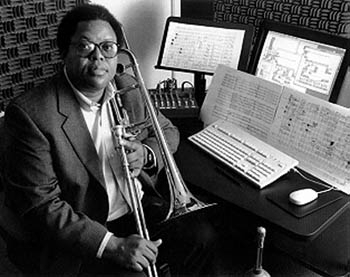
Standing in the wings of the Perugias Morlacchi Theater watching George Lewis rehearse the AACM Great Black Music Ensemble for the first of their six concerts over three nights at the 2009 summer edition of Umbria Jazz, Marija Sepac marveled at the singular nature of this particular cohort.
"They are very precisemore than 20 people, and they work as one," said Sepac, who has observed musicians closely over her eleven years as a quasi-chaperone for the festivals various performers. "Concentration. Many hours of hard work. Everybody in an excellent mood all the time. I got a feeling that the people in the orchestra are honored to play with George Lewis, but that they really like him. I can feel the connection which goes beyond respect and professionalism. It was beautiful staying with them yesterday. I think its the first time Ive seen such a thing. Its amazing!"
At this moment, Lewis was systematically making sure that each sound in the orchestra (and there are dozens, from saxes, trumpets, and trombones to didgeridoos, vocals, electronics, and more) was properly accounted for in the mix. After this was done, there was an hour to rehearseor, more precisely, to run throughthe repertoire he'd chosen for the late-afternoon concert.
Scant preparation or no, an inspired performance ensued. Lewis set the tone with a rambunctious opening trombone salvo, before putting down his horn to conduct his five compositionsswaying, dancing, cuing, and (when appropriate) leaving the stage to allow the musicians to figure-out the next step on their own. Over the next five concerts, which transpired at 5 p.m. and midnight over a three-night span, GBME members Ernest Dawkins, Nicole Mitchell, Douglas Ewart, Mwata Bowden, Renee Baker, Tomeka Reid, and Saalik Ziyad presented compositions that took full advantage of the possibilities presented by the 21-member unit, which executed each chart with the world-class technique, high collective intelligence, and an open attitude that has been characteristic of musicians involved with the Association for the Advancement of Creative Musicians since it was founded in 1965.
Himself an AACM member since 1971, and now entering his sixth year as Edwin Case Professor of Music at Columbia University, where he also chairs the Center for Jazz Studies, Lewis chronicled the organizations history in A Power Stronger Than Itself: The AACM and American Experimental Music [University of Chicago Press], published in the spring of 2008.

A Power Stronger Than Itself is a landmark work. The bedrock of the text is an exhaustively researched linear narrative history, constructed on over 90 interviews from which Lewis traces keen portraits of numerous members; AACM archival records; encyclopedic citations from contemporaneous literature, both from American and European sources; and vividly recounted personal experience.
Furthermore, Lewis contextualizes the musical production of AACM membersa short list of "first-wavers" includes such late 20th-century innovators as Muhal Richard Abrams, who stamped his character on the principles by which the AACM would operate; the founding members of the Art Ensemble of Chicago (Roscoe Mitchell, Joseph Jarman, Lester Bowie, Malachi Favors, and Don Moye); Anthony Braxton, Leo Smith, Leroy Jenkins, Henry Threadgil, Amina Claudine Myers, and John Stubblefieldwithin both the broader spectrum of experimental activity and the critical theory that surrounded it, expressing complex concepts with rigorous clarity and elegant prose.
A native of Chicagos South Side who earned a Bachelors Degree in Philosophy from Yale, Lewis established himself as one of the major voices on the trombone tree during the 70s, for his seemingly unlimited technique and singular tone, setting new standards on his instrument with bandleaders as diverse as Braxton, Count Basie, and Gil Evans. As the 70s progressed, Lewis turned his attention to interactive computer music, eventually imagining and creating Voyager, a software program that improvises either in real time with a musician partner or on its own initiative. In a sense, he breathed anima into the computer, enabling it to function as an autonomous, social entity.
Over the course of two interviews last summer, Lewis discussed these subjects. This is the first installment of a two-part article.
Whats been your previous relationship with the Great Black Music Ensemble?
The genesis of my working with them was that somehow the Sons DHiver people (which is a kind of French play on words, 'winter sounds' but it sounds like 'diverse sounds' somehow to my untrained ear in the French language) managed to get the entire Great Black Music Ensemble to come to Paris in 2008 and do concerts there. So they asked me to sort of collaborate with that (because Im not really a member of it), actually to make pieces. So I was also able to bring in some people, like the violinist Mary Oliver, who lives in Amsterdam; the bass player, Leonard Jones, who lives in Dsseldorf (he was also in Perugia); and my spouse, Miya Masaoka, the kotoist and sound artist. I made kind of a triple concerto format surrounding them, and I made three pieces for the first half of the concert. Were playing all of those three pieces here, plus a new piece that I wrote for them, because its stable enough so that I know who is going to play, and I know who can do what and who likes to do whatnot what they can do, but the comfort zone. Thats what you want to do with any group of musicians.
Actually, more and more, I am inclined to just write music, and not worry about what people can and cant do. We always hear about the Duke Ellington model, that a lot of that work apparently was improvised, although the scholarship on that is kind of spottyits more like anecdotes and stories. I dont know if anybodys ever really sat down and said, 'Look, how did you guys do it?' Part of the problem always with the interview process is that people are kind of performing, and the people who are interested in anecdotes and so on dont really get into process that much. I would have been fascinated to find out how they improvised these parts, but theres nothing written on what they did and how did they do it. You wouldnt be able to get that unless you bring in somebody who had the interest in documenting that part of the process, and also the outlet for being able to publish it or put it out there, and then the constituency of people who really want to read it. Because I imagine that a lot of times the musicians say, 'do you really want to know this?' Or 'Are you really qualified to receive this knowledge, or somehow equipped ...' Not 'qualified.' I guess that's more of an insiders viewpoint. We want to get beyond the everyday, mundane stuff. We want to get to the deep parts of this. A lot of people feel they dont want to do that with people they dont feel can really understand it. Its a funny way of thinking about things.
But in any event, when I work with the group, I concentrate on the written music, and I write a lot of stuff for them. For the first concert, I wrote a lot. Im not a conduction person. I dont like to improvise conducting. Its too centralized for my work, and I'm not good at it anyway. I want people to make it up on their own, and I kind of like the idea of large ensemble improvisation without some center person pointing to people and making them do things. They should think it up on their own. But that takes a lot of time to develop, a kind of personal transformation, and a method of sorts, and we didnt really have enough time here to develop that to the degree Id like.
Well get another chance in August in Chicago. Theyre having a tribute to Fred Anderson, this wonderful musician, a mentor of mine, while hes alive (which is greathes 80 years old), and Im writing a piece for the Great Black Music Ensemble surrounding his work. It emanates from Paul Steinbeck, my Ph.D student who's going to be a post-doc at the University of Chicago this fall. He published a book of transcriptions of Freds solos. I took one of these solos, and Im sort of orchestrating it. But not like Supersax. Its more like counterpoint. The idea is that everybody has a piece of Freds solo, and the solo kind of proceeds on its own logic. Looking at it on paper, being able to listen to it over and over, and reflecting on it, and so on, you realize that Freds solos do have an inner logic, and its not really that capricious. Its pretty well-organized and very stable, and hangs together. So tearing that up and imposing your own order on itits a clash, a dissonance you can feel. Youre sort of stepping on very important stuff. So I try to avoid that. I want to find ways to support from below whats going on, and the solo just emanates. Thats the approach for that. But you can do that, once again, because the [GBME] personnel is stable. You get to see how three voices might interpret Freds music, or how a group of strange trumpet players might interpret it, and so on.
Can you elaborate on the pieces of yours that they played during the week?

Theres Chicken Skin II, which I actually wrote in 2003, for a group in Munich, the International Composers and Improvisers Ensemble, or ICI-Ensemble, which also has pretty stable personnel. They were great at playing the written music. Nicole Mitchell and Leonard were there, too, and Mary Oliver, so they played as a part of the group.
My feeling now is that I like to go and work with professional artists to realize things, but I also want to bring some people that I know well. Its not so much that I want to have my people there to make sure that the solos are going to be good. A lot of people can play today; its not a question of that. But I like the idea of diverse experiences that come from the cultural exchange in the group. Thats very important to me.
Theres also 'Fractals,' which is based on Brownian motion1/F, statistical stuff. Its not real 1/F. Its not algorithmically made. I just made an impression. It would have taken more time to make an algorithm than just write it out of your head.
Then 'Angry Bird,' which is a re-orchestration of a small section of my orchestral piece from 2004, Virtual Concerto,' for the American Composers Orchestra. The original piece had a solo piano part played by a Yamaha Disklavier with software that we made to play piano and listen to the orchestra, and be interactive. Basically, the orchestra played the written music, and the computer basically improvised its part the whole time, except for some little parts where, for a certain section of the music, a certain algorithm would come in. Theres a sort of violin part that got orchestrated. The nice thing is that GBME has this super violinist, Renee Baker, and a super cellist, Tomeka Reid, who both have the classical training, so that they can really play that part, that way. Then everybody kind of plays it. Then, 'Shuffle,' which is a shuffle, I guess, an interpretation of that.
The big problem in working with any kind of ensemble of this kind nowadays, especially in jazz, is the social and infrastructural area. It was unusual to have a scene like that week at Umbria Jazz where all we did was rehearse, and think about the music, and figure things out. You see that more often in non-jazz scenes that Im a part of. The Morlacchi Theater is fantastic. It was built in 1780 and has a great sound. So we did have more time to do things than we did in Paris.
So I write these pieces down for ensembles with that milieu in mind. I dont think that much about writing difficult stuff. The idea is that even if people dont necessarily play all the right notes, it will sound good anyway. Its sort of diverse enough so that wrong performance will still sound right, so people can feel good about what they do, and theyre not obsessing over minuscule passages and all that, and I dont worry people about, 'oh, this is a quintuplet youre not doing'if it ends up being a sextuplet or a bulltuplet, it will still work. So thats ok. Its deliberately noisy, with a lot of room for that.
The last thing, which we are going to rehearse for, which I really want to do and get on tape, because its new, is called 'Triangle,' and its inspired by something I heard a while ago. A young percussionist in a New York-based contemporary ensemble called Wet Ink whose name is Ian Antonio, who also does noise improvisation, performed an Alvin Lucier piece, called 'Triangle,' alone, amplified slightly and subtly processed. The piece was 20 minutes, and all he did was DING-DING, DING-DING, DING-DING-DING for the entire 20 minutes. After the first five minutes my arms started to fall off sympathetically just watching Ian doing this.
When I was creating my gloss on Alvins piece, I thought, Well, this will be a great start. I didnt think I wanted to have Turk Burton playing triangle for 20 minutes, though. I just wanted to give the impression. Then I didnt know whether people would really do that, or maybe they would get bored doing it. But Turk has fantastic rhythm, so hes playing the triangle in a super great way, and I dont really have to conduct. People hear the triangle, and theyre on rhythm. Then theres all this stuff surrounding it. Iits a pretty ambitious piece, so we didnt have time to prepare it all.
You said yesterday that youd never seen me do this kind of extended composition and conducting. Not many people in the U.S. have. Its not like I do these things all the time. But when I do them, I tend to do them somewhere other than where I live, in another country. say. I dont think Ive ever really done it in Chicago except for bringing the NOW Orchestra from Vancouver to the Chicago Jazz Festival in 2001 or 2002.
Youre playing in the concerts devoted to the music of the other members. So youre functioning not just as a composer and conductor of your own music, but as a member of the ensemble, which is very much in line with AACM principles.
Yes. The curious thing about that is theyve been rehearsing this music, but I have to get the parts and rehearse, and then play catch up. Im also trying to document all the concerts. So I kind of have this split brain, where Im sitting next to the hard disk recorder, on which I did all these sub-mixes and stuff, both recording and then also playing the music. But Ive been doing this sort of divided attention thing for a long time. I documented the AACM concerts as far back as 71 on my high-test cassette recorder, the first sort of so-called hi-fi cassette stereo things. Ive got all those tapes, and this is in that kind of tradition. Setting up mikes and stuff, I can do that.
They let us say what we wanted to say about presenting the group, and I preferred it as 'The AACM Great Black Ensemble With George Lewis.' instead of 'Featuring George Lewis.' Otherwise, youre expected to do a lot of stuff, and Im tired of meeting expectations. I just want to do what I want on stage. Youre supposed to play an improvised trombone solo on every piece or something, and Im not going through thatand so I dont! So the strategy for the first piece, the first evening of my music, was to play an improvised solo at the beginning, and then that was it. I didnt have to play any more. I had a lot to do. The music doesnt stand or fall on whether I play the trombone or not, just like my book doesnt stand or fall on that. The book is the book, and if its any good, its supposed to be good because of the scholarship, and not because of some insider knowledge. So basically, you want the stuff to stand by itself.
Also, the AACM is a collective, and so its supposed to be a collective enterprise, and theres no reason for me to hog the entire thing. I began to realize that it would be very boring for me to be the only composer for six concerts, not because I dont have six concerts worth of music, but because all those other composers would just be sitting there, and thats not a good thing to do. When youve got all that diversity, you want it to come out.
Could you apply some of the methodologies that you apply to the history of the AACM in A Power Stronger Than Itself to the Great Black Music Ensemble? For example, you explore ethnography, personal history, analyzing the individuals who comprised the AACM by class, by family background, and so forth. Who comprises this ensemble? Are they primarily members of the second and third wave of the AACM, with a few fourth wave people? Break it down.
I dont remember what I said in the book about waves. If I did adopt that terminology wholesale, I was still a little murky about it. If Im part of a second wave, then I would say Nicole would be a representative of a third wave, and then people like like Saalik Ziyad and Tomeka Reid would be representative of a fourth wave. Basically, every seven to ten years a new wave kind of comes about. For example, Mwata Bowden and I would be second-wave people. Its partly generational, but the wave thing doesnt necessarily correspond with the age of the people involved. Someone like Taalib-Din Ziyad is more of a third wave person, but hes older than me, I think, or close in age, and his son Saalik is in the groupthey're both super singers. Its very complex.
The book is mainly about people up to the third wave. Theres not a lot to be said about the fourth wave, because I didnt have a chance to interview all those people. It changes a lot when you get to the fourth wave, because theres less international visibility, which has always been one of the AACM lifebloods from the beginning. Its not an organization that stands or falls on, lets say, the standard hinterland-to-New York model of the jazz experience. Early on, people sort of flew over New York to Paris.
The books approach is to place personal experience and personal background in dialogue with what was said by scholars and historians, sociologists and historians in particular, about the experience of black people. The Great Migration, the urban sociology that came out in the 40s through the 60s about conditions in Chicagothats all critical to the experience of these people. So when Malachi Favors, for example, talks about how he remembers rats in the street all the time--well, thats something that comes up in a lot of the sociological literature. Chicago has had this ongoing problem with rats in the street. If you remember, they would always post things in the alley about to watch out because they were using Warfarin to kill rats all the time. Then Malachi talks about fires all the time, and thats another big thing. There were thousands of fires, and a lot of them apparently were set deliberately by landlords. People got killed. That comes out in a lot of the urban sociology literature. But the other thing about that is, people didnt know why there were so many fires. They just knew there were fires.
So what I wanted to do was to give back to these people, to kind of say, 'Well, heres why these problems came up.' They werent necessarily equipped to know why. For example, Oliver Lake blaming the demise of Black Artists Group on himself when, in fact, the foundation that was supposedly supporting them was planning their demise under the table. How could they know that? That only came up twenty years later, through archival research with people like George Lipsitz and Ben Looker. So the approach isnt just the ethnography itself. The idea is that somehow the stories dovetail with whats said in a more dispassionate way, which ends up, first of all, validating the experience of the musician on another level, and showing how those experiences become emblematic of the period.
One of the overarching continuities of your analysis of the AACM is that the organization and its cultural production represents a cohort comprised primarily of working-class origin, many of them first-generation Chicagoans (although some not)that its the expression of their agency. Is it your sense that the AACM still reflects a similar set of circumstances, or if the background of the membership has evolved in line with the evolution of African-American life over the years?
This is a very brief answer, by necessity. I dont really know. African-American people, even the people who have the so-called 'middle class' background, which is an increasingly growing group ... In other words, maybe they were born into the working class, but a lot of them have been to college now. That wasnt really so true of the earliest generation. A lot of them have masters degrees or whatever, and a lot of them are searching for higher education in different ways. Things that werent available so much to people in the earlier generation.
I have the working-class background but I also have the Ivy League background and basically a prep school background, so thats a strange combination. You go back into the so-called ghetto at night after coming from the University of Chicago Lab School during the day. That kind of bifurcation is part of the experience of a lot of African-American people, going back quite a long time.
So I am going to say that my initial impression is that its still primarily a working-class group, even for those who have managed, at this point, to develop another kind of living for themselves. Another thing about the Chicago AACM is that a lot of people do music, but they also have other jobs. Theyre not necessarily on the road all the time. They have families. Theyre people who have managed to combine two careers successfully. Its always been like that. They dont necessarily try to actively cultivate the aspiration of being like a working musician in that sense. The idea of experimentalism being supported by other kinds of work in order to supplement it, in the old days, was considered like, 'Oh, you have a day job; thats terrible; fuck that'to be a real full-time musician, thats great, authentic. That aspiration isnt a big part of the thinking of a lot of people. I think this example shows its not as important as people think it is. Its probably a little self-serving, in a way. A little too romantic. The idea is if youre doing the music, youre doing the music. Thats it. Who really cares whatever you have on the side?
It also occurred to me that you yourself, over the course of your career as a musician, which is 38 years ...
First of all, I didnt think of music as a full-time career all the time. I always had jobs. In New York, I had a job. For two years, I was the Music Curator at the Kitchen. That was a paying job. It was that kind of day job that musicians dream of, where you can go on the road. In Paris, I did concerts and stuff, but I also had a job. I had a commission from IRCAM, the French computer music institute, and I could have income there. Also in Holland. The time when I really had a full time itinerant position as a musician, which was in New York from about 87 to 88, I had a pretty hard time doing that. Then I started getting into academic life. So its not the same experience as people who have a full-time occupation. That hasnt been a big part of my career.
You moved to New York in 1977, I believe.
Around there. There was a transition period of 76 and 77.
So in 76, you play with the Count Basie Orchestra for two months. Then you join Anthony Braxton, youre on the road with him for a yearhe was pretty visible, working a fair amount.
He did a lot of gigs.
Youre on recordings in 1978 and 1979 with Sam Rivers. It seems to me that during the latter half of the 70s, youre a full-time musician, and thats when you established your tonal personality very strongly.
Im counting back from 82. In 1980, I started at the Kitchen. So maybe for three years from 1977 to 1980, I dont know if I had any part-time jobs.
And a lot of activity was packed into those three years. Theres a body of documented improvised trombone playing that people still refer to when they think of your tonal personality.
Im just basically saying that I come from the working-class background, but Ive been very lucky, because a lot of musicians had extreme privation during those years. I really didnt. I have to say that I was incredibly lucky to have that.
You have quite a bit of experience with orchestral music in the jazz and creative music traditions. Im wondering if you could position the Great Black Music Ensemble within the full spectrum of such units youve worked with. Also, if you dont find it too anecdotal, could you relate some of the experiences you had in big bands in the 70s that influenced your thinking of music as a full-time career.
Let me go first to the part about situating this group. Ill start with the AACM.

by Michael Wilderman
Now, the AACM has always had a tradition of supporting research in composition. In fact, from my perspective, the AACM began as a composers collective. In my time, at the AACM School, mainly you got lectures in composition from people like Muhal or Wallace MacMillan, or whoever showed up. They didnt teach instruments. No one was talking about improvisation and stuff like that. Then you were always encouraged to compose your own work and present it; that was kind of a requirement. You were always encouraged to compose, and if you said you didnt want to compose any more, people would complain. In that regard, the AACM membership itself would play your music, provide opportunities for you to explore large-form compositions, because there was no other way to do it. People werent receiving commissions from anybody to do anything like that. As far as I can see in Chicago, no one was calling up Douglas Ewart on the classical side to produce anything, and Ive been on various panels where the classical ensembles are reviewed by funding organizations, and Ive had a chance to kind of complain that these organizations never interface with the black community, and they should be called to account for that. It would be obvious that these experimental contemporary music ensembles should logically interface with the AACM. Thats one way of situating it.
For example, lets imagine the AACM Great Black Music Ensemble in conjunction with various hybrid kinds of structures, which is the way the AACM was going. The book cites the first press release of the AACM, which Muhal and Ken Chaney wrote, which said that their mission was essential to the advancement of new music. I dont think they were necessarily talking about the next Count Basie. I think they were trying to figure out a way to situate themselves in the broader tradition of musical experimentalism. That was really clear. I dont want to narrow that focus.
So when you look at the various AACM big bands, as they called it, there was always this thing called the AACM Big Band, which was their way of interfacing with the big band tradition. Its precursor before that was the Experimental Band, and before that there were people like Muhal and Marshall Thompson and Eddie Harris who got together and created a rehearsal band, just to try out some ideas. The whole big band experience had kind of ossified, and a lot of people couldnt get work going on the roadthere was no longer that kind of work. As Eddie said--wasnt that in an interview he did with you, Ted?--you didnt learn certain things about how to perform or compose. There was no real infrastructure for that. So people had to make it themselves and create it.
Now, I think that there was a deliberate decision taken by people like Mwata Bowdenin particular, Mwata, I thinkto recast that in a different way. In other words, they decided to change the name of what they were doing to the Great Black Music Ensemble. That was an important step also not in breaking with tradition, but establishing a new discourse surrounding their relationship to the AACM. Very important. They didnt have to be the AACM Big Band any more. It wasn't like, 'Oh, here's the next edition of the AACM Big Band.' What I realized, sitting in the band for those three nights, was that I played in all the AACM big bands, or a lot of them, for many yearsthe ones with Muhal, the ones with Roscoe Mitchell, Leroy Jenkins, and Henry Threadgill, and all these people who people think about from the first generation. I was kind of their student, in a way. But there was nothing like this. They didnt have four singers or five singers. They didnt really have cellists and violinists. With all respect to these great people, I dont want to say that this is better, but its a fundamentally different kind of animal, and its really, in a way, the most diverse set of possibilities that I have seen in any AACM ensemble. Things happen in this ensemble that never happened before in the AACM Big Band. Plus, they have women, a lot of women, not just a few, like we did back then.
And theyre not just singers.
And theyre not necessarily singers. Theyre great players. Some of them sing and some of them dont. With that in mind, GBME has a fundamentally different and very particular identity that theyve established through regular rehearsal and through modification of a discourse which ends up causing everyone to reflect on how we are doing our thing and not necessarily just doing the AACMs thing. Thats one thing. I was pretty impressed with that. The things that happened during those three nights couldnt have happened in the same way with those earlier people. The earlier people should be proud of that. I certainly found myself being very proud of it.
Now, the next part of your question, asking me to situate this in the context of other experiences that Ive had in various kinds of big bands ... thats hard to do. A lot of people who did experimental improvisation ensembles like Globe Unity Orchestra werent necessarily thinking about themselves as reacting to traditional big band music. They were just trying to create something different based on a broader interpretation of how you combine improvisation with composed stuff. Certainly, the standard big band model that we know and in which people have created wonderful music was based on that, in some way. The band was playing music, then you took your solo, and so on. But they didnt have that much collective improvisation. They didnt have everyone in the band writing a piece. For example, in Count Basie, we were playing pieces by Eric Dixon and so on, but it wasnt a big feature. Thad Jones wrote most of the music for his orchestrafantastic, classic pieces, like 'A Child Is Born.' But it wasnt that everyone in the band was encouraged to write music. Duke Ellington, the same thingDuke Ellington and Billy Strayhorn wrote the music. I dont seem to remember Duke Ellingtons Orchestra playing standards, so-called, too often. That makes sense. It was his band, and it was his music, and why not?
In this ensemble, anyone can contribute. Thats like the AACM thing. As Joseph Jarman said, the difference between the AACM and Sun Ra is that in Sun Ras band it was Sun Ra who could say and do, and in the AACM everybody could say and do. Thats a huge difference. Its actually a very different political model, too. You can think about it in terms of notions of radical democracy, egalitarianism, different models of ethical conduct that comes out of music. Its not a negative example, but its more of a difference in orientation.
I was talking about the Globe Unity Orchestra. Basically, Alex Schlippenbach would do a lot of the writing, if there was writing, but a lot of the time there was no writing, and people would just improvise the entire gig. It was great. You had all these people who, really, that was their metier, and they specialized in it, and they knew what do in that environment. Im not sure this band does that in the same way. I would like to see that happen at some point, where we could say, 'OK, lets improvise the entire concert with no music.' But that takes a particular kind of orientation to personal training, which might take time to develop. Maybe a retreat somewhere, a funded retreat of the sort that people coming from the jazz-identified area dont really get, where youll have an ensemble come together ... Composers get this. Im going to Rome for two months in 2010, at the American Academy, composing music. Im not going to spend my time in Rome going around and playing in bands and presenting stuff. I want to sit in Rome and compose, and talk with people, and learn about whats happening there. But thats the idea. Imagine if you had an ensemble for a week to play together and work this out. We did that with a smaller group in Portugal. In August in Lisbon were presenting the electro-acoustic project called Sequel, which we recorded in 2004eight improvisors working with both acoustic and electronic instruments.
One of the festival chaperones told me that she had never, in eleven years of shepherding bands around in Umbria and Orvieto, encountered a group of musicians as disciplined, organized, and good-humored as this group.
I do know where that sense of discipline and order comes from. I had never thought of this until J.D. Parran mentioned it, that the AACM people always were very organized and disciplinedhe used that word, too. I never thought of us as particularly disciplined, but in fact, I had to ask people for their dietary requirement. My thing was, 'Just give me some good Italian food,' but all these people were very specific about their requirements'Im a vegan' or this or that.
I dont want to say this in the wrong way, but I think the reality of the jazz industry (I think I want to use that term) is that a lot of the bands that are brought to a place like this dont come out of the collective experience, but out of the experience where someone gets a gig and they are hired by this or that person. Theyre always on a bit of an edge, because theyre competing with a lot of other people who could also have been hired, but in fact they werent, so if they dont do the right thing or play the music in the right away or dont have the right attitude, they could get fired. I mean, nobody can get fired from the AACM. You cant even resign voluntarily! Once youre in, youre in, and even if you say youre out, youre still in. So people dont feel they can get fired. What are you going to do? Are you going to fire yourself? Its a collective. Whos going to fire you?
Isnt what youre describing a sort of collective characterological trait thats been passed down from the beginning through Muhal Richard Abrams, and then various other members who had experience in the military? Lester Bowie and Joseph Jarman both talked about their military experiences as crucial to what they did when they got to Europe, to their ability to survive and be self-sufficient.
You could say that.
Im wondering if that attitude might run continuously throughout the AACM experience.
Maybe it could be. But I dont know how many people of the younger generation had military experience. I mean, I didnt, and then its whole different thing with these younger people. Volunteer army. Who wants to volunteer? People dont want to do it. So maybe some people did. But theres also a different kind of experience. Ernest Dawkins and Ameen Muhammad had the experience of being disciplined within the East Side Disciples, a gang! Thats a really different thing.
But youre disciplined because this is your thing, and youre encouraged to take personal responsibility for the outcome of the decision, whereas if youre playing in a regular band that tours, you dont have much personal responsibility other than to show up and do the music and do what youre told. I dont care whose band it is. Here you have to take on responsibility for playing your music and other peoples music. Youre contributing to the collective experience because it could be your turn next time to play the music of someone else, your colleagues. So its a stronger sense of collegiality than the standard kind of working-for-hire situation. Were clearly not doing that, even though we are being 'hired. But were working for ourselves as much as anyone else. We werent formed in response to some industry mandate, or Ill form a band and try to sell it. Its more that we form a band because we want to do this music. So we have full responsibility for it, and nobody tells us what to play. If we get hired for something, they hire us because were us.
I think thats one thing thats very important about discipline and collegiality and congeniality. It adds to the atmosphere. I remember working in bands where you were subject to one persons way of looking at the world. There are people who like to have those kinds of groups, but I dont. Im more of a composer type. My band is kind of virtual. Its on the paper.
Your mention of the Globe Unity Orchestra makes me reflect that this residency in Italy is part of a long timeline of AACM-Europe interactions, that the AACM bypassed New York and went directly to Paris at the end of the 60s. Indeed, you yourself had a great deal of personal experience in Europe during your formative years. I was thinking of questions of mutual influence: How you see the AACM having affected European notions of experimentalism and, conversely, ways in which European notions of experimentalism, the European avant-garde, impacted the AACM, whether in the early years or later on.
This ensemble is very interesting to me for several reasons. Early on in the history of the AACM, among the first generation of people, Roscoe Mitchell and Joseph Jarman, for example, studied with Richard Wang. Richard Wang was teaching them serialism and stuff like that, and they were looking at those models and trying to figure out 'Whats my relationship to this?' So when a guy like Joachim Berendt says, Well, European musicians have a closer relationship to Stockhausen than the Americans, he seemed to be thinking about the fact of their being Europeans, but in fact music crosses those kinds of lines. Lots of U.S. musicians have studied European contemporary music as closely as anyone else. Certainly, Muhal and Roscoe and those guys knew about this. I mean, I heard about Elliot Carter from Muhal. He had the score of the First String Quartet sitting in his house. In fact, that was my introduction to scores, Stravinsky and all that. He had the scores sitting there. Phil Cohran, too. They all knew that.
But by the time you get to, lets say, Ernest Dawkins, he says, 'Well, we werent really so much into Stockhausen; we were trying to look at more sort of black models.' Im trying to put words into his mouth, unfairly perhaps. But he basically said that. It reinforces the idea that there are several models of experimentalism. Why not have an experimentalism that comes out of the black experience and doesnt necessarily assume that any routes of experimentalism run through Europe? So you started to see that this version of the AACM doesnt owe very much to those models of experimentalism in improvisation that arose at that time. I dont see a lot of influence or even contact there. Now, Nicole [Mitchell] has had more experience in that way than some of us do. Or Leonard Jones, who moved to Germany, who is much older, of course.
Now, I have had those kinds of experiences, and I find theres a productive interchange, because I can bring to the table aspects of that experience that others did not have. This generation of people is young enough to think about, lets say, going to composition school and studying composition in a graduate composition program, like the one I teach in at Columbia University.
As I point out in the book, the traditional route for African-American musicians was that we studied music education. You get something to fall back on, a teaching credential, and all that. That means that all of the composition programs in the U.S. mainly comprise white male composers and mainly whiteand a few Asiancomposing students. So I've told them, "Why not go to composing school?" They hadnt thought about it. "Well, whats going to keep you from doing it?" Then there was all this stuff about how they might have to write fugues to get admitted. People dont do that any more! [LAUGHS]
The funny thing about jazz studies programs is that theyre probably the only programs in the country that actually require someone to learn both jazz and European music, so you have to be, like they say about anything black, "twice as good." And theyre usually very well equipped. But the problem is that, in many cases, the model of twentieth century European music they learn is a little outdatedDebussy, Bartok, Stravinsky. So as someone whos a little older and is involved in this kind of program, my advice for people of that generation is that they can always do their jazz and other things without having to reinforce it by taking it in jazz school. Just go into a regular composition program, and learn all you can there. If you dont know enough right at the beginning, you might have a little extra work to do.
So I have this thing now for my younger AACM colleagues that I call "modernism boot camp." [LAUGHS] Its really just an email.exchange. Theres still the autodidact tradition in the AACM. People are teaching themselves to compose, teaching themselves to teachall kinds of things. When you teach yourself, lets say, orchestration or composition, the reality is that you are generally learning from books that are 20 or 30 years out of date. If you want to hear whats happening now, youve got to go into one of these programs, and learn it from there. Since Im in one of the programs, I can say, well, heres what people are doing. Matthias Spahlinger, Olga Neuwirth--they havent heard about it. Theres no book published in English that you can read about people like this. You cant get the scores unless you know where to look.
So I just present the people they should listen to.' Sure, Stockhausen is on the list. You say, "Well, heres the people who come out of this; heres the generation, another generation, and Im going to take you up to about 1985, and after you listen to these, lets say, one hundred people and look at the scores, then youre good until about 85." Now, thats still twenty years out of date. But it puts you in a space where you can go into a composition program and youre not left behind, because you know whos doing what. Then youve also got your jazz experience. So you know what spectral music is, or things like that. Then youre in a position to do what, lets say, Steve Lehman is doing in the Columbia program, which is combining spectralism with parallel ideas coming out of Steve Coleman and Jackie McLean to make this super hybrid. Its amazing work. Tristan Murail, one of the founders of this area of music-making, loves it. Its taking his ideas into areas he never thought were possible.
The second part of my question was your speculations on the AACMs impact upon European musical production, experimental or otherwise.
The second and third generations of European improvisers were more influenced by the AACM than the first. They had a chance to listen to recordings and concerts, and they also are trying to do composed music more than the first generation. They are trying to combine improvisation and composition. So you get something like the Glasgow Improvisers Orchestra, which is great. Theres the Instabile Orchestra here in Italy. They all know about the example of people like Roscoe and Braxton in particular, who have spent more time here than the others. I wouldnt say the experience is overweening. I would just say that the AACM thing has become part of the reference mix. People who are looking to do these kinds of hybrid things cant consider themselves informed about the possibilities without having looked at the Braxton model at least, or the Threadgill model and then other models of how to do it.
The Art Ensemble coined the 'Great Black Music' component of GBME, and the question of who that term does and does not include has been part of the ongoing discourse around the AACM. In the book, you talk about creolization as an overriding strategy that you follow. GBME is entirely comprised of people of African descent. Im wondering to what extent the AACM today reflects strategies of creolization, or if it denotes an entirely black experience. As its an organization situated on Chicagos South Side, it makes me consider the journey taken by President Obama, himself a biracial person, who formed his mature sensibility by intersecting with the many worlds that exist on that same terrain.
Well, in the U.S., everybody is already creolized. We hope that Obama is thinking about the AACM.
Well, Jeremiah Wright certainly knows about it. Reading your account on Vandy Harris memorial, I was thinking about that.
I went there. I had never heard Jeremiah Wright before that. I was stunned. He went off on this Iraq thing, relating it to a Biblical text about hubris.
He also did a recording with Wynton Marsalis. He gives the sermon on 'The Majesty of the Blues.'
First of all, Ingrid Monson said an interesting thingthe ethnomusicologist from Harvard whom I work with quite a bit, most recently on a seminar on post-colonialism in music. She said that African-American culture is majoritarian in jazz culture. That is to say, African-American spiritual, cultural, and psychological values are majoritarian, even in all-white bands or all-European bands. So they adopt jazz models. You see people here, theyre using black slang routinely. That means that African-American ways of thinking ... theres a creolization present even in an Italian jazz ensemble. You hear it all the time. You heard it at Perugia with that marching band, Funk Off.
The second thing is that the people in the Great Black Ensemble, although it comes out of a black milieu, dont seem averse to having Mary Oliver play, or having Miya Masaoka play. So theres a lot of creolization there, if you want to identify that with black-white mixing, which isnt really what the concept is about.
What I think will happen eventually is the creolization of individual ethnic provenance, which is something that the AACM is not necessarily that into on an organizational level. Although one day it could. I think it might. This is probably the moment, as Joseph said, when the third generation, or the fourth, could really entertain that notion. But its very difficult to do that in the context of the history of American race relations. Because there may be a majoritarianism of black culture, but there is also a sense that whiteness is still the ruling ideology of the country in terms of the distribution of infrastructure, and that tends to produce a kind of divisiveness that many organizations cant support. Now, that may still be true, and it may not be true. A lot of people are reluctant to risk the integrity and the tradition to find out.
So anyone who does that has to be someone of whatever non-African-American provenance who understands that reality of race. It cant be some naive, "we are the world" color-blindness strategy. Thats not going to work. It has to be someone who understands politically the complexities. Thats possible in Chicago, I think, as well as anywhere else. You need people on both sides of the aisle who understand when to account for politics and when to leave politics out. Im talking about racial politics. You see racial politics coming into the organization not through the people, but through unconscious pressures that are being placed on them ... For example, the pressures of identity politics that caused [vibraphonist] Gordon Emanuel to be put out. The organization couldnt withstand that, which was too bad. Gordon took it quite personally. Why wouldnt he? It was too big for him to understand. It was too big for a lot of the people who are in it to understand.
Hopefully with this book, which was written as much for the AACM as for anybody else, people will look at this example and say, 'Well, how can we do better? How can we construct a multicultural, multiracial AACM?' Maybe the possibility would be that the first person is someone who is not of U.S. origin, but is an African person, an Asian person, or a Brazilian person, or something like that. There are all kinds of possibilities. Then you get out of the black-white dichotomies which people get stuck with all the time routinely, without even thinking about it. Even a question like this. We are constantly being asked to evaluate things in terms of white and black because of the historical struggle that takes place. You cannot just blank that out. So even in my early scholarly articles, I tried ... Like the Afrological-Eurological thing that I wrote about, which people in the scholarly world have taken up and are sort of waving around. Im a little wary of it now. Its uncomfortable. But it does reflect a certain historical reality. So to do better, you still have to be aware of that historical reality, and to overcome that using a revised discourse is as important as anything else.
There are not that many collectives in Europe, as far as I can tell. I also dont see even a lot of multiracial ensembles over here, even though Europe is becomingeven Italy is becomingincreasingly multi-racial. Look on the streets---its incredible. You never used to see these kinds of people. I think thats well see that increasingly as a part of the new reality of Europe as well.
You mentioned writing A Power Stronger than Itself for the AACM as much as anything else. What were some of the other reasons why you wrote the book? It took ten years of your life. A lot of labor was involved, a lot of detective work, and you had many other contemporaneous duties.
Why I wrote the book really has everything to do with why I got involved in academic scholarship. I was teaching at UC-San Diego, where we were trying to teach improvisation, and, at the time, being from the performance world and not the academic world, I had a few very inchoate ideas about how to teach that. At a certain point, I was brought up short by one of my faculty colleagues. I think I write about that in the book, actually. Basically, he said, 'Wheres the bibliography? How are you going to teach it if you dont have a bibliography?' Then I thought, 'Actually, hes right.' So where is the bibliography? This was in the mid 90s, and the new work in jazz studies was just coming out. But even that work didnt seem to touch upon the experience and implications of what improvisation waswhat it produced, what kinds of contexts it made, how it altered our thinking, how improvisation became imbued in our everyday life experiences, and how improvisation relates to an understanding of humanity, political situations, everyday interaction, and so on. It just seemed as though that literature was not really as present.
I think the first article I got published was an attempt to come to grips with a lot of that stuff. It was sort of long, too long, and still it got published in Black Music Research Journal in 96. Its that article on the Afrological-Eurological thing that I just mentioned. The issue is much more complicated than I was making it out to be. Its nice to know that you can grow and change, and revisit a lot of the ideas you had.
We also had a couple of smart graduate students at UCSD, Dana Reason and Jason Robinson, who organized a conference on improvisation. We were trolling for people who were confronting improvisation in the scholarship, and confronting it in a different way than, lets say, the way that early ethnomusicological studies addressed improvisation. We werent so interested in finding practices and forms, and finding order and vindication of improvisation as an art form. We could see that improvisation was, in fact, an everyday critical practice, and we didnt see a lot of people talking about improvisation as a critical practice. We mainly saw them interested in looking at alternate classical traditionsPersian improvisation or Indian improvisationand concerned to find out what forms were being used, the rhythms, the compositions, and once you identified those forms, your work was done.
It just seemed to me that your work hadnt even started! We were having these cross-cultural discussions with people at UCSD, and we would ask them questions that were burning in the classical music community. We would ask these Indian improvisers questions like, 'Do you think about global form?' 'What?!' Wed get no response at all. [LAUGHS] So we were at a cross-cultural space in thinking about improvisation, and there was a very important musical community that had no interest in these things that are burning in the Western contemporary music community, where its generally said that if you dont have the aspect of global form your music is basically worthless, or not of any intellectual interest. But this is obviously not the case.
So you had to ask yourself how are these people getting along without thinking about these things, and why dont they think about them? Why is it so unimportant to them if its so important to everybody else? Because we are being sold, as improvisers, a whole bill of goods about how formless the practice is, or how it didnt produce this or didnt produce that, and a lot of moral posturing purely based on the writings of John Cage or people like that, which was already distorting a lot of what those people did, but somehow enlisting his words towards finding improvisation lacking.
So there were enough reasons there to write anything. If you really wanted to start writing, get started. Since then, weve been able to find a global community of people attacking this problem from many different standpoints. Id say the book comes out of that more than anything else.
Beyond that, the AACM is a very important organization. It seemed that it needed to be given its due in terms of its achievements and influence and impact, and also that it needed to be contextualized historically along with other movements. But there was not enough material available to do that. So the books purpose also was to provide some of that material so that future scholars can come in and perhaps elaborate on things that the book only touched upon, or that didnt get talked about at all. Maybe some people would be interested in musical analysis, which I hardly spent any time with. So many things could be done on the AACM that, as large as the book is, its more like an amuse-bouche, in a way.
So there were a lot of reasons why it was important to me to get this work done. On the other hand, it took a long time just because I was learning a lot about, first of all, how to write a book. Then secondly, the AACM was developing while I was writing. It was kind of a moving target. It wasnt a dead chicken or anything. It kept moving! Its hard to pin down, but at an arbitrary point it had to be pinned down.
The book itself was probably a moving target while you were writing it. Is the final product somewhat in line with what you envisioned when you embarked upon it in the mid 90s?
This is the reason why I have such trouble writing. A lot of people complain that the work is always late. Its because I cant work like, 'Oh, heres Chapter 1, which is going to be about this, and Chapter 2 is going to be about that.' First of all, I tried to assemble and read whats been written about the AACM in several languages. Then there was this ambitious project to interview just about everybody. I got pretty farI didnt interview absolutely everybody, but I interviewed more than 90 people. I wasnt even able to use all the interviews. In the middle of that, I found a communitarian aspect. In other words, people were excited to be interviewed. They were excited that a book was going to come out. They were also afraid that it wouldnt come out. A lot of it was sort of like the idea of Obama getting elected, and then hoping he doesnt get assassinated or something. People are used to these projects not coming to fruition. So I got a lot of moral support. No one said they didnt want to be interviewed. Everybody was into it, even people who I didnt really know well, like Phil Cohran. So that was OK. I met new people through doing it.
So I sort of started in the way I generally start, which is to collect everything I could collect, and then plow through it and read it all, then throw it up on the wall and see what sticks. Then, at a certain point, its got to take shape in the form of chapters. Of course, some things get left outfor example, a whole section on the Harlem Renaissance. The reason is because I was the only person who was interested in it. At a certain point, it was like hardly anyone in the community of the AACM referenced the Harlem Renaissance. There was no reason for me to put a chapter in there and say, 'somehow I feel this has relevance to the AACM.' Well, of course it does. Anything has relevance to the AACM. I put in stuff about the Society for Private Music Performance in Vienna. But at a certain point, if I did a whole chapter on it, it would have been a little out of place. So basically, I had to save a lot of material.
I first worked on it during a six-week residency in Umbria, Civitella Ranieri. When I came out of there, I already had 400 pages of writing. Plus, I had to transcribe all those tapes. I was in a castle, and there was a field with sunflowers, looking out on all this beautiful weather every day, and Im basically sitting in a room, sitting in a virtual meeting in Chicago, on the South Side, listening to these tapes of people arguing about this and that, and being obtuse and being brilliant, and occasionally just not being able to help myself and sort of barging in, and then realizing that no one is listening to me! Im listening to the thing, and this is stuff that is already thirty years old. But it was so present! People I didnt know. People I knew.
What youre referring to is the meeting at which the principles of the AACM were formed, which you describe in detail in one of the chapters.
Not just that meeting, but a bunch of them. I had a lot of meeting tapes, but only referenced a few. But yes, in general, it was that early period of the first couple of years of the AACMs formation, when they were taping all the meetings in which I recognized voices of various people I knew. They had a rule that you had to say your name anyway, so even if I didnt know the people, I could identify who spoke. A great idea. And people stuck to it.
In our conversation on WKCR in 2008, you wanted to be very clear that a lot of the boilerplate narratives of jazz historiography dont work with the AACM.
Thats true.
The book explores multiple narratives, in addition to the broader, linear narrativehow the AACM was formed, its antecedents, its different stages, the people it comprised. Id like to throw out a few of the narratives that seem important, a few that you mentioned yourself, and see what you have to say about them now. One is that A Power Stronger Than Itself is a narrative of an organization that expressed the agency of a group of working-class African-Americans. Another is the notion that the AACM also expressed the agency of people who had been impacted by migration, both the immigration from the South, but also their own emigration from Chicago once the AACM was established. Can you offer some statement on how those narratives became clear to you?
Of course, the book reflects my own experience, even though I am just one person. But I think the key image that brings all of those strands together is mobility. And the extent to which people fight for mobility. They fight against being stereotypedall these things that tend to place you in fixed contexts, tend to root you to some spot and not let you leave. I wrote about Farah Griffins book on the migration. She references Foucault, who has an idea about about agency and power expressed through being able to move. At some point, these southern-based people were able to get out. As I discuss in the book, a lot of people were unhappy to see this super-exploited labor force leave the South, and even went to various agencies of the government to say, "Cant you make some laws to keep these people here?"
Thats one kind of mobility. Then youve got another kind, where people start to say, before even the term comes up: "We dont want to be stuck in one place. We want to do any kind of music that strikes our fancy. And not only any kind of music. We want to get involved in the visual arts, we want to get involved in theater. We want to do everything connected with art-making." Performance art. People like Jarman or Muhal or whomever. Thats another kind of mobility.
I saw the AACM fundamentally as a sort of successful struggle to achieve mobility. One saw also how this mobility was very hard-won. There is a discourse of immobility which you have to combat. I love that interview thats on the web that I think Fred Anderson and other people had copies of on tape, where Charlie Parker is being interviewed, and they're asking him the same question over and over again, hoping to get a different answer. The answer that they want is that his music is a logical outgrowth of the work of European classical music. At a certain point, he comes out with one of these Charlie Parker type licks. His spontaneity is incredible. He says, 'Not a bit of it was inspired or adapted from Bach, Beethoven, Chopin, Ravel, Debussy, Shostakovich, Stravinsky, etcetera.' Thats an incredible lick. Thats like the great alto break! For me, that says it all. Encapsulated classical music history. First of all, proving right away, in a sense, that he knew that tradition well enough to be able to do that. Then secondly, the idea that not only was he connected with that, but he had his own music. I felt that this kind of mobilitythe freedom of referencewas important to bring out in the book.
The problem with this kind of mobility is that you cross-cut a lot of communities, but its hard to find a home base. Its hard to find the people who will support you no matter what. Youre in this world for a while, in that world for a while, or have a lot of feet in one world, but its not as though there is one place where you can count on a certain kind of support. Thats why the AACM was important, because it did provide a group of people who would really support you no matter what. Even though they were critical, certainly, but the critique was offered with the idea that you were part of a community that deserved this kind of critique, who were invested in you by making this kind of critique. So wherever you went and whatever you explored, you would have this kind of home base, and its a home base thats totally in your mind, which is where the most powerful stuff generally is.
Charlie Parkers remark on the source of his music prompts me to double back to my question about the mutual relationship between the AACM and Europe. In our 2006 conversation, you stated that you saw the AACM and the European experimental music organizations as parallel streams. Both were interested in John Coltrane, in post-Webern music (Stockhausen, Xenakis), in collective practice, in developing certain sorts of social networks. Then you said: 'Both the European improvisers and the AACM have a peculiar relationship to European classical music. That is, the AACM people, people like Braxton, like Muhal, like Roscoe, are actually working inside of those traditions as well. You dont really find that in the European improvisers, who are working against that tradition, with the large exception of Alex Schlippenbachbut even there, they have an oppositional stance, which is partly political, to this thing which is actually very close to them, this hegemony of European classical music.'
I thought that was a pretty great riff. We could call it the great trombone break!
I suppose, except that it didn't come out of my horn.
You said there was no reason for the AACM people to oppose European classical music, because for them, European classical music was the thing they were being kept out of. So for them, engagement with it was actually overcoming strictures of race.
Not just the AACM either. Thats an ongoing trope in American history and black American music history, the idea that somehow youve been kept out of something, and so to gain that knowledge becomes the object. Not necessarily to become part of the community. Thats more complicated. But certainly, to be in touch with that knowledge and be in dialogue with it becomes important.
End of Part One. For Part Two, click here.
Tags:
December 11, 2009 · 0 comments

Comments are closed.