Octojazzarians profile: bob dorough
For the first time in jazzs brief century, many leading artists are staying active beyond their eighth decade. OctoJAZZarians is an on-going series celebrating these living legends, pioneers who were first hand participants in the evolution of America's greatest art form.
Our subject in this installment is pianist/vocalist Bob Dorough.
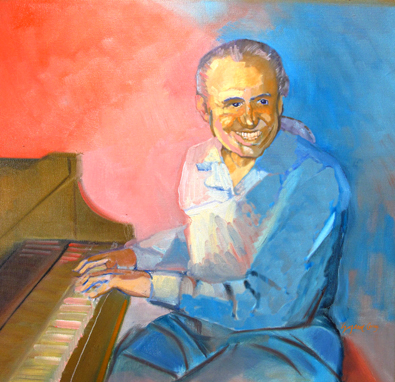
When was the first time you heard Bob Dorough? Adding new insinuations to Hoagy Carmichaels Baltimore Oriole? In a rare Miles Davis vocal? Writing lyrics to Charlie Parker tunes? Doing a cameo on an all-star jazz recording of Porgy and Bess? Probably none of the above. Most likely it was the syndicated television cartoon shows Schoolhouse Rock and Multiplication Rock, which found their way into our homes, hearts, and psyches when we were a bit younger. You could actually learn stuff from TV back then, Dorough remarked when we finally got this thing together. We had been dodging each other in New York and the Delaware Water Gap, Pa, where he lives, since this column first breathed life. I am so busy when I come there (NYC) that I really only have time to do my business and split, the ultra-hip Dorough said. That business included an extended brunch series at Iridium from which a recording emanated. He also comes into town as a guest pianist or second vocalist with friends--either live, on recordings, or to just offer support. A live Birdland (the most recent incarnation) appearance and recording with fellow hipster Dave Frishberg asks the show biz question, Whos On First? (Answer: Of course.)
After a friendship now in its 30th year [At least, he interjected], we tend to anticipate each others Q's & A's. Therein lay the problem--what do you leave out, or worse, what did you leave out?
We got right down to basics: his surname. I pronounce it both ways, Dooroh and Dooroh, he began. His Arkansas family pronounces it Durrah. There was a DJ in San Francisco who fell in love with Devil May Care [the premiere Dorough recording on Bethlehem Records]. People began telling me that they heard me on the radio calling me Door oh. Better they should know who I am and pronounce it wrong than not know me at all. Sounds better than, Huh? or Who?
The Dorough style, while creatively standard today, was a bit, shall we say, different, 60 years ago. While he was living in Los Angeles, Dorough was championed by the hippest DJ there, Tommy Bee. When he moved to New York in the 1950s the late, great Mort Fega was the prime advocate of the Dorough style.
[Fega, who was on the air late at night and into the early brights when my radio was supposed to be off, replaced Symphony Sid Turin on WEVD. Others whom Fega consistently played were Horace Silver (Senor Blues with then new voice Bill Henderson), and the Miles Davis rhythm section rhythm section playing Billy Boy. Fegas under-theme was Morts Report, written for him and played by Miles Davis pianist, Red Garland, from the Manteca LP. It was the first time I was to hear the name Ray Barretto, as he was featured on congas. Fega also produced singer Bobbi Rogers (whose initial offering was an LP of the music of poet Fran Landesman) and composer Tommy Wolf, who hipped the jazz-listening world to the cool phrase Spring Can Really Hang You Up The Most. So to get played by Mort Fega regularly was high praise indeed.]
The Dorough style does not lend itself readily to labeling. He explained. If Im asked by a club owner what I do, I say that I sort of sing bebop vocals. I hastily add standards as thats what most like to hear. If pressed I say that Im basically a piano player who sings.
"Cabaret" is a catchall phrase with a dedicated and devoted following. Some jazz singer-pianists have joined that milieu, as it can be lucrative, unobtrusive and harmless. However, cabaret is not often challenging. (The late Bobby Short set the standard; others who come immediately to mind include Daryl Sherman, Ronny Whyte and Barbara Carroll.) Some jazz players did and do cabaret. Ive been asked to join some cabaret functions, Dorough elucidated. And I guess it would behoove me to identify myself as cabaret, but I wouldnt want to damage my true jazz image. I havent been able to figure out if he was talking with tongue planted firmly in cheek. Actually, in the second five years of his New York sojourn, he decided he wanted to try his hand at the east side clubs. So I bought a tux. We didnt call it cabaret back then; we called the eastside work. I call them the "too precious crowd. The trouble is, I dont fit anywhere there.
Case in point, a Dorough hit, Im Hip, tells the tale of someone who so wants to be, so he/she offers up all the clichs of what hipness is supposed to be: dark glasses indoors, popping thumbs. My favorite line goes, Im so hip I call my girlfriend man. I still do, except shes now my wife. And she is.
"Im a songwriter, a hip songwriter. I became a singer basically to sing my songs. They were so hip who else was going to sing them? Back in 1953-54 I wasnt very good at promoting myself so I thought I would work on my singing. I wrote for myself [and he was lucky enough to be able play his songs]. They were written for a swinging piano player, he said.
After three years armed forces band (see below), from 1946-49 Dorough studied at North Texas University as a composition major. The famous Lab Band had not yet been formed. As far I know, that was the beginning of jazz education, he noted. We were jamming all the time. When the Lab Band became official, I wrote charts for them. Sometimes if a student was late I would sit in. You had to have practical playing experience to be in the band. Having given up clarinet and saxophone as his primary instruments, Dorough found work in the schools grand chorus giving him valuable vocal training. I wasnt a band or an orchestra player. You had to play something to be in the One OClock Lab Band, as it was called then.
Dorough (b. 1923, Cherry Hill, AR) began his musical life playing reed instruments. In Texarkana [Texas] Junior High School I became the clarinetist in the band. The leader was a talented gentleman who didnt like jazz. He gave lessons to serve his purpose, which was to have a better band. Half the year it was football music; the other half concert music. Thanks to transcribed sheet music, Dorough got to play some high class music. A much hipper member of the band, the drummer, suggested they start a jazz band. It didnt work out. I didnt own a saxophone, Dorough said. And I didnt want the chief thats what we called himto know that I was playing saxophone or jazz. [In all honesty] he was developing me into a serious clarinetist.
Jazz just wasnt serious enough to be taught in the late 1930s early 1940s. I was conducting the Jr. High band when he was too busy, and writing marches for the concert band. The first piece of sheet music the drummer ordered was In The Mood, very popular at the time. Dorough was high on Benny Goodman and Artie Shaw. I never did make up my mind who I liked better. I looked over the chart [of In The Mood] and saw the second tenor man got all the solos. We played it without a sax at all, just me on clarinet. Its in the same key. It was a pretty miserable affair.
After Texarkana came the Plainview High School Band, and then Dorough moved to Lubbock [Texas Tech], where there was in a Jack Teagarden-type combo. Those cats could play, he enthused. I remember the clarinetist was Aubry Smith. The trombonist played like Teagarden and sang, too. I was majoring in band music. The band director was very good and he led me along so I learned by doing it. Dorough eventually bought an alto and played in the dance band.
[Back-story: While at Plainview Dorough took a test, on which he scored high in music. The teacher came to my home and told my parents that I should be in the band, he remembered. They were impressed. I went to the orchestra where all the clarinetists played the melody but I heard other instruments playing other things. I came home and told them I wanted to be a musician. And they said OK. I had great parents.]
Then came the draft. I was stationed at Camp Hulen, between Galveston and Corpus Christie. We called it the asshole of Texas. I was in an artillery unit. A perfect place for a musician, youd agree. His band director at Texas Tech, to whom he was still sending arrangements, happened to know the warrant officer at Camp Hulen. The C. O. heard that I was a pretty good clarinetist. The next thing I knew I was called to bring my gear and I was out of artillery and into a band. There was also a childhood punctured eardrum situation exacerbated by the artillery. He never saw action. Instead he was shipped to a base in California and into a special services band. That was quite an eye-opener for me. In the three-plus years Dorough played in that band, it was in a professional capacity. And a bonus, which was to serve him well in later years: I got to mingle more with black musicians.
Dorough remembered: I always carried my clarinet in my duffle bag, but I never opened it; I was afraid all the other cats would laugh at me. Sure, you had to practice every morning at 0800. Heck, you were still in the army. There were some fine cats from the north who could write well, so I played quite a bit of tenor, alto and sometime baritone. As there were a limited number of piano players he began to play more of it. They played some jazz work and one player introduced him to Blacks Chord Book. Youd open it up and there were no notes just letters and slashes. I got a tenor player to teach me the melodies to go with the chords as I played them. I didnt know much music; just what I heard on the radio, 'Body and Soul, 'Heart and Soul,' stuff like that."
Many non-piano playing musicians learn piano in order to write and arrange. They appear to be informed by the harmonic instrument and translate it to their own. Dorough pondered and hedged. Id like to say the piano informs the clarinet, but not in all cases. Diz[zy Gillespie] told Miles to play the piano, but he didnt do it until he was well-established. In a short video called A Night In Tunisia, Gillespie demonstrates how he wrote the tune, and he never puts trumpet to lips, sitting instead at his congas, and the piano.
While the understanding of the clarinet is not enhanced by the piano, improvising on the instrument is, Dorough explained. You tend to see the chords. That coming from someone who had a half dozen lessons as a teenager. I minored in piano at North Texas and played some Bach, a little Beethoven and Mozart. My first lessons were from a grocery store owner who had a piano in the back. She owed by father money. At that time he drove a panel truck from which he delivered bread, so she paid him back by teaching his son, me, at least for six lessons.
Sometimes we had a piano, sometimes an organ on which my father could play a hymn or two. As we all learn with our ears, Dorough was no different. I was soaking it up and didnt know it. Very primitive compared with what kids learn today. Bless Mrs. Keanes five finger exercises and the sheet music she sent me home with from her grocery store studio.
One of those sheets was something called Underneath the Harlem Moon which contains the now racist line which reads, thats where darkies were born. Speaking of [the influence of] black people, we would go to the movies and one night there was this short starring Cab Calloway on a train doing the Hi-Dee-Hi-Dee-Ho routine [from] Minnie The Moocher. I just flipped out. I was about 10 and Mrs. Keane had once told me that if I cant play the melody try to figure out the harmony. So there I was making my own pop songs.
With some time left on the G.I. Bill and some theory and harmony from North Texas, the Arkansas-born, Texas-taught Robert Lrod Dorough - accent still intact - entered the big time: the Apple, New York City. He applied to Juilliard. I didnt do well on the exam, and I think I was too old for my level of achievement. He took some private lessons from a composer whom he had met at Juilliard. Eventually he enrolled at Columbia and studied with composers Otto Luening and Jack Beeson. The problem there was that while he had a Bachelors in Music, I was so intent on catching up with the music [at North Texas] that my academics suffered. I didnt take up much besides music, with a little [music] German. [As a result at Columbia] I had to take two semesters of undergraduate work.
A 1952 divorce and some constabulary entanglement caused Dorough to, in his words, drop out. His G.I. Bill funds had also run out at about this time. Thanks to Dr. Luening I had gotten into the graduate division with a teaching fellowship. But now Doroughs patience ran out as well, and his academic career came to a crashing halt. Thats when I became a pro, he proudly announced. I did a lot of things with the piano from then on. [Singer, choreographer] Geoffrey Holder brought 'Mack the Knife' to my house and asked me to arrange it for him to sing at rehearsals. Composer Kurt Weils widow, Lotte Lenya, was then starring in an off-Broadway production of her late husbands Die Drei Droschen Oper (The Three Penny Opera) and Mack had become a hit. I had never even heard of it, Dorough said. I played it, liked it, and thought, hey, Im going to sing it too. The tune in its original German was called Moritat. Dick Hyman initially recorded it as an instrumental. The dam broke after Bobby Darins vocal. Louis Armstrong, Ella Fitzgerald and Frank Sinatra all used it in their performances. Ernie Kovacs used the German version, called Mackie Messer, on his irreverent television show. (Messer = knife.)
Dorough also accompanied at Henry LeTangs School. Dancer, choreographer LeTang ran a studio in Midtown Manhattan. Among his clients was Middleweight boxing champion Sugar Ray Robinson, who learned his legendary footwork at LeTangs. Eventually Dorough and Robinson took it on the road. The LeTang gig was playing mostly stop time for the dancers. He demonstrated vocally. It paid me three-dollars-an-hour, and that covered the rent. Bear in mind that minimum wage in the 1950s was fifty-cents-an-hour.
In the meantime we might say mealtime Dorough visited the Union Hall (AFM local 802) regularly and answered calls such as need a piano who can sing, and vice versa. The usual dates followed: bars, clubs where I would play and sing stuff like Up A Lazy River, Hong Kong Blues, and, yes, Mack the Knife, and no one was paying attention.
There was the occasional Birdland off-night date, Like everybody else who played there I had to deal with emcee Pee Wee Marquette. Marquette was a midget who would purposely mispronounce your name unless you greased him. But there were others who encouraged me to come up [to NYC] and stay. One was Chuck Lilly. Lilly, who was at North Texas, was the drummer at the Keyhole Club in San Antonio with Hoyt Hughes, a territory band. He told me to go to New York where he thought I would be more appreciated.
In New York I had an upright [piano] in my apartment so we would jam at my place, but only till 10 pm. You didnt want the police involved. We had all the Detroiters except Hank Jones come through. Max Gordon, the proprietor of the Village Vanguard [which was not yet exclusively a jazz room] asked me to come in and accompany Broadway singers prior to the jazz sets. I did that for a while, but then Max asked me for my cabaret card. [A license issued by the Police Department to play where there was liquor sold. If you had a record, no card.] That canceled that gig. I still didnt have [the card] when I worked with Sugar Ray and a comic hoofer named Gil Scott. Scott was part of a vaudevillian troupe called Burnham, Harris & Scott who did USO shows. He was [Sugar] Rays tap partner and straight man. Ray got me through a gig at the French Quarter without the card, but after that [1952-54] we worked out of town. They traveled throughout the U.S. creating headlines during an extended run in Las Vegas. The Count Basie Band opened for Sugar so I was lucky enough to ride their band bus. And better: When they announced Ladies and gentlemen, Sugar Ray Robinson, Basie got up and I sat down. It was a hot seat, man. We had some Jimmy Mundy charts and the band just swung right through em.
Other times there would be pick up bands in which Dorough would either play, or if the pianist was good enough, conduct. Sometimes they were part of Variety Shows working opposite Earl Fatha Hines, Louis Armstrong, Basie, Eydie Gorme, the Platters, and other rock n roll groups. I was ready to quit when Ray announced, Were going to Paris. Ray wanted to bring some of us but they told him they had great musicians in Paris. Drummer-photographer Dave Pochinet got us our first gig and we died, musically. Sugar was on the stage shouting faster Bob, slower Bob. He knew something was wrong just couldnt figure out what. [Harmonica virtuoso] Larry Adler was on that bill; he stole the show. The rest of the tour was fine. Dorough stayed on in Paris at the Mars Club where Blossom Dearie and Annie Ross had also headlined. One time I played opposite pianist Art Simmons, another expatriate, who had a bass in the back. So he would take his break and come back playing bass with me. As the Mars Club was primarily solo pianos, that gig was the first opportunity that Dorough had to do what he most wanted to do: play the piano and sing.
Dorough remembered another Parisian bon mot. There was a Porgy and Bess tour which settled in Paris for three months, he began. Maya Angelou was in the dance chorus and vocal choir. Truman Capote was along. [As their chronicler; I guess he would be called a blogger today.] She came in [to the Mars Club] and I accompanied her. She sang calypso songs, which didnt thrill me. But she said later that I had ears like crystal. I guess she meant that my sense of harmony was good, as all I did was comp chords. At first Maya was taken aback by Doroughs accent. Having bad memories of her southern heritage she probably thought he was one of those. [A cracker?] She looked rather frightened. But we became pals. She would roam the streets of Paris [at all hours]; I couldnt keep up with her. She would see and stop black people asking where they came from. Africa? What tribe? She was probably Watusi as she was so tall. Now Dr. Angelouand an inveterate baseball fanMaya Angelou was Poet Laureate of the United States under Pres. Bill Clinton.
He returned home in January 1955. Charlie Parker shed his mortal coil that summer, but not his soul, which still inhabits a few of us, including Dorough. He immediately wrote lyrics to Yardbird Suite as a paean to the man. We all went up to Abyssinian [Baptist Church] to view the body and attend the funeral. It was a packed house. But not Birds last.
I came back [to NYC] thinking I was hot stuff, and couldnt get arrested (sic). [That cabaret card bullshit, again.] I did some short shots where I didnt need the card. Someone from the Billy Shaw [Booking Agency] Office heard me and took me up to Bethlehem. And I got the record date [Devil May Care reissued as Yardbird Suite]. There was also the now-legendary Porgy that was nearing completion, but each role Dorough asked for he was confronted with, 'Oh, so-and-sos got that."
It came down to the Crab Street Vendor. I said that Id take it. A wise decision considering the heavyweights on the LP. The producer was Red Clyde, who also produced Devil May Care. The guys became my buddies: drummer Jerry Segal and bassist Bill Takas. Bill and I became a duo which lasted until I had to move to Los Angeles due to that cabaret card business.
As it turned out, Dorough loved the left coast. It was 1958 and there was quite the scene there: Paul & Carla Bley, Ornette Coleman and Eric Dolphy. I was playing both cabaret and bebop gigs. Bill Takas came out and I got the boss [of Twelfth Knight, a club where he was playing solo] to kick in an extra $50 for him for the week. Thats where I met Tommy Wolf and [later] Miles [Davis].
Miles asked him to sit-in with him, singing Baltimore Oriole from Devil May Care. That song is not one that lends itself readily to just any singer. It has a sad ironic dramatic message. It emanated from a Humphrey Bogart-Lauren Bacall movie, To Have and Have Not, which also featured the composer, Hoagy Carmichael singing his tune. If sung as written, it is a-tempo and contains a lyric you have to follow carefully; in other words, right in Doroughs wheelhouse. It has become a signature for him. I dont know why; I just bonded with the song. Id seen the movie, but thats not the reason. Perhaps because its got a southern feeling (?). Ive watched the movie carefully, he noted. And its never sung, only as a melody in the background. When I was in the army I had a V-Disc of Hoagy singing that and 'Hong Kong Blues,' which he did sing in the same movie. I recorded both but with my own arrangements.
[Back story: It was Brooklyns own 19-year-old Bacalls first movie - her mother was on the set - and contains one of the sexiest scenes ever. Long dirty blond hair drooping over half her face says Bacall to Bogie leaving his hotel room: If you need me just whistle. You know how to whistle; you put your lips together and blow. They were married not long thereafter.]
By the way, that river mentioned in the lyrics of Baltimore, the Tangipaho, is still un-locatable by me. Neither Hoagy, nor his son, Hoagy Bix, could tell me where it is. Its probably in Indiana, Dorough said. Thats where Hoagy was from and he just wanted it in there. And it fit, phonetically and syllable-wise."
The Miles Davis meeting happened because Dorough had heard that Davis had listened to Devil several times, so I knew I had to meet him. Why Miles singled out that song I will never know. Maybe it brought up some memory. I dont remember hearing a Miles Davis recording of it. Their meeting was propitious. Read on.
Back from L.A., Dorough still couldnt get a job in the Apple, so he took one at the Mount Airy Lodge in the Poconos. It was a hotel gig, but I couldnt get any real jazz work, he said. It was rock n roll time and the only jazz people working were the marquee stars. His friend Bill Takas was working at Bradleys. He asked me if I wanted to work there and I told him that I didnt think they had singers in there. They dont but you can sing, he said. I believe I was the first singer in Bradleys. I worked there many times, two or three weeks at time. [During that same period] I worked at the Matador in San Francisco with Bill. We had become a traveling duo: we worked cheap, traveled cheap, ate and slept cheap.
From 1970-75 Dorough was pumping out Schoolhouse Rock, but it wasnt until that Bradleys gig in 1975 that the breakthrough finally happened. Bassist Ben Tucker heard him. I owe a lot of [commercial] success to Ben Tucker," Dorough said. I wrote lyrics to his Comin Home Baby and a couple of other of his tunes. He wanted to get into advertising, so he and I started a little company. He would get the gigs and I would write the charts. We made a couple of scores, nothing big. Tucker was also playing at the Hickory House with Marian McPartland and/or Billy Taylor, where George Newall, a major advertising executive who loved jazz, heard him. Unbeknownst to Dorough, Newall told Tucker that Newalls boss was looking for someone to put the multiplication tables to music. They asked Dorough if he could do it. I said, not very confidently, yeah. Evidently other composers had tried but didnt get what Newell had in mind. Newell said that his kids could memorize the lyrics of Jimi Hendrix but not mathematics. Actually I was something of a mathematician having taken a course in [what was then referred to as] the new math at Columbia when I was doing that undergraduate work.
Dorough spent some time on it, and came up with Three Is A Magic Number and a second tune, which was rejected. (My personal fav is My Hero Zero.) He was still doing commercials and worked with Chad Mitchell for a couple of years. I bought my house here [in the Gap] thanks to that. I would spend my spare time in the studio working on Schoolhouse Rock and my own recordings.
Earlier Dorough was part of the first Music Minus One concept, where a rhythm section or larger ensemble would record leaving space for one instrument for students. [MMO] was my first studio experience. The producer was Irv Kratke (in a studio built by the same person who would later do the same for Cream drummer Ginger Baker in Lagos, Nigeria, my reedman brother Noel. Thats where Dorough and I met.) Kratke also produced one of the earliest jazz Broadway show concept albums, Oliver. The band was Dorough, Tyree Glenn, trombone, Clark Terry, trumpet, Bobby Thomas, drums and tympani, Al Schackman, guitar, and Paul Motian and Ed Shaughnessy, drums. Dorough also recorded a Gershwin collection, which introduced trombonist Bill Watrous to records.
We bounced around his moments with Miles Davis, about whom he seemed reluctant to expound. Davis had used other singers occasionally Pancho Hagood, Brock Peters. Dorough would go to Birdland (the original) and catch Miles there. It was the place we could almost afford, he said. You could nurse a beer after paying admission and sit in the Peanut Gallery. Wed see Sarah Vaughan or Duke Ellington sitting at the tables. You could get pretty close to the piano. One time I saw Duke try to speak to Bud [Powell] and Bud just stared back at him. Said nothing.
Dorough has penned a thin tome about the experiences surrounding Blue Xmas, his signature recording with Davis. Its available privately through him. In 1962 Miles called me out of the blue and asked me to write a Christmas song for him. (Say, what?) Dorough has recorded Blue Xmas no fewer than three times. Davis & Dorough also did Nothing Like You. We became estranged because he was a heavy user [coke] and was constantly changing wives. He once offered to share a line in the mens room at the Vanguard. Im still friendly with Frances Taylor. [Taylors is that beautiful face which adorns a couple of Davis album covers and for whom Miles wrote Fran Dance, based on the childrens nursery song Put Your Little Foot Right In.] [During the electric period] people would come up to me and ask, What the hell is he doing? I would reply, Turn the other stuff off and just listen to him.
Speaking of Christmas, Dorough was working at the Iridium for three years worth of successful Sunday Brunches, even on his December birthday. He related how that world-respected gig came to a close. One December one of the bosses called and told me to not come in till sometime in late January. I know thats the slow period, but I gave it some thought and said that I wouldnt be back even after that. It gave me some satisfaction. Thats no way to do business. That said, I dont like being invisible in New York; its a hang up of mine. Maybe its the cabaret in my soul. A little singing, a little acting, a little Nat Cole, Joe Mooney, even Jack Teagarden sang, and Louis, of course. And lets not forget Hoagy. You could see him playing at least in the movies.
Regrets: I would have loved to have seen the Nat King Cole Trio in person. That kind of excitement is what I wanted in my life: a well-rehearsed trio, entertaining people, communicating and interacting; those brunches were perfect.
I also regret not keeping up the relationship with Miles; he was good to me.
When Geoffrey Holder came to me about the Mack The Knife arrangement I didnt follow through. I could have sung the tune and probably would have been better at it than what they were looking for than Geoffrey was. Perhaps my style was not what they were looking for either. Neither of us could remember who eventually sang it in the show.
I regret not getting my second degree. He was presented with an honorary Doctorate from East Stroudsburg University. That DWG community is home to such as Phil Woods, Bill Goodwin, Urbie Green, and Dave Liebman.
Hinted Regrets: That he didnt carry his vocalese talent beyond Yardbird Suite, the lyrics for which he never copyrighted due to an incident with the widow of the composer of Youre Driving Me Crazy, for which he wrote lyrics to a Lester Young solo. And at this writing, that he hasnt called Iridium for his brunch job, redux.
Unfinished: I have an entire autobiographical [musical] show which I cant seem to get to. Theres the composer-goes-pops, after all I majored in composition. I wanted to be [another] Igor Stravinsky, but bebop waylaid me, which is OK. There is no composer left in me. I admired them a great deal.
Rewards: That Schoolhouse Rock has had such an effect on children is very rewarding. People come up to me and express how I got them through school, or I changed their lives, or I woke them up. I was wondering if kids watched television to learn. So I watched my own songs. I got out the phone book and booked myself into 10 or 12 schools, rich, poor, didnt matter. Id say, Hi. Im Bob Dorough from ABC-TV and Ive got a show I can bring to your school. When I said it was free, courtesy of Schoolhouse Rock, they grabbed it. The teachers never head of it but they said the kids seemed excited. They nudge each other when they hear my voice. Thats him!
Tags:
December 27, 2009 · 0 comments

Comments are closed.