In conversation with brian blade
By Ted Panken

"The way I was brought up, boundary lines were never laid on the ground between people or the music," Brian Blade told me almost a decade ago, not long before he joined the Wayne Shorter Quartet. As I wrote at the time, Blade, then 30, was "one of the few drummers with a distinct personality in hardcore jazzcredits include Kenny Garrett, Joshua Redman, Pat Metheny, and Mark Turnerwho has also stamped his imprint on popular music through stadium gigs and recordings with Joni Mitchell, Daniel Lanois, Seal, Emmylou Harris, and Bob Dylan."
At the time, Blade had just released Perceptual (Blue Note), the second release by Fellowship Band, on which the leader and his unitKurt Rosenwinkel, guitar; Myron Walden, alto saxophone; Melvin Butler, tenor saxophone; Jon Cowherd, piano; Christopher Thomas, bassinterpreted original tunes by Blade and Cowherd that drew on a range of heartland folk styles, with guest turns by Lanois and Mitchell punctuating the flow. Last year, after an eight-year gap, the same core personnel performed on Season of Changes (Verve), comprising a succinct, streamlined suite propelled by Blades singular ability to shape the flow through permutations of groove and drum timbre.
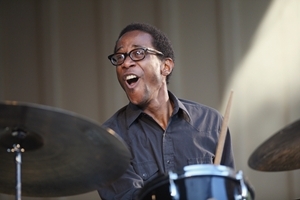
During that interim, Blade toured extensively with Shorter, Redman, Garrett, Herbie Hancock, Bill Frisell, David Binney, Edward Simon, and other high quality jazzfolk of various predispositions. In the process, he burnished his stature as, in the words of Jeff Ballard, "the top cat around" among his generational peer group. In a Downbeat Blindfold Test a few years back, after remarking on Blades 'real old-school sound,' Ballard continued: "Brians choices are amazing. What he plays is all for the composition. His mix of texture and tonality is perfect for that moment in the whole tune. So is his matching of sound to whats going on in the placement. Also, hes got patience with the biggest 'P' on the planet. He forces things not to be automatic."
In a more recent conversation with Jazz.com, Chick Corea, fresh from several weeks interacting with Blade in the Five Peace Band project with John McLaughlin, Garrett, and Christian McBride, made a similar point. "After working with Brian for a couple of tours, hes become one of my favorite drummers of all time," Corea stated. "He thinks as a composer, and hes very expressive. He carries the tradition not only of Philly Joe Jones and Roy Haynes and Tony Williamsin my mind, he kind of holds the torch of the creation of jazz drummingbut he also does what might be considered, in more conservative music, radical things. Like playing very quietly. Or not playing at all, or playing very edgy and bombastically, all within the same framework. He came in and the whole set turned around."

Blade himself presents what might be described as a full 360-degree turnaround on Mama Rosa [Verve Forecast], his 2009 release, on which he plays barely a beat on drums, but instead communicates primarily with his voice and his guitar, revealing himself to be a first-class singer-songwriter. The 13-tune recital includes ten songs that comprise a quasi-autobiography, touching on themes of faith, family, love, loss, and remembrance. Blade sings them without affect, allowing the power of his words to come through with phrasing and nuanced articulation. Lanois, the dates producer, counterstates Blades message with pungent guitar solos, and Kelly Jones provides eloquent vocal harmony. Fellowship colleagues Cowherd and Rosenwinkel also contribute to the proceedings.
"Revealing more of ourselves is always daunting," Blade stated in the publicity materials attendant to the release of Mama Rosa. "But I feel like I need to keep challenging myself and peeling away layers to get to the core of who I am and what I have to offer."
Youre in L.A. now playing with Fellowship Band, then with Wayne Shorter on Sunday; next week youre playing in Canada with Daniel Lanois, and then in 12 days at Highline Ballroom launching the Mama Rosa album, en route to the summer season. A lot of activity mirroring your documented musical production.
Yes, its all coming together all at once. Its bizarre. Im thankful for it, but also just trying to keep my head about me, and be prepared for the next step.
On Mama Rosa you reveal a side of yourself that you haven't previously offered to the public. Its a suite of music that includes ten songs you wrote while touring over the years. Can you tell me how the recording took shape? Is there an overall narrative arc, and did the songs fit cleanly into it? Was there a lot of production involved?
As you say, it has been running parallel to my writing for the Fellowship Band, but in a very private way. Everything on the record was recorded at home on my 4-track, and it gave me enough satisfaction just to know, ok, they exist, and Im fine with that. Im thankful that Ive had a little bit of time to write down my memories and experiences, and thoughts about my family, and life in general, and connect them with music. Some of those original four-track recordings are on the record as I did them in my little room, or various rooms around the world. But then it got to the point where Id share them with my friend Daniel Lanois, and he encouraged me to try and make an entire record of it. As we went through the process hed say, 'Ok, I dont think we can better this version from your home recording, so thats on the record.'
How many of the tunes are home recordings?
Definitely 'Natures Law' is exactly how it came from my little machine at home, and 'All That Was Yesterday,' and 'Youll Always be My Baby' as well. The others, as I said, Id done recordings at home, but we thought wed try to change them in the studio, or make a new recording.
Which is the first that you wrote, and when did you write it?
I guess 'After the Revival.' Yes, that's the first song. I want to say on guitar, at least 12-13 years ago, even before Fellowship music started to come to me. It was a song written from the perspective of my mothersay, 1964, when shes about to have her first child, my brother Brady. I was trying to think of what she might have been feeling at that time. My father is a pastor, so he often used to go out to preach at revivals when we were growing up. He was trying to build a home and take care of his family, but also go forth with his own mission as a minister. Its really all about my grandmother Rosa, who is my mothers mother, and also my mother and brother.
Can you tell me something about Rosa? Is she from Shreveport?
Yes, she is. Basically, she always took care of peoples houses, like a housekeeper her entire life, and she ran several kitchens at Southern University and places like that around Shreveport, Louisiana. Actually, the cover photograph is from the Jaguar Grille, which is the Southern University kitchen there. Shes a sweetheart! So I felt it was fitting to dedicate the record to her, and what she means to me, and hopefully the songs embody the joy she brought to my life and to so many other folks.
I gather youve recently moved back to Shreveport.
Ive been spending more time there since I gave up my place in New York, just to connect with them more than just Christmas every year, as I get older and they get a little older.
This happened about two years ago. Has living there had any impact on your musical production? You remarked in conjunction with this recording (and Im paraphrasing) that in a certain way you feel its time to be more open about who you are.
Well, maybe so. I dont think I was ever concealing anything necessarily. But particularly with this Mama Rosa music, they almost feel like diary entries to me. Its kind of like, 'well, do I want the world to read my diary?' No, not really. But at the same time, its my music, too, which is something I love to share. So I felt, well, I have to let it go in order to move forward, and feel like Im doing the right thingnot only for myself, but for the grand scheme of things.
When did you start writing songs?
I want to say 96-97, just before the first Fellowship record came out.
So the process begins during or right after the time youd been on the road with master singer-songwriters Emmylou Harris, Dylan, Joni Mitchell.
Exactly. And Daniel Lanois.
Who you met in New Orleans. Was writing something that had always interested you? Did it start to emerge for you at that time?
It did, particularly from being around my friend Daniel Lanois, and watching him in the process: how he would write down ideas and form them into poetry and connect them with music. Obviously, Joni Mitchell, too. Shes my hero and my greatest inspiration for this way of seeing a story unfold, and putting down your observances and experiences in some way that might strike against someone elses life and experience. Thats why I think her music endures and keeps getting deeper and deeper, the more I listen to it. Its always a privilege to be around her, and to be around Daniel or Emmylou or Dylan, and to see the attention they place on all the elements of storytelling.
Are you or have you been a big reader? I noticed in an old interview that you majored in anthropology at Loyola University in New Orleans.
Yeah. I always sort of wanted to be Alan Lomax in this life, just go around finding cultural significance through peoples music. In a way, Im doing it as a musician, strangely enough, not necessarily documenting other peoples music, but trying to take in as much as I can, and having it distill itself in me. Its a constant research, a constant study, and youre never thereyoure just on the trip, I think.
You moved to New Orleans in 88. How soon after arriving did you meet Daniel Lanois?
It would have been around 91-92. Maybe a little later.
By then, hed already produced Dylan.
Yes. The second record, For the Beauty of Wynona, was about to come out, and he was going to go on tour with Darrell Johnson, who played bass with the Neville Brothers at the time. Daniel made a record with them called Yellow Moon. But we met and rehearsed at a little theater in Algiers where he was holed up, and became fast friends. We went on the road for three months, and we havent stopped since. Were bound as brothers.
Was he the person who led you to Joni Mitchell and Dylan and Emmylou Harris?
I was already very aware of their music and a fan.
I meant personally.
To Joni ... yes, I guess to Emmy and Bob as well.
Songwriting. Apart from the inspiration and the message behind the words, it involves a specific craft. Did it take a long time for you to develop the craft?
Its a good thing that in my time off from the road, or even on the road, I put down every little fragment, or thought, or word, or chord that might be an inkling to something whole, something larger, a full song, a full idea. In those times, its almost like a meditation. You just try to stay in it as long as you can, to focus on the thought. Hopefully, Im getting better and better at that. Same with the Fellowship Band music. Im trying to write specifically for the guys in the band and for myself to hopefully get in on this story, to be able to deliver it and know it well. I guess the challenge is to do that ... well, not necessarily quickly, because you cant rush it. The process is still a mystery to me. Youre still almost grabbing ... reaching out into the darkness for these little points of light, and youre not sure where theyre coming from. But if you can just be in the moment and hold onto it as long as you can ... Its hopefully getting better.
But from what youre saying, storytelling has always been an abiding interest for you.
Absolutely.
Id imagine that your time in New Orleans perhaps influenced you to apply the notion of storytelling to the way you think about drumming.
New Orleans was my first time away from my family, starting college in a whole new community, one of the greatest places in the world, so unique in feeling and just the emotional vibe on the streets and the beat that lives thereand my teachers. John Vidacovich was very important. Theres a deep sense of groove, but also a deep concern with creating melodic motion from the drums, with moving and shaping the music. He's more of a philosophical teacher than one that taught in a methodical way. David Lee had me play out of books, and placed names on certain beatsone is a calypso, another is a merengue.
I guess along the way, my experience in New Orleans finds its way into all my music. Unconsciously, its just a part of how I go about making music.
Your creativity emerged on this very solid foundation. It sounds like a similar process was at play in your songwriting.
I must say that my teachers definitely gave me that foundation. Youre always grappling with that place between your head and your hands that you want to connect, and not have a gap between what you hear and what you execute. I used to go to Congo Square, where a slave would walk from Mississippi just to be there for a day, to do this vigil and play the drum... There is storytelling in the instrument, but you have to go to it wanting to tell people something. If you're only playing beats, then what is it for?
Now, with the songwriting, I felt I was a little on my own. But the thing is, even before I met Daniel or Joni or Bob Dylan or Emmylou, their records existed. What I definitely know is that when I hear something that touches me, then I go into the analytical process after it touches me, to say, 'Ok, what is it that touches me about it? And can I put it into words? What makes it so emotionally powerful?' So I try to step away from my own writing and hopefully have that objectivity as well. 'After the Revival.' What is this song trying to tell you? Whos involved? Where are we? Is it in a specific place? Is it literal or is it more metaphorical? When you start to put words on things, too, perhaps it gets a little closer to the bone. Joni Mitchells influence also infuses the instrumental music, the Fellowship Band music, and its just as close to my heart as the Mama Rosa songs, but when the words enter the picture its maybe a slightly different trip, a more personal trip.
A lot of the songs on Fellowship Bands Season of Changes sound like they could very well have lyrics. For all I know, they do, and you havent recorded them.
Some of the songs do begin with a lyrical idea, but then they end up living in the instrumental world. I guess Im never so sure as to where a song is going to end up living. The process is that either I end up developing this one sentence into a full lyrical idea, or else that idea is just a starting point that will give me the instrumental story. Im never sure. Maybe thats the great thing about the mystery, too. It throws you into the process, and you just have to take the trip.
When did you form Fellowship Band? Youve had a fairly stable personnel.
It starts with [pianist] Jon Cowherd. Jon was already at Loyola when I arrived in New Orleans in 1988, and we became fast friends and played all the time. That was the genesis of the band, actuallynot knowing it, of course, until a decade later, when we made our first recording. A year or so after I met Jon, in 1989 or 1990, [bassist] Chris Thomas moved to New Orleans to attend the University of New Orleans, to study with Ellis Marsalis. So there was this trio core in New Orleans that was the beginning of the band.
You must have met Myron Walden after moving to New York in the 90s.
Yes. I met Myron at Manhattan School of Music. I was playing with [bassist] Doug Weiss and [pianist] Kevin Hays, and Myron was there.
Its hard to think of too many other bands in which Ive heard the excellent tenor saxophonist, Melvin Butler. His sound seems perfect for what youre trying to do.
It is. Melvins tenor voice, and how he delivers melody and emotes the feeling, the essence of what I feel the music is ... hes just a gifted person. Its in his heart and in his soul. He went to Berklee, and had relationships with Kurt Rosenwinkel and musicians in New York, like Debbie Dean and Seamus Blake, who were all at Berklee during that same period of time. I met Melvin through Betty Carter, when she hosted her first Jazz Ahead at BAM. At the time, Chris Thomas and Clarence Penn were in her band. Peter Martin, too. Melvin is a very studious man, very much on a mission. Hes a professor now. Ethnomusicology. Hes busy writing, but hes got a dedication to the band, which Im thankful for.
Do you hear the drum kit differently playing with Fellowship than with other people?
I dont necessarily think its different. The vocabulary is all the same. Within each situation, Im primarily trying to do the same thingserve the moment, serve the song. Thankfully, Ive been given that liberty in almost every situation Ive been a part of. Sometimes Im amazed. Im back there, Im looking at Wayne Shorter, and thinking, 'God, this is what I do!' There he is, the very man himself. When you encounter your heroes, it becomes even deeper and greater to you in terms of your reverence and respect for them, and love, just as people.
Are you composing or thinking of the overall sound of the Fellowship Band from the drums? Or are you thinking in a similar way as you would as a sideman, reacting to the flow around you?
Thats interesting, because obviously, I have a connection with Jon Cowherd. Whatever Jon brings to the table musically, I know Im going tohopefullygive the right thing for it. Myself, after Ive written something, I then have to leave the guitar and sit by the drums, and its really kind of new for me at that moment, as if Im playing someone elses music. Especially when its in the hands of the people in my band, all of a sudden it becomes alive to me. So I have to create a part for myself in the moment. I suppose Im always doing that. Insofar as how it fleshes out in terms of the group dynamic, I think everyone is sensitive to finding their thread and fabric, so to speak. Thats what Im always trying to do.
As a working drummer in live situations, you always have to play the room. One week you might be playing the Village Vanguard, after spending a month playing concert halls with Wayne Shorter.
True. I think a lot of it comes from my earlier experiences, firstly playing in church in Shreveport, and doing many, many gigs in ballrooms and hotels and lounges, all these different environments, different musics. That has informed my ability to adjust, to adapt to the environment quickly and say, 'Okay, this is the sound,' and be able to fill it but not overwhelm it. Its always a challenge. Every day is a different experience.
Also, on the road you may not always have your own drum kit, especially these days, with transportation being what it is.
Im trying not to be diminished by all that. I would like to stick to my conviction of saying, 'This is what I do. My life doesnt fit on a laptop, unfortunately, but here are my drums. Accept me.' With Wayne, thankfully its been possible to bring the drums. John Patitucci travels with his bass. So Im thankful that we can have these constants in the ever-changing environment.
Can you speak to the bands name, Fellowship?
I guess the big idea is what I hope to present with the music itself, this bond and this solidarity, not separatism or things that place boundary-lines between us. The music is perhaps not always easily defined, but I would call it our folk music, and its based on our relationships.
In a previous conversation, we spoke about the role of location being crucial to your broad conception of musicAmerican heartland music. Shreveport is more or less equidistant between the Delta, the Bayou, and the Ozarks, which is the confluence of a lot of streams. I suppose you absorbed a lot of them as a kid.
I suppose I did. Gospel, of course, being at the core of it. But then, I heard so much music. Chuck Rainey and the Neville Brothers, Asleep at the Wheel, this kind of cross-section of Soul and Country and roots music, as well as all the recordings I was trying to listen to. So yes, it is a curious place, right at that point in Louisiana.
Have your experiences with Wayne Shorter modified/morphed your views on presentation, or forms of tunes, or how you tell a story on the drums?
Its definitely given me a greater degree of courage to take chances. Thats what I love about Wayne. Hes such a master, such a genius composer, such a funny man. So for him not to rest on what hes already established, absolutely the bedrock of this music, his unrivaled compositions ... hes still searching for new pathways and a different direction every night. So I try to do that myself. There is that unknown, which Wayne embraces wholeheartedly, and hes brought us into that, like, 'Okay, flashlights onlets [go on an] adventure.' But then also, Wayne is always writing and bringing things in, and often, as a trio, Danilo and John and I will go through things at sound checks. We may not get to them for a while. But Wayne is always planting seeds, and the growth comes slowly but surely.
The concerts give the impression of being 60 minutes of collective improvising, with occasional references to the tunes. How does it function? Are there cues? Is it just that youve been playing together for so long that you have that mutual intuition?
Right. After nine years, that unspoken language develops, just from that immeasurable amount of time together. But beginning from nothing, there are points at which someone might actually play something that we are familiar with. 'Oh, I know that melody.' 'Oh, do you want to play that?' 'Okay.' You might agree, and everyone goes there, but sometimes four threads of thoughts are intertwining. So somehow, within all that variance, comes a singularity as well. Wayne loves that. He loves for you to make your choice and stick with it.
Theres a quality of real sound-painting, almost as though hes seeing the sounds as colors and shapes as hes creating them.
His imagination is so incredible, and you can hear it in his tone and his improvising. I think of it as always this cinematic view running. Theres also the symphonic aspect of everyones vision. It always seemed to exist in Waynes music, all the records I bought while I was in college, all of his Blue Note recordings, and later his Columbia recordings, and obviously Miles quintet with him, and also Weather Report. He always projects some other idea somehow, something bigger, something out of this world. Wayne is such a pictorial thinker, and he has such a cinematic, descriptive eye, and its great to feel like were part of that vision that can make his music. Its perfect on paper. As far as Im concerned, we just have to play whats on the page and I would be so satisfied with that. But he wants to break out of that form almost immediately, before we even get to it, to create something thats all of ours, so to speak. Its been such a privilege with him to hear and just play one note, and whats in that note is so profound and beautiful. But its also been great for me and for Danilo [Perez] and for John [Patitucci] to have played together for so many years now, where we can walk out on the wire, so to speak, with no script, and improvisecompose together for the moment. It requires a great deal of trust, and also simultaneously, ambition, and patience to put yourself in a vulnerable place, and hopefully have your instincts kick in and deliver the goods.
You mentioned how important the recordings that Wayne Shorter was on were to you as a young guy. Parenthetically, I once presented a track of yours to a veteran drummer in a Blindfold Test, and he mistook you for Tony Williams, which indicates your command of that vocabulary. Could you speak of the drummers you studied early on?
As to Waynes recordings, of course his Blue Note recordings with Elvin Jones, but I also initially tried to absorb Art Blakey as much as I could. Max Roach as well. Definitely Tony Williams. After I met Greg Hutchinson and Clarence Penn, they said, 'Man, you need to check out Philly Joe Jones, you need to check out Papa Jo Jones.' So obviously every thread connects. Then you start to look at the progression. You can hear Papa Jo in Elvin. You can hear Art Blakey in Tony. Even Tony at 17, youre talking about a fully formed genius. He set the bar so high, and you can hear that he absorbed the history of not only swing, but how to command a sound at the instrument. I guess Im trying to do the same thing. Those are my pillars.
Were you an emulative drummer as a kid? What I mean is, would you try to play as much like Elvin Jones as you could, or as much like Art Blakey as you could, or as much like Tony Williams as you could, and then form your own conclusions out of that to become Brian Blade? Or was it more an osmosis thing?
Well, at home, in practice, I would try to. I did a little bit of transcription, but also less writing of it and just sitting at the drums and trying to learn how to execute these things that I liked. But when youre playing in a situation with people, you make music in the now and not play something that you ... it becomes a part of you, hopefully, and you can transmit it, but I know where it came from. I had so many opportunities to play all kinds of music. I was always listening to Steve Wonder, and Earth, Wind and Fire, or Toto! Again, these connections. Like, Id hear Jeff Porcaro play a beat, and then later I would come to hear Bernard Purdie, and say, 'Oh. Bernard Purdie!' Id start to go deeper into the roots of where things come from. Sometimes when I listen back to things and hear myself, I think, 'Wow, theres New Orleans!' Its always there, that pulse and memory of that place, my teachers and heroes there. It all has formed my way of playing music and seeing the world to a certain degree as well.
Did guitar precede the drums for you?
No. Violin did, however. But after, I guess, junior high, the line got blurryI started playing snare drum in the sort of symphonic band. But for me, the guitar ... I never had a great connection with the piano. So for me to be able to travel with this acoustic thing, and feel like, 'Oh, these little gifts are coming to me, and if I have 15 minutes somewhere as we travel along ... .' You never know. So I always like to keep it with me, and even if I get a fragment of an idea, who knows? It might develop quickly. But at least I was there to receive it.
Did any of the tunes on Season of Changes stem from guitar explorations?

Absolutely. 'Rubylous' and 'Stoner Hill'. The one song that I wrote at the piano is entitled 'Alpha and Omega.' John and Myron do this amazing improvisation that precedes it, and then connects to that little piece of music. Im proud of that one. I fancied myself in my room, the electricity had gone off, and Im at my little piano, and Laura Nyro kind of came into the room a little bit in spirit!
When you played at the Village Vanguard with Fellowship last spring, the distinctive sound of Kurt Rosenwinkel was prominent within the mix. Jon Cowherd sat stage left at the piano, Rosenwinkel stood stage right, and, as I believe you mentioned at the time, their sounds comprised the pillars through which you navigated. Speak a bit about the bands texture, the sound youre hearing from the unit in your minds ear.
Obviously, Kurts brilliance and expressive power and eloquence comes from this core love of harmony. Also John, the same thing. This interweaving conversation is happening within every beat. Theyre constructing these, I guess, monoliths! As a band, when it all comes together, the lines move in a linear way, but then also move in blocks, as these stacks. I often write that way. Not so much long lines, but more sung, shorter phrases perhaps. Jon and Kurt are able to make those two chordal instruments not collide with each other, but create a sort of fabric, and we all are able to stand on and jump from these posts.
Kurt Rosenwinkel was one of so many consequential musicians who developed their musical ideas at Smalls from the mid 90s on, as is well-documented. At that time, you played there regularly on Wednesday nights with Sam Yahelthe ambiance was more a straight-ahead, kicking drum thing, signifying on the approaches of some of the drummers you mentioned before. Can you talk about those years?
I miss it. To go down to Smalls with Sam and Peter Bernstein, for a while, every Wednesday, helped me. In our development as people, but specifically as musicians, you hit these plateaus, where you feel, 'okay, Ive been able to express these things, but Im stuck there now.' So you have to place yourself in situations where youre going to be challenged. With Sam and Peter, it was always a feeling, 'Wow, I have to raise the bar,' because they were really talking on a high level. It helped me so much. And it was fun. Youd walk out of there at six in the morning, and it was as if, 'Okay, we had an experience tonight.'
But it seems that towards the latter 90s, leading up to Wayne, you started to move from 'blowing' drumming to longer-form sorts of things. Now, this is a gross generalization, since everything goes on at the same time. But Im wondering if theres a kernel of truth to this observation.
I suppose so. I feel my writing became much more compact on Season of Changeslittle 3-minute statements, very short sentiments. But were also able to balance that with, say, Jons writing, 'Return of the Prodigal Son' or 'Season of Changes,' that are much more of a trip, much more of a landscape through the mountains and valleys. I dont know. Its ever-changing. Maybe Ive got another suite in me somewhere around the bend.
You mentioned that you started playing snare drum in junior high school.
I started playing drums when I was 13. My brother Brady, who is five years older than me, was playing in church. At the time, he was leaving for college, so it just seemed it was my time to step into the seat in church once he left. It was an unconscious move, really. It just felt like, 'Oh, thats your duty.' 'You want to play? Oh, great.'
You once mentioned to me that when you started playing drums in church, you were directly next to the chorus.
Yes. But particularly the organistor piano, depending on which side and which church we were in. Theres been three locations of our church, Zion Baptist. We started in one part of Shreveport when I was very young, and for most of my life we were in a second location. Once I moved away to college, we moved to yet another location. So it was a different arrangement within each church, but very similar. The choir is always behind the pulpit, and the piano and organ are always behind the left and right, and the drums could have been on either side.
Thats a very dramatic context in which to play drums every week. Did those early experiences have a big impact on the way you think about playing drums now?
It is definitely the ground on which everything stands for me. Every situation which Im a part of, that initial experience of serving the song, where its about praise and not some show or entertainment, but the rhetoric and being in worship service ... I feel like every time I play, Im in that place, even in an unconscious way. I think it gave me a certain focus to hopefully get out of the way! Obviously, theres a lot of practice that we all have to do to get better at playing and expressing ourselves. But those lessons and that experience is where I come from, I think, in every other situation.
Can you speculate similarly on whatever impact your fathers sermons or rhetoric may have had on the way you express yourself and tell stories?
Yes. Actually, Im writing a song for my dad right now, because were going to make a record for him later this year. I guess a lot of times, people dont necessarily see Biblical stories as being connected to their lives. But my father had this great ability to break down parables. Often in church, when something speaks to people, they say, 'Make it plain!' By 'making it plain,' its like, 'Ok, I see what youre saying; its real to me in this moment, in my life.' Im trying to do that with songs. My dad definitely has inspired me and influenced me so much in trying to make it plain, these things that sometimes can be heavier thoughts or seemingly abstract.
Does the 'Make it plain' notion have anything to do with the way you approach playing drums in the flow of things?
Perhaps it does. I remember my brother, when I was starting to play in church, would say, 'Its all about the train.' Keep the train moving. Just the simple thought of CHUG-CHUG-CHUG, seeing my role as being the train, so to speak, or the engine of the thing. Then you find yourself in that description. Ok, maybe the train is a colorful train. Maybe the train makes little stops on its route. So I try obviously to express myself, but at the same time not lose my sense of responsibility in a situation. <./p>
Eight years ago, you told me, 'Jazz definitely is predominantly what I do play. I am not offended by the word jazz.'
Yeah!
Then you followed up with a remark that we get caught up too much in terminology.
I think so. Perhaps its so loose ... I wouldnt say its impossible to define what jazz is. But maybe it was something much clearer to folks when it was somewhat popular music, say, from the turn of the last century 'til as late as the 60s. You could look to Miles Davis or Louis Armstrong, and just say, 'Ok, this is jazz.' But as things became much more combined and influences started to come together, those lines started to disappear as to clear definitions. But when I think about jazz, certain folks come to mind. Thelonious Monk. Duke Ellington. Or hopefully what the Fellowship Band is doing I would call jazzbut other elements and feelings come into our music as well.
Hopefully, what we provide for each other is this trust, the confidence to take chances. We dont want to rely on what we played last night, or any automatic rote actions. We want to be in the moment as well, and surprise ourselves, and surprise each other, to have that mutual connection and know that everyone is completely submitting themselves to the whole idea. I think the audience feeds off of that. Im not comparing us to the John Coltrane Quartet, but they are the example of what great group interplay is and the power that comes from that. Each individual is so virtuosic and delivering such emotional power on their instrument, but then theres even something higher that we can reach together, something unseen, something that is a grace thats been given.
Ted Panken spoke with Brian Blade on June 19, 2008.
Tags:
July 14, 2009 · 0 comments

Comments are closed.