In conversation with bill charlap
By Ted Panken
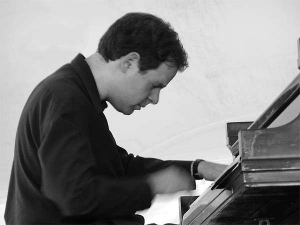
"Ive really been running the last two days," said Bill Charlap in the lobby of the Algonquin Hotel, a block east of the Times Square theater district. It was mid-afternoon on the Saturday of Memorial Day weekend, and Charlap was anticipating night five of the first week of a fortnight engagement at Dizzy's Club Coca-Cola with Peter Washington and Kenny Washington, his trio partners since 1997.
Charlap, who looked none the worse for wear, was referencing a duo recording hed made on the previous afternoon with alto saxophonist Jon Gordon, a close friend since both were classmates at New Yorks High School of Performing Arts at the cusp of the 80s. "I drove out after the gig on Thursday, stayed in the Delaware Water Gap, recorded with Jon, drove back to Manhattan, and played three sets," Charlap said. "I was really hurting."
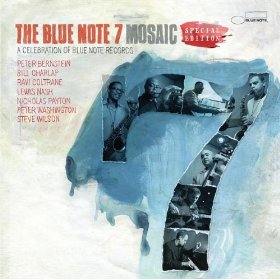
The trio was playing its first extended engagement since the end of 2008. During the five-month interim, Charlap had been on the road as band pianist and de facto music director of the Blue Note 7, an all-star groupNicholas Payton, trumpet; Steve Wilson, alto saxophone; Ravi Coltrane, tenor saxophone; Peter Bernstein, guitar; Peter Washington, bass; Lewis Nash, drumsassembled for the purpose of playing iconic repertoire from the Blue Note Records catalog in observance of the labels 75th anniversary. Reunited with his trio, Charlap now was ready to return to his first love, the Great American Songbook, which was at its apogee during the 30s and 40s, when such classy writers and legendary wits as Dorothy Parker, George Kaufman, and S.L. Perelman frequented the Algonquin Roundtable.
A quick glance at Charlaps recorded c.v. makes it clear how intimate a relationship he enjoys with this material. On the 2004-05 albums Plays George Gershwin: The American Soul, Somewhere, and Begin The Beguine (the latter made for the Japanese market), Charlap, now 42, celebrated repertoire, respectively, by George Gershwin, Leonard Bernstein, and Cole Porter. Stardust, from 2000, is a vivid exploration of the world of Hoagy Carmichael, while Love You Madly, from 2003, is a kaleidoscopic tour of Ellingtonia.
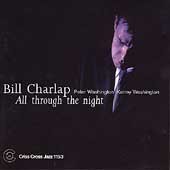
On eight other trio albums recorded since 1995, Charlap has rendered incisive, nuanced interpretations of tunes iconic and obscure by Irving Berlin, Jerome Kern, Harold Arlen, Richard Rodgers, Frank Loesser, Burton Lane, Alec Wilder, Jule Styne, and other luminaries of the periodincluding his late father, Morris "Moose" Charlap, who composed the score for the original Broadway production of Peter Pan. Each performance expresses an informed point of view, articulated---as no less an authority than George Shearing remarked in the liner notes for All Through The Night, documenting Charlaps first meeting with Peter and Kenny Washington---with "touch, swing, sound, precision, and just about everything you need in a well-rounded, well-schooled jazz pianist."
"Usually, I will play a song at a tempo or in an arrangement where you could hear the lyric, because to me, words and notes are very much 50-50," Charlap told me a few years back. "The lyric doesnt always inform my approach; sometimes I choose, as an arranger and improviser, to paraphrase the composition. But if the lyrics are good, they drip off of the notes. For example, Where Or When has many repeated notes, but each note has a word, and those words inform the playing."
This is the trios first extended run in some time, its longest period of inactivity since it formed. Has this break had an impact?
Well, I can only sayand maybe its just part of getting older and part of our experience together as a groupthat I feel the value of playing together with Kenny and Peter more and more each time. I never take it for granted, and it feels very high on my priority list.
So being away from them ... absence makes the heart grow fonder?
Its not even necessarily about having been away, or working with the Blue Note 7, or anything like that. Its that, as years go on, the things that are really important to you get more important, and things that are less important to you also become less important. Im not saying that the Blue Note 7 was less important. That was very important, too. But the trio is central to my musical world, and continues to expand and deepen. While we're at ease playing together, it's still a challenge. If it's not, there wouldnt be a reason to continue.
Are you bringing in new repertoire?
I recently brought in about seven new pieces, and that always helps. But also approaching things differently. Sometimes Ill reassess a couple of things, or change tempos. I feel that its expanding in its scopethe organic qualities continue, and willingness to take things in maybe subtly different directions. The cues are very fast, organic and intuitive. That was always there, though. Chemistry is chemistry. We had chemistry right away, from the very first time we played. But the chemistry grows. Maybe sometimes when you rest on certain music for a little while, it does have a chance to gestate a bit. Im sure that has something to do with it, too.
Whats the percentage of arrangement versus the percentage of improvisation, or the ways that they mix, within your concept of the trio?
To be honest with you, I never really sat down and thought about it. But as times gone on, Ive realized that there is a side of me that is an arranger and loves to come up with concepts for the trio or myselfor ways of playing a piece. Sometimes an arrangement means a harmonic arrangement or a harmonic approach, maybe just a vibe. Sometimes its much more involved. Sometimes it does become a full arrangement inclusive of piano, bass, and drums, and counterpoint, and all that sort of stuff. So the answer is ... I dont know the exact answer. I think its a balance of a number of things. Sometimes Ill call some tunes or play something that there is no real arrangement of, although because of the way that we play and how well we know each other, these things can also organically become an arrangement or the point of view from which well approach it.
What I find happening in the triowhich is very gratifying and fun for me and for usis that even the arranged parts become more pliable, and more subtle, and more able to be renegotiated in terms of phrasing, chord disposition, bass notes, the drum arrangement. None of those things are set in stone. They change all the time, very quickly. Its almost like when you hear a concert pianist, like Rubinstein, play a Chopin waltz hes played 300 timesthe idea is not to waste any moment of it. Its what Im talking about in regard to ones priorities as you grow as a musicianit becomes more important not to waste. Each time you play is precious, in the sense that ... Its that old song, 'For All We Know, We May Never Meet Again.' Nobody knows.
Its really worth a lot each time youre able to be in a situation like the Blue Note 7, which was very special. It would be wonderful if we should do something again, and I would not at all be surprised if we do. But you never know when you might look back and say, 'wow, we never had a time like that again.' so its good to really value it all the time. I think thats part of what Im talking about in even approaching the arrangements.
Back to the answer to your question. There are so many different ways of arranging pieces that I couldnt say theres a percentage. Certainly, though, I like having a point of view for each piece. Even if its improvised, I think the arrangers aesthetic is there from all of the things that we have done with arrangement within the group. A quick nod or a quick musical cue could mean double-time now, or break the double-time, or all kinds of things. Kenny orchestrates at the trap set. Hes so fast at listening to everything, the right and the left hand, all the cues, that hell hear something, and tailor it. Right away. Sometimes its intuitiveoften, as we know each other musically so well now, well hear each other giving the cue, and take educated guesses that sometimes come out right. Even when they dont, the pieces of the puzzle, at its best, fit like a good Swiss watch.
Lets talk about Blue Note 7 for a bit. It was put together as kind of front group to market Blue Notes seventieth anniversary, and probably a chance to make some good music. Tell me how it was presented to you, how you conceptualized it once the basic parameters were presented, how the personnel coalesced, how you interacted with the personnel. One thing, parenthetically: When I interviewed Bruce Lundvall after Christmas, he said he was impressed with the way you had focused an ensemble of musicians with different points of view, mostly leaders, strong-willed artists, towards your point of view, as he interpreted it.
I appreciate Bruce saying that. But I didnt make anyone come to my point of view. You had six musicians and myself, who are accomplished and classy and respect each other, and they were very professional and gracious in being able to have someone to be an organizing force. But I was not forceful in any way. I do think that its useful in a band to have somebody who does that. Its not always the easiest thing to have a group where you have seven heads of state. Im not even saying that Im the head of state ...
Well, youve made a similar comment about the trio as well.
Yes. Well, I think its good to say, 'What do you feel like playing tonight?' Or, if somebody says, 'Lets do this,' maybe thats not what you want to do that night, but figure out a way to make that work. You really should allow people to do what they want. Thats where theyre going to play their best. Its not a solo gig, so its good to have some direction, but you dont need to be a boss. Ever. I think there is a way of allowing everybody some space. That doesnt mean there might not be a time when you say, 'Well, I really dont want to do that right now; lets do that the next set.' That doesnt mean that there isnt a leader.
But back to the Blue Note 7. The way that it worked was Jack Randall, who is my primary booking agent at Ted Kurland Associates, gave me a call. He said, 'Were thinking of putting together a septet with a number of players, playing classic Blue Note material.' I said to him, 'What do you mean by classic Blue Note material?'just trying to get him to clarify it. It was clear that we were on the same page, the page that pretty much anybody might choose, which is mid-50s to late-60s, essentially the great period of modern jazz when youre talking about the classic albums of the great composers-playersJoe Henderson, Wayne Shorter, Herbie Hancock, Bud Powell, Sonny Clark, Art Blakey. All the great ones.
Of course, right away it was an attractive idea to me, because its music I love to play anyway. Its music I cut my teeth on, that we continue to be inspired by, that is the best rhythm section playing, the greatest jazz compositions, some of the greatest recorded music, some of the greatest small group musicit is still the paradigm of small-group playing in terms of all the music thats there. And all of us in this group grew up with that music. We all grew up with Maiden Voyageand Blue Train and In and Out and Speak Like a Child and Ju-Ju and the The Real McCoy, The Amazing Bud Powellall the records.
So that was attractive right away. I said, 'Well, thats repertoire that I can certainly wrap myself around. Who do you imagine is going to write all these arrangements, though? This is a septet. We cant just call these tunes. Plus, how do you pick it?' Then the obvious question: 'With over a thousand albums, and all of them great, many of them classics, how do you choose?'
Jack said, 'Well, we were hoping that you would do that.'
I said, 'Well, thats very nice, but this is a group of very accomplished, important players, and I wouldnt think of being the sole person responsible for that. But I could help organize it, and my idea is that we should probably spread out the arranging and probably spread out the choices of the pieces. What kind of pieces do you have in mind?' They thought it could really be anything that works, along with some commercial ideas, such as 'Sidewinder' and 'Song for My Father.' Later, Nicholas Payton wrote an arrangement for 'Song For My Father,' but it was very far afield from the original 'Song For My Father.'
That was very good, because finally, the idea is to pay tribute to those pieces without ... Its a repertoire band, but not a repertory band. My idea of a repertory band is a band that almost plays the same original arrangements, maybe even some of the same solos (some bands are like that)Smithsonian Institution type of things. That wasnt the idea. You have seven players who are playing jazz in 2009 and should play the way that they play, and should approach the pieces the way that they would want to approach them.
However, of course, we want also to have the essence of those pieces. Thats very easy to do. After all, Horace Silver and Joe Henderson and Wayne Shorter and Herbie Hancock are master composers. Their pieces are so strong, the aesthetic is there. Everything is there. All you have to do is start with the correct raw materials, and then, if you approach it your way, with taste, generally the pieces will speak. It has to do with taste and it has to do with experience. Any of these players could have done anything with any of the pieces. I think because of the respect for the material, they didnt want to recompose them so much as illuminate whats so beautiful about them in the first place, and not to get rid of the elements of swing and bebop and the blues and great rhythm section playing. Thats just a natural. Nobody was told, 'do this and do that, and dont do this.'
So, the first thing was the idea that, ok, everybody can contribute. And the ideas of players made sense. I worked as a guide in some cases, and in other cases it was right on the money, just in terms of the musical and personal chemistry of the players. We lucked out. Seven equal members. Thats all that it should have been.
Finally, we made the album very quickly, with one or two rehearsals. We did it in May 2008, recording during the day while I was playing at Dizzys at night. I cant do this kind of thing any more; its really getting too tiring. But we made it happen; everybody wanted to make it happen. The players mutual respect and love for this music made everyone stay late in the recording studio, to burnish these things and polish them to be the best they could be. The album is very good, in my opinion. It came out beautifully and naturally. But it was done before we went on the road. Of course, things grew organically, and if we had recorded the album in April, it would have been quite different. Anyhow, we actually did hire a recording engineer to record all six nights at Birdland, so Im sure we will eventually have something. Those were our final performances, and we stretched out on things, so it will be interesting to hear those recordings in contrast.
Anyway, after thinking about what artists we had to represent, as I say, somebody had to be a guiding force so you wouldnt have all up-tempos, or all ballads, or all swinging thingsall just one aesthetic. You want to have a well-balanced meal. So I picked one or two things for each player who wanted to arrange something and asked: 'What do you think about this? It would be nice if we had a piece representing this musician, and I thought this would be a good piece to have.' Usually, the player said, 'Yeah, that appeals to me; that works for me; Ill do that.' Or sometimes someone said, 'well, thats good, but I like this a little better.' Always I would say, 'Yes, ok, thats fine; sounds good to me.' Again, have players do what they want to do.
Certainly as an apprentice, you sidemanned with some quartets as an apprentice, worked a long time with Gerry Mulligan and Phil Woods, and have done a lot of duos, as well as leading the trio ...
And lots of singers early on.
But of your recordings for Blue Note, only on Plays George Gershwin is there a larger ensemble. Can you speak to the way you approach the flow of a piece when youre not the lead voice?
Its balance. Just like anything else, you make a concert, you want to make sure everybodys got some space to shine and that everybody gets a chance to play enough. Theres a big band aesthetic, because you cant solo on every piece. We had mature musicians who understood that and chose their moment to shine, and would always defer to each other. You might even have in the band a player who said, 'Hey, why dont I give my solo to him? He hasnt played too much.' Thats the type of maturity Im talking about.
But as for me, Ive certainly played plenty with horn players and in large ensembles, big bands. Maybe not recorded myself that way under my own name. Ive been in that situation well enough times to know what to do. Like everybody else, I played every gig that was worthwhile that I could.
And probably gigs that werent so worthwhile.
Sometimes not. But theyre all worthwhile when youre cutting your teeth. Play with a lousy singer who plays in the weirdest keys and cant quite keep things togetherbecause it will teach you.
Youre also artistic director of the Jazz in July concert series at the 92nd Street Y, and your fifth season is coming up.
Yes. This means putting together six concerts each year, each one with a different point of view, thinking about either a different artists work, or a different type of presentation (each one a presentation), and then, of course, putting together the music that the musicians will play, amassing the cast for each of the concerts. I play on every one of the concerts, and I am the Master of Ceremonies, and basically put the whole thing together, inasmuch as I can, and then allow the musicians to put the rest of it together. Thats what its about.
Dick Hyman did that for twenty years before me. Hes my distant cousin on my fathers side, and hes always been a great mentor to me. When I was in my early teens, he took me around when he was doing record dates, or playing solo concerts, or film scoring, just about anything he was doing, and I would sit as a fly on the wall and watch him operate. Hes such a great artist and professional, I learned a great deal from that. Types of things you couldnt learn at a traditional piano lesson. When he asked me if I would like to be artistic director of that series, he said to me, 'Well, if you want to do this, do it your way. Dont feel like you have to do what has been.' I took that exactly in the spirit that it was meant, and it was very generous of him. Of course, I would do that anyhow. But to know thats how he felt about it was very freeing.
Would you talk a bit about the role that this event has within the structure of New York City jazz life?
I can really only speak about it during my tenure so far, and Im in my fifth year.
But you were a close observer of it before.
Yes. Its a New York jazz festival, and whats great about it is you have a very high percentage of some of the greatest jazz musicians. Just this year alone, we have Phil Woods and Jimmy Heath and Mulgrew Miller, Barbara Carrollso many great people who are world-class on any level. Over the last five years, weve had everyone from Billy Taylor to Hank Jones, Wynton Marsalis ... In a sense, these are all New York players, so its really a New York festival. In fact, one of the concerts this summer is a New York concert. 'A Helluva Town,' is the title. That is cast across the generations and across some musical styles as well, playing everything from Joplin to Coltrane, and New York songs, too.
Theres also a concert devoted to Sondheim and Jule Styne. Theres a piano jam in tribute to Oscar Peterson, a saxophone jam, a tribute to Gerry Mulligan, and a Vince Guaraldi tribute. Were these all ideas that you had on the back burner?
Its just music that I love.
Why Vince Guaraldi, for example?
I always loved Vinces music. This is one of the places where jazz has gotten into peoples souls without them necessarily knowing it. It holds a special place in American popular culture, in that there is some real jazz playing that everybody knows. Everybody knows the sound of it. Vince had something. His music communicated. It was very hearable for maybe a non-jazz listener. But the feeling was really warm, with that little Latin tinge as well. Its really soulful. There was a lot of optimism in his sound. Anyway, its perfect that it was the soundtrack for Peanuts. It was a stroke of genius on the part of the producer, Lee Mendelson. He heard 'Cast Your Fate to the Wind' on the radio, which was a hit record, and said, 'Ive got to find out who that guy is; thats the music I want.' Well, both 'Cast your Fate to the Wind,' and then 'Linus and Lucy,' the classic that everyone knows, have a similar feel, both in the way that theyre played and the concept of it. But theres a lot more Guaraldi music. 'Christmas Time Is Here,' which well do, even though its summer in July at a Jewish institution. But thats ok. Its New York, like I said. I was born into a Jewish family, though we were never religious, but we always had a Christmas tree. What can I tell you? Thats what I mean by New York.
It would seem that only one of the concerts, 'Saxophone Summit,' doesnt draw directly on some component of your experience. Sondheim and Styne is another layer of songbook repertoire, musical theater repertoire. 'With Respect To Oscar'I dont know how much you were an Oscar-phile in your youth, but ...
Oh, in a major way. Oscar was one of the first and foremost pianists, both the trio aesthetic and his overwhelming, comprehensive command of the piano.
Was he someone you were looking to as a young guy?
Absolutely. I still do.
The Mulligan Songbook is a major component of your musical consciousness as a professional, and several of his tunes are in your regular trio book.
Thats true. I love Gerrys music. Something he used to say is, 'Well, I shot for 42nd Street, and I over-shot and ended up on 52nd Street.' What he meant by that is, of course, that his jazz compositions are just this side of popular song. Theyre very tuneful. You leave the theater singing them, in a sense. So theres a great influence there. Yet theyre certainly jazz compositions.
Apart from the visibility that you accrued by being with Mulligan when you were 22-23-24 years old, you also have spoken of the way that his expectations of the pianos function in his group shaped your approach to piano playing and shaped certain aspects of your style.
I felt lucky to be with him. Gerry Mulligan was a really original arranging voice in jazz. Dave Brubeck said about him, 'You hear the past, the present, and the future, all at the same time.' He had an open mind, yet a love for bebop, but a love for Fletcher Henderson and Jimmie Lunceford, and equally a love for Prokofiev. There was a lot of dimension to his music. And lyricism. So Mulligan the arranger was important, and of course, since he played the baritone saxophone, though often in the register of a cello, almost like Lester Young ... That was, I think, his paradigm of playing, unlike Pepper Adams, who was, of course, a super-virtuoso, and also one of the all-time greats. Very different aesthetic. Because Gerry played the baritone saxophone, you had to think a little differently at the piano because of range and register. Also, Gerry was an arranger who didnt want the piano player to just comp along. He wanted a more orchestral approach. It got me thinking. Thats all. I also would pull his coat about some of his classic things, particularly Birth of the Cool and the tentet things that he did later. Id ask, 'What are those voicings? What were you thinking? What were you doing? Will you write that out for me? Would you show me that at the piano?' And he did. He was generous about that. Just naturally, that probably opened up a lot of thinking for me. I realized it later. Id start writing something, or playing something, or arranging, and say, 'Hmm, Gerrys a piece of that.' I was lucky that before he passed away, I got a chance to tell him that he would be a part of every note that I play for the rest of my life, and I was grateful for that.
As far as Sondheim and Jule Styne, Im trying to recall whether you have or havent incorporated Sondheim repertoire in your trio.
Theres one Sondheim tune in my book. Its called 'Uptown, Downtown.' It was cut from Follies. Its a wonderful tune, one of the few Sondheim songs that you can really swing. Ive played Sondheims music before, but not with the trio. Actually, I did a Sondheim concert around ten years ago at the 92nd Street Y for Dick Hyman when he was the artistic director, probably coming into about ten years ago, where we played two pianos. I also played with Kenny and Peter on that concert. So I got to learn some more of that music there. I love Steven Sondheims theater music; hes the logical extension of all of the giants.
Its often been remarked that, perhaps because youre so immersed in the lore and content of musical theater, you do something that many people find challenging, which is improvise upon that repertoire in a very open way, but also wrap your improvisations very much around the nuances of the lyrics. Can you speak to how you accumulated this knowledge? It couldnt all have just been bloodline.
Born around it. Born around the aesthetic. Born around the love for it. My father, Moose Charlap, was a theater writer. Naturally ...
And Im sure your mother knew a ton of songs [Charlap's mother is the singer Sandy Stewart].
Oh, yeah. So there is that. But I just loved it. It made sense to me. To me, it was important to know what makes Irving Berlin different than Richard Rodgers, different than Gershwin, different than Arlen, different than Kern, different than Porter. What was it about them, about their songs, that made a stamp? Its not just a standard. To call it a tune is too small a word for these guys. They were master composers of the blueprints that they made. One thinks of what it is about Monks songs that makes Monk sound like Monk. Well, how can you recognize Rodgers? It was interesting to me. As I learned the composers, I started to see what their personal slants were, and all of the pieces started to fall into formation. This process continues; its not something Ive mastered, by any means. In any event, as a jazz fan, as you get to learn the history of jazz piano, you understand where Earl Hines sits in relation to Bud Powell, in relation to Herbie Hancock. Well, you start to see where Jerome Kern sits in relation to Gershwin, in relation to Rodgers. Its just another huge piece of American music, and a huge piece of the repertoire for jazz musicians. So to me, it didnt make any sense not to have that be a very large part of my aesthetic.
Again, Mulligan loved the songwriters. He thought that way. It was nice to be around somebody from that generation, who was certainly a master jazz musician, who had that kind of awe of and respect for another way of thinking. This was my fathers world, so I knew what it was to write a score, and launch a show, and have an arranger, and have a producer, and out-of-town tryoutsand all of that world. But Im a jazz musician. I am lucky to have had a window into that world. So thats all.
But I think it accumulated both naturally, just amassing maybe a knowledge of the lyric and the song and all of those things. But when I say 'naturally,' it means listening to many albums and scores; and reading through many books on composers; talking to people; being around people like Marilyn and Alan Bergman and Jule Styne, and a lot of people who were around in my life when I was a kid.
At what stage of your life did you start to become obsessed with jazz? Someone like Michael Feinstein, for instance, knows everything about musical theater, but he isnt a jazz musician.
Well, I dont know everything about musical theater or everything about anything else. What I mean to say is that Feinstein certainly has a much more vast knowledge of that type of thing than I would.
That being said, you did your jazz interest run in parallel?
The whole thing is one giant, cross-related thing!
So you saw it always as cross-related.
Everything. Not to mention Bach and Schoenberg. They were in there, too! I was interested in what makes American music. What makes this repertoire? Why are we playing 'Rhythm' changes? Why do we play the blues? Why do we play these songs? Why do we keep going back to these songs? Then, in relation to that, what makes Monks compositions great? Not just in relation to that, but also its own thing. All of that. So it was a natural thing for me, I guess.
Also, in learning the songs (and frankly, this is not something unique in any way), I figured, 'Well, this is part of what you do.' One of the first gigs I did was at the Knickerbocker when I was in my teensI was given Monday nights to play solo piano. A guy came in and asked, 'Do you play some Irving Berlin tunes?' I said, 'Maybe I do' or something like that. Or I knew maybe one or two. I thought, 'I should be able to rattle off fifty of them; hes too important.' So a light went on in my head. I said, 'Well, you should probably be able to say yes.' But its never scholastic with me. Really Im a fan. Im a fan of Wayne Shorter and Im a fan of Irving Berlin.
But the one point I wanted to make is, in learning the songs, to me, its learning the lyrics, too, because theyre part and parcel of the same thing. The lyric will inform you how to phrase a melody. Or, what it is that youre doing in not phrasing the melody. I just want to have a full box of tools before I make the choice.
Im trying to thread some of these themes along the New York idea.
300 East 51st Street.
300 East 51st Street. Jewish family. Part of a line of ...
Not that Jewish. Jewish in culture, but not Jewish in religion.
Like a lot of Jewish families of that generation.
Exactly. I wasnt bar-mitzvahed.
But 300 East 51st Street. Town School. High School of Performing Arts.
Yup. New York.
But not that many New York based professional jazz musicians are actually from New York. Apart from a place to grow up, New York is also a melting pot. Can you speak to the challenges of being an aspiring musician from New York and the opportunities that it affords?
Its both. When I was a kid, I could go to the Village Gate and hear Junior Mance, or go to Lush Life and hear Kenny Barron, or go to Bradleys and hear Red Mitchell and Tommy Flanagan. It was all ...
What do you mean by 'a kid'?
In my teens I was able to do that. So when youre exposed to musicians of that level, as close as you could be in a place like Bradleys ... You could sit right there. Geez! Tommy Flanagans playing right in front of you. What better lesson is that? I like what Ed Koch said about New York. Im misquoting, but he said something like, 'If youre one in a million, therere ten of you in New York.' What I mean by that, of course, is that the level of competition is incredibly high. Even going to the High School for the Performing Arts, there were kids in my class in freshman year who could play all the Chopin Etudes, letter-perfect technique. I was never geared towards being a classical pianist. Not that I didnt study classical music, but it was way later. I was already playing theater songs on my own, improvising, and whatever else I was playingit didnt really have a name. But the bar was set really, really high. And you know the energy of New York. Things go at the speed of light. The cultural milieu is huge! Jackie Mason said something funny when he said, 'Oh, I could never leave New York, because it has the ballet.' 'So do you ever go to the ballet?' He says, 'No, I never go to the ballet. But its there!'
So jazz always appealed to you.
My parents were listening to it, and it was always part of the sound around my house anyway. Not to mention that my father passed away when I was 7 years old, and my mother was remarried a number of years later to a trumpeter named George Triffon. He was my stepfather. He passed away a couple of years ago. He was a great trumpet player, not an improviser, but played third and second trumpet in Benny Goodmans Orchestra, he was on the Merv Griffin Showa professional in his generation who was always listening to Bill Evans and Count Basie and Sarah Vaughan and Clark Terry and Bob Brookmeyer ...
So the template was there.
Yeah, it was all there. Thats what they were listening to.
Well, when [bassist] Michael Moore is telling Whitney Balliett that not too many kids your age have absorbed Jimmy Rowles, or when Balliett in this 1999 New Yorker piece describes you as having ' absorbed every pianist worth listening to in the past fifty years' within the flow of your improvisational thinking ...
It was nice of him to say, but its not true.
But the references are there, because you heard them.
There isnt anyone that he mentioned that I dont love. There are many more he didnt mention that I also love. And I dont remember what the short list was.
I can read it to you.
Its ok.
No, Ill read it. 'Starting with Art Tatum, Teddy Wilson, Duke Ellington, Jimmy Rowles, Erroll Garner, Nat Cole and Oscar Peterson, then moving through Bud Powell, Thelonious Monk, Hank Jones, Tommy Flanagan and Bill Evans, and finishing with Herbie Hancock, Chick Corea, and Kenny Barron.'
Well, theres a lot more. Did he say Sonny Clark? Did he say Earl Hines? Did he say Red Garland? Did he say Wynton Kelly? Did he say Ahmad Jamal? Theres a lot more that I love, who are giants.
This morning I was listening to the dates you did for Criss Cross before the trio with Peter and Kenny, and it was a different sound. More abstract, different time feel ...
Different cats.
Different cats. But there was a difference in the way you were approaching material, it seemed to me.
I was growing, and you continue to grow. It also had to do with the chemistry between whoever those rhythm sections were, and then maybe what I was thinking about musically at that time. All of that stuff comes together. It gives your music dimension. I never thought of cutting away something. Maybe its a matter of you get more focused.
One thing struck me. I was listening to 'Confirmation' from the 1995 Criss-Cross record, Souvenir, and it was very abstract, almost 12-tone ...
At the beginning.
I dont think you would do something like that with this trio, for instance.
Well, I might have some element of that existing in there. I wouldnt say that I couldnt and wouldnt. Things have happened like that. Its a matter of taste, thats all, or whatever ...
Everybody grows, everybody crystallizes their ideas, everybody develops an aesthetic that suits them for the different places they find themselves. Im just wondering if you can reflect on how your aesthetic has evolved over this last 12-15 years, or what role the trio has played in your aesthetic evolution.
Its very hard to say that. Its almost something I cant answer without contradicting myself, without contradicting how I really feel about it. Because finally, I really love a lot of music, and appreciate a lot of peoples aesthetics. I dont need them to be the same as mine to really appreciate them.
Im talking about your aesthetic.
I wouldnt even want to say Im trying to do this or Im trying to do that. Because I cant think that way. Both Kenny and Peter have such a beautiful originality in the way that they play their instruments and approach their music, yet they are so deeply informed also by the history of the music and the focal players on their instruments. Their aesthetic is very mature, very experienced. The depth of their time playing is very high. Maybe theres a purity to the aesthetic that appeals to me. I just like beauty. What can I say?
Youve made that statement: 'Truth and beauty.'
Well, I didnt invent it. Its what Bill Evans told Tony Bennett before he died. I think that its right there in the music. If anyone wants to know what it is that means the most to me, all they have to do is listen. Its right there.
You have another trio, the New York Trio, with Jay Leonhart on bass and Bill Stewart on drums, that you dont perform with, but record with, which has made almost as many records, all for the Japanese market, as this trio.
I wouldnt exactly say, though, its another trio that I have. Its quite different, because this is a trio that has only existed in the recording studio on those albums. We did one gig once. So this is a band Ive recorded with, but I still wouldnt ...
But its the same three people over a period of years, and the musical production is documented, and the notes and tones come from you.
True. It has to do with a bunch of things. First of all, I know going in that were going to record an album. Were not going to be working on this material over time. Also, if an album is brought to me, it may be the producers concept: 'Wed like to do a Richard Rodgers album.' Well, I think about these players playing this music, and maybe wouldnt approach it the same way as I would with Kenny and Peter, and purposefully leave things in a way that allows the players to approach the pieces with ease. Because after all, were not rehearsing. Were recording right away, going right to it, and letting it go. Often, its just a harmonic arrangement of a tune, or something like that.
Do you approach ballads differently now than you did 10 years or 12 years ago?
They mean more to me. They always meant something to me, though. I hear my mom singing them over the years. Its the song. The song is meaningful to me. A ballad is not always a song. We played 'Search for Peace' of McCoy Tyner, which is gorgeous, with the Blue Note 7. I love playing that.
Now, the Blue Note 7 repertoire, for the most part, is not repertoire you would play with the trio.
Oh, it might be. We were playing 'Criss Cross' for a little while. Not to mention, Blue Note 7 really was a Blue Note 8, because Renee Rosnes, my wife, was the arranger of four of the pieces that were staples of our book. So she contributed in a very big way to the sound of the band.
She has the piano chair in another put-together-for-a-purpose group, the SF Jazz Collective, which has a very different approach.
That's true. They focus on original compositions as well as those of the composers they're focusing on that year. They're a great band.
Although the Blue Note 7 did come from a commercial idea, what appealed to me was the idea that we could have a group that would exist in a non-commercial way. Not that its not an honor to tout Blue Note, and not that we would not want to tout Blue Note. Forget about if I was signed or not. But the idea was that it be also not be just a gig. A band is a band. A band has to want to be a band. Thats what you want. As musicians, we are in the incredibly lucky position that were able to work and get paid for doing what we love doing. Its been said many times before, but my idea is that I am lucky to do things that I really care about on a very non-commercial level. The records Ive made for Blue Note with my trio are the exact same records I would have self-produced. I feel that way pretty much of any project Ive done that hasnt been done with somebody elses idea of what it should be, and thats very fortunate. So the reward is right there in the music.
With the exception of Live at the Village Vanguard, which documents a live performance, most of your recordings for Blue Note have been thematic. Im wondering if you can speak to the benefits and pitfalls of doing repertoire-directed sessions where the repertoire is arbitrarily selected.
Theyre all different; each one begs a different answer. Theres no downside to it. I wouldnt call it a downside; its a challenge ...
I said pitfall.
Theres also no pitfall. Its like doing Bernsteins music. The only pitfall (and I wouldnt call it a pitfall; Id call it a challenge) would be how to approach this music and give it integrity within our context, and also keep the integrity from the context it comes from. Thats a challenge. But its a welcome challenge. The reason for doing a composer or a point of view? Very simply, its like a concert pianist doing a program of all Beethoven. It certainly helps to round out your performance and tie it all together, not just because they have their name signed on it, but because it has a personality. Hoagy Carmichaels music has a personality. Gershwins music has a personality. Bernstein has a personality. So finding a program that works as a program ... again, its like the Blue Note 7. You dont want eight ballads. You dont want eight up-tempos. You dont want all the same music. So you have to find a way to make that work. Then you also want to make sure that you feature the bass and the drums all the way around.
Its music that has a personality, but then it also has to suit your collective personality.
Thats true.
Its not like a cabaret performance of the repertoire.
Well, you try to do that as naturally as possible. Of course, these are things I give great thought to. But in an organic way. Not any other way.
Is there a contemporary songbook? Is there a songbook of the 70s and 80s and 90s and 00s that you consider to be ripe for similar interpretation?
Its different. Most of these songs, the great songs, come out of American musical theater, and there really wasnt that much from American musical theater in the same way ... Our culture changed. It completely changed. People werent excited about, oh, the next Gershwin show or the next Rodgers and Hammerstein show. They were talking about other things. They were talking about the Jefferson Airplane perhaps.
Or they were talking about the choreography on Chicago or Cats. The theater may have become more about spectacle, for the most part.
Not in the case of Sondheim. But also, its the English infiltration of the theater when youre talking about Lloyd-Webber and all of that. But the aesthetic changed, too. Cy Coleman and my father and a couple of writers continued on, and were at the tail end of the great theater writers.
Is there a songbook? Well, there are still some beautiful songs, certainly of Sondheim, although, because he expands the musical theater, he expands it a little bit away from us as song players. Like Bernstein, too, who was expanding things, and more through-composed ... With Bernstein, that was the challenge, I think, that you didnt want to throw away all his underpinnings, all his orchestration, because they were as much a part of the composition. After all, he was a real composer from soup to nuts. That doesnt mean that Kern was not a real composer. I dont think Bernstein could have written a Kern song any better than Kern could have written West Side Story.
But the question is: Is there a contemporary songbook? There are beautiful things written by people like Stevie Wonder. There are beautiful things written by people like Michel Legrandalthough you may consider him part of an older tradition of writing, and thats probably true. Johnny Mandel. Its different. Much of the popular music today wouldnt appeal to me. Not that it isnt good. Not that its not expressing something viable and real, and that its creators are not brilliant musicians. But certain things simply are not there for a jazz improviser, particularly in that they are triadic in nature, that they deal with three-note chords, not four-note chordsand thats a big, big deal for us. You almost have to recompose them to make them right for us. Their blueprint is not a blueprint like 'All The Things You Are.' The blueprint needs to be rewritten. 'All The Things You Are' does not need to be rewritten. They also often rely upon the performer. I dont think theres a better performance of a Beatles song than by the Beatles themselves, whereas I do think that there are often more quintessential performances of some songs from, say, Oklahoma, though theyre quintessential in American musical theater in their original forms ... Coleman Hawkins playing 'Climb Every Mountain' means a lot more to us as jazz players than it does within The Sound of Music, albeit that its perfect within The Sound of Music.
So the answer is: I think they are few and far between. I believe that there is repertoire for us, but its very differently-built. Thats not necessarily bad.
So you would be coming from a different place than some people situated just across the border of the generational divide from you. Someone like Brad Mehldau, born in 1971, addresses Radiohead and Bjork ...
And he does great things with them.
Im not asking you to judge what he does, but that sort of repertoire ...
Its not for me.
You yourself are 42, and your teenage years, the years in which you developed most rapidly, coincided with the 'young lions' coming to New York, in 81-82-83 ...
Stevie Wonders pretty good! Im sorry. I was still answering the other question. Id like to play 'If Its Magic.' Thats gorgeous.
In any event, did that development have an effect on you, or were you so tied into the older generation ...
I mean, I never was tied into the older generation.
You knew it intimately, though.
I guess so.
You have a certain time feel with this group, thats very much a bebop time feel.
Sure.
Im sure thats partly because of Kennys presence.
No, its not just because of Kenny. Thats the center of my musical world for sure.
I dont think thats necessarily the intuitive feel for most pianists born after the Baby Boom. For me, thats also a New York thing, in a way.
Could be. But I think a lot of my generation grew up with that. Renee, Dave Hazeltine, Mike LeDonne ... Theres all different places within it, everywhere from Wynton Kelly through Herbie Hancock. But its still about swinging. Its still about playing within a rhythm section. Maybe I happen to feel post-bop things and bop thingsand beyondall together. Theres a lot of that together. If you think about Oscar Peterson, hes playing harmonically all kinds of things, but theres a swing feel to his playing thats not really like Bud Powell. Its more Nat Cole. Then you just get into personalities. He had such a strong personality that its Oscar Peterson music. Its just not categorizable any more.
But as far as the 'young lions,' when I was coming up I didnt feel negative about it at all. I always felt, 'Well, thats good; its good that people are immersing themselves in something thats really valuable and some tradition.' Of course, the media was jumping on it as a way of promoting a way of thinking, and maybe there was a sociological current going on with that then. But I always saw it in perspective, even when it was happening, which was: Well, thats for now, and thats a good thing. That wont last forever. Nothing else lasts forever. Thats a good thing, because finally, the bottom line is that it just forced players to learn how to play well. There was a criteria of playing well.
Now, I dont really care too much for any idea that says, 'Well, this is the only way to do it' or 'this is not worthwhile because this is really the stuff.' I dont feel that way. I dont think most great musicians do. It just doesnt interest me to think that way. But also, if you really, really love something, and if youre an artist, there is sometimes some myopia. You have to have it. You have to be able to focus very finitely on something. So its a delicate balance. Its personal. I just thought, 'Well, thats another way to do it; that way is good, too.' Thats how I really felt. I never felt that it negated what somebody else who didnt do that, did, and I didnt feel that they negated what ... Quality is quality. Thats all.
You played with Jim Hall. You played for a long time with Phil Woods. You played duo with Michael Moore. You played duo with Gene Bertoncini. Real serious New York purists, and very demanding taskmasters. Can you make some general comment about your apprenticeship and the value of those sorts of gigs to what you do now?
Those guys are masters. You get around any master, theyre going to show you the path in ways that are technical, in ways that are very clear, and then in ways that are about being around their experience that you continue to learn from. It never ends. Things that you cant put into words. Theres a feeling there.
Someone who was very important to me was Eddie Locke, the drummer, whom Ive known since I was in grade school. He was always talking about the feeling of the music, the great musicians he played with, like Roy Eldridge and Coleman Hawkins. Hes from Detroit, close friends with Tommy Flanagan and Roland Hanna, whom he had a trio with. Eddie has lived the center of the music, and is about the human feeling in the music. Hes been like family to me over the years. Theres been a lot to glean from being around a person like that. I also was lucky that I had great teachers. Jack Reilly, a wonderful pianist, a composer, classical pianist and jazz pianist, and a great musical intellectual as well, very able to impart technical things about the musica natural of a teacher. Eleanor Hancock, a great concert pianist who was a pedagogue of the pianist, Dorothy Taubman, part of a technical school of playing the piano that was valuable for me in terms of production of sound, getting me to think.
They all showed the way. From each person you learn some very special thing, or many special things. Im lucky. I always saw that the benchmark was really high, and you know, just try to play better every night.
The another thing, which might seem obvious, is learning to play your instrument with command. All those players are virtuosos of playing their instrument. I think that its not too small of a point to make that a comprehensive approach to expressivity on your instrument is essential. One of the things that makes Kenny Washingtons and Peter Washingtons playing so great, is that they are virtuosos on their respective instrumentsand Phil Woods, and Gene Bertoncini, and all those people. The bar is very high in terms of their command and sound production. None of that is wasted. I think thats a key thing for young musicians to understand, is not to be satisfied with just the ability to do some things. There are so many colors out there. Thats what differentiates a Coleman Hawkins from a very fine, educated tenor playerall those colors, and then, of course, the personality. Which will come through. But you have to take care of making a full box of tools, and not cut corners.
That particular cohort of older musicians you played with are not the type to let things go.
They did not cut corners.
And you cant either, can you.
You cant. Not if you want to honor how great this music isand also not if you want to keep the gig. And why would you want to? Finally, to me, its all just about being a fan. A couple of nights ago, I heard Barry Harris play 'It Could Happen To You.' It was a solo version. And he told such a story on it with so much nuance, it was inimitable. Of course, it was looking down from a lifetime of music and experience. But it was certainly educational, and certainly held up how far away that is.
Is there still such a thing as New York jazz thats relevant to you?
Well, I dont know. I only know what I know. Not to quote a lyric ... its in 'Time After Time.' Not Cyndi Laupers. But there probably is such a thing. Maybe it has to do with bebop and swinging. But Im 42, so Im not on the street with the 20-year-olds any more. I think things are changing a great deal. I dont think its about bebop maybe as much. These days, its about odd time, changing time signatures, and not always about swinging. To me thats a shame. Because if youre missing that quarter-note and that feeling, youre missing something very important to the sound of our music. Not to sound like an old fogey, but I think thats absolutely central. The blues is central. Being part of a family tree musically is central. Theres no outsider art in jazz. Its too high of an art form. It would be like being a great writer, and not knowing Faulkner and Melville and Thomas Mann. You have to be part of a continuum to say something original. I dont think you can really bring something 'original' without being a part of the canon, and I dont think you can seek out just being original. I mean, you cant think of someone more original than Monk, but Monk wouldnt be Monk without Duke Ellington and Earl Hines. It wouldnt exist that way. Coltrane wouldnt have sounded like Coltrane without Charlie Parker and Dexter Gordon.
I will say this. My mother and my father were very influential. I saw my Dads intensity. Even though he died when he was 7, I watched him at the piano, I heard him play his music. He had great time and he had a great expressiveness in singing and playing his own tunes.
Anything else to say about your mother, Sandy Stewart? Youve recorded together.
Shes a beautiful singer. She really reads a lyric, and shes a great musician. Were going to perform next year again at the Oak Room at the Algonquin, as we have on a yearly basis.
After Jazz in July, are there any special projects, or is it primarily the trio?
There is. Im going to record a two-piano album with my wife. Renee is a giant of a musician, and a perfect duo partner. She has perfect ears, brilliant time, and taste.
Ted Panken interviewed Bill Charlap at the Algonquin Hotel on May 23, 2009.
Tags:
July 30, 2009 · 0 comments

Comments are closed.