In conversation with hiromi
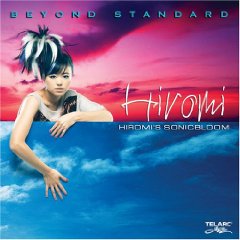
Hiromi Ueharas career burst wide open in 2003 when Ahmad Jamal discovered her demo and produced her successful debut for Telarc Records. Since then, the 30-year old pianist, composer and bandleader has recorded five CDs as a leader, including the most recent, Beyond Standard, featuring her group Sonicbloom. Earlier this year, Hiromis live encounter with Chick Corea at the Tokyo Blue Note was released as the double-disc Duet (Concord), and her session with Stanley Clarkes trio has now been issued as Jazz In The Garden (Heads Up). This conversation took place during a live radio broadcast on WPFW-FM, in Washington D.C.

Youve worked frequently in a trio setting. How has the addition of guitarist David Fiuczynski changed your vision or concept as a composer?
Ive been a huge fan of Davids for many years, and I love his band, Screaming Headless Torsos. He was a guest on my debut album and I knew that I wanted to make an entire record with him. So I had him in mind when I wrote all those songs.
The new CD, unlike your previous records, consists mostly of compositions written by others. What drew you to these specific songs?
I wanted to collect the songs that Id been listening to and playing for at least the past 10 years. These are the songs I grew up with and kept playing in many different ways. And with this band I have now, playing standards is like the furthest thing from what wed been doing before. So I thought its a great combination [laughs].
Youre from Shizuoka, the part of Japan known for motorcycles (Suzuki) and musical instruments (Yamaha). Did you grow up with a piano in your house?
Yes, but I went to my piano teachers house to take lessons.
Did your teacher work through classical repertoire first?
Yes, and she was also the one who introduced me to jazz. When I was eight, she played these records of Erroll Garner and Oscar Peterson, and I instantly fell in love with them. She saw me dancing to the music, so she kept playing me jazz records and I kept imitating what they were playing.
Did she teach you how to improvise?
No, she never did any studies for jazz. She was purely a classical teacher and she taught me to play the piano. The other things I just learned by ear.
You were already a professional musician when you enrolled at the Berklee College of Music. With whom did you study?
At Berklee, I was studying jazz composition and arrangement, so I had writing teachers more than deep piano teachers. I did take some lessons from Ray Santisi, but my main study was orchestration and big band arrangement.
You can buy books written by arrangers explaining their methods. What did they teach you that you couldnt find in books?
Basically, I was studying about instruments that I dont play. It started with horns and strings, then quartets and larger ensembles. The best thing about Berklee is that right after I wrote something, I could hear it live. Every week you could bring your new piece to the Project Band and you can have it played. When you hear what it sounds like, you can fix your charts.
Did you initially think you would be a studio composer or arranger? Or did you always have it in mind to be a soloist and a bandleader?
I always knew I would be a pianist. And I knew I would play what I would write or arrange. Ive been writing since [I was] six years old. I kept a musical journal and every day I would write something that touched my heart. So its not a special thing for me to do, it is daily life.
Do you look through the journal periodically to see if you can use something from years ago?
Yes, because a lot of those things are not completed. They may be fragments of songs that were just 16 bars, and I hope to finish those things while Im still alive.
Do you ever dream about music?
I would love to play with an orchestra.
No, I mean when youre sleeping, do you ever hear music in your dreams?
All the time.
Do you wake up and reach for notation paper?
Like John Lennon? [laughter] Maybe once or twice, its not that easy.
How did studying composition and arranging help you as a trio or quartet leader?
To know the instruments you dont play definitely helps. I dont just write the chords. I write all the lines so that it can be contrapuntal.
Do you write out the drum parts?
I do write rhythms when I want orchestrated parts, and I have specific ideas of rhythms. I have completely locked parts and complete freedom parts, with just one or two chords where you can go where ever.
In the locked parts, is the band allowed to make changes during performance?
Yes, but it depends on the parts. Id rather not change the parts that have more classical elements.
The reason I ask is because youve been on this tour for a while and youre playing material from the new record. Surely the music undergoes changes on the road, or is it just the solos that change?
The improvisation for me is not only the notes. Its also about dynamics, how you play the melody, how you phrase it. Even if youre playing the same melody, its never the same. So I tell the band to look at each other to see what kind of breathing we take today.
Are you a tough leader?
I think so [laughs]. My band once told me that the band should be called Hiromis Boot Camp. When you see or create an image of what you want in your music, you have to be tough, I guess.
What do you think makes a good leader?
[The] Most important thing is you have to respect your musicians. Then you have to respect the music to be able to say what you have to say, and make the music closer to what you want it to be. But you also have to be open for what musicians might suggest, because they know about their instrument more than me. And it helps to be flexible, because sometimes I can be stubborn [laughs].
Have you always been a leader, or did you ever work as a side woman?
I just did. I recorded for Stanley Clarkes trio, with Lenny White on drums.
So how is that different, when you just show up as a hired gun?
Its very different, because I have to sense what Stanley wants and what hes looking for, what kind of motion picture he has in his brain. When I play, I like to have a certain visual image in my head. And I have to fit with what the bandleader wants it to be. So, its a lot of sensing.
Do your collaborators ever explain or describe what they have in mind? For example, how did it work with Chick Corea?
With Chick, it was 99% improvised.
Did you discuss which tunes youd play?
Yes.
Who would take first solos?
No. It just happened. Wed just look at each other, and when I dont hear him start soloing for the first two seconds, then Id go, or sometimes hed go. It was very organicnothing was fixed. It was quite an amazing experience.
It requires trust to do that. How did you and Chick establish that trust?
I met Chick for the first time when I was 17. I lived in Shizuoka and I was taking some lessons in Tokyo. That same day, Chick happened to be in the building where I was taking lessons. I got so excited and I wanted to say hello. I knocked on his door and told him: 'Wow, Im a big fan, Im so happy to meet you in person, thank you so much for the inspiration,' blah, blah. He asked me what I played. I said piano, and he pointed to the piano there and said, 'Play something for me.' So I played one of my pieces. There were two pianos there, so when I finished he began to play and we started to play together. When we finished, he asked, are you free tomorrow night? Do you want to play in my show? That was one of the craziest events of my life. I wasnt planning to spend the next day in Tokyo, so I had to book a hotel and stay over. I was only 17 and I called my mom and said, I dont know what happened but I think Im playing with Chick Corea tomorrow night. And he called me at the end of his show and I went up and played with him. It was a completely improvised song, kind of a call and response thing. Then, ten years later, the Tokyo Jazz Festival asked me to do a duet concert with Chick. So we played together for about an hour, and this time he asked, do you want to make a record? [sighs] He always surprises me.
So of course you said yes.
I said yes, and then I left his room and ran down the hallway going AHHHHHHHHH! I was running all over the place, I was so happy.
How was the second experience with Chick different from the first time?
When I was 17, I didnt understand anything. I dont even remember what I played, it was too much for me, I guess. But when I was 27, I was more controlled and I understood what was going on in each bar. I could do my best to respond to what he played and get the best out of the duet experience. I enjoyed it very much. And a year later we did this duet session at the Blue Note in Tokyo. That was an amazing experience because it was the first time I played with him three days in a row, two sets each night. Every minute of it was a learning experience.
Did you prepare?
A couple of emails; like what do you want to play, which originals do you want to bring?
How does it feel to play with your heroes? Is it ever intimidating?
I think my happiness and excitement wins, I guess. Playing with Stanley and Lenny was just a gift. Theyve been playing together for 40 years, so its amazing. They dont have to talk about anything; they know what each other needs. Its like a 40-year married couple.

When you record with Stanley and Lenny, or with your own band, is it all done live in the studio? Are they first takes, or do you do any editing?
No, its all done live. I live for performance.
You seem to have fun on stage.
I do.
Can you say what the best part is?
When I see people smile. The day I knew I would be a pianist, I was 12 years old. I did my first concert abroad in Taiwan. I didnt speak a word of Chinese and I didnt know what the MC was talking about. I just knew when they tapped my shoulder I should go out and play a couple of songs. When I finished the first song, all these peoples faces just lit up. They were so happy, and I said, 'Wow.' I had heard about this, the power of music. It transcends everything. So I wrote this sentence in my journal: 'I want to make people happy with my music.' And thats always been my goal.
Audiences who spend a lot of time with your recordings, they want you to play just like the record, because that will make them happy.
[laughter] Right, thats true.
So how do balance making your audience happy, and making you and your musicians happy too?
I never play the same thing I play on the record. I believe in the things that can only happen on that very day.
You have strong technique on all your instruments. Do you ever write things for yourself that you cant play?
All the time [chuckles]. All the time, thats why I keep practicing.
Do you then create the technique to play it?
People tell me that Im technically good, but I never thought so because there are so many things I cannot play. I never feel like I conquered the piano.
No one ever does, do they?
But seeing all these amazing pianists that I love, like Vladimir Horowitz, they have a deep understanding of the piano. Im not even close. Theyre really the masters and Im far from it, so I have to keep practicing.
Whats the difference between somebody whos good and someone who is a master?
The masters have very colorful voices. They have millions of voices in piano. Like in dynamics, they have a hundred different ways of playing pianissimo.
What do you do on the road to keep your technique up?
I bring a keyboard with me, and I can always practice on the table, for dexterity and to keep the muscles working [demonstrates by tapping her pinky on table top]. Sometimes I do this on the airplane and the person who sits in front of me gets so annoyed, so I try not to do that.
What are you listening to these days?
Michael.
Michael?
Jackson [laughter]. I have to.
Your favorite Michael Jackson tune?
'Smooth Criminal.'
Why? What do you like about it?
Everything. I dont know I just love that piece so much.
Have you thought about trying to incorporate it into your show?
No. To do the piece that you didnt write, you have to have a version thats as unique as the original. And I cant think about making a unique arrangement of 'Smooth Criminal.' Its perfect.
So you grew up listening to Michael Jackson?
Yes, singing the songs and trying to imitate his dancing. I was always hoping he would do another record. I had huge respect for how much skill he had: as a singer, producer, writer, his dancing and how he dressed. He was a complete package, in his own world. It wasnt just music. Michael Jackson was one art piece. Hes everybodys hero, I guess. You have to go through him somehow.
Who are your heroes outside of music?
Bruce Lee [laughter].
Do you study martial arts?
No I dont. But I think martial arts and improvised music are similar because you need the conscious effort and discipline for practicing, and you have to improvise when you fight against enemies, right? And for me, the enemy is myself, because I have to play against what I played yesterday. Im always trying to play something I didnt play in the past, so Im always fighting against myself.
And who wins?
It depends on the day [laughs]. Its hard, especially if I see the beautiful landscape of music the day before, then its more difficult the next day. But I love it. I love taking risks in music, to not take the same route. Its like if youre mountain climbing and you see a beautiful waterfall. And youre tempted to go back the next time and take the same route and see the same waterfall, but its never as beautiful as it was yesterday. So I try to go somewhere else in the bush, and maybe there is nothing in there, but its better than repeating the same route.
Youve collaborated with other pianists, not just Chick Corea, but also Michel Camilo and Ahmad Jamal. Which other pianists would you like to play with?
Oscar Peterson.
That will be difficult. Did you get to know Oscar?
Yes, we met, and then later I opened for him when he did a 4-city tour of Japan.
But you never played a duet with him, not even backstage?
No, and I never played with Ahmad, either. He produced my first record and hes the one who opened my career in the States and everywhere else. Thats another crazy story that happened to my life. I was studying at Berklee and one of my teachers really liked what I did for my mid-term project. So he asked me to bring some more things in and I brought my demo tape. Then he asked me, who is this piano player, because he only knew me as an arranger. When I told him it was me, he said he wanted to have his best friend listen to it. His best friend turned out to be Ahmad Jamal, and he played it for Ahmad over the phone. And Ahmad called me for lunch, we talked, and he introduced me to Telarc Records. And all these things happened suddenly. Wow, it was crazy.
As a pianist and musician, how do you measure success?
[long pause] I dont know. I dont really have a big picture. I only have every day a very simple goal, to make people smile. Thats success for me. Its the hardest goal, but I just have to keep doing that every day.
Larry Appelbaum interviewed Hiromi on August 2, 2009.
Tags:
August 09, 2009 · 0 comments

Comments are closed.