The Jazz.com Blog
January 29, 2008 · 8 comments
Remembering Bill Evans
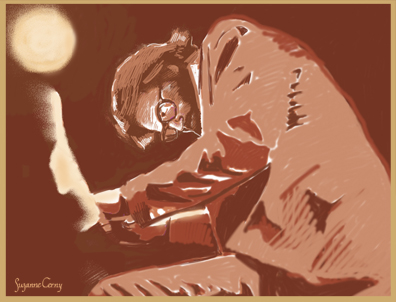
Bill Evans, artwork by Suzanne Cerny
On Friday September 5, 1980 I was waiting next to the bandstand of the Keystone Korner in San Francisco, anticipating the performance that evening by pianist Bill Evans. Little did I know that ten days later, Evans would be dead. The official cause of death would be a laundry list of sufficient causes: bleeding ulcer, cirrhosis of the liver and bronchial pneumonia. But a more accurate description might be blind self-destruction, fueled by an out-of-control cocaine habit. Evans was fifty-one years old.
I had secured my favorite location in the club: the front row on the left hand side, where I was only a few feet from the piano keyboard. I was so close, I could almost reach out and add a few notes to the performance, if I felt so inspired. I had enjoyed many great piano players from this same spot—McCoy Tyner, Jaki Byard, Tommy Flanagan, and others—and I would always make sure to arrive early in order to secure this choice real estate in the small and often over-crowded club.
Seeing Bill Evans live was a special treat. I was twenty-two years old at the time of the Keystone Korner gig, and had been listening to Evans' music since my high school years. In all honesty, my earliest experiences with his recordings had made only a modest impact on me. I probably had heard more than a dozen Bill Evans LPs while I was still in my teens. But I listened voraciously to all the jazz I could find back then, and the Evans albums were just part of my general and on-going musical education. The great "Aha!" moment was still to come for me. It arrived when I discovered Evans' 1961 Village Vanguard recordings (with Scott LaFaro and Paul Motian). These performances had an over-powering impact on me, changing my evaluation of Evans and radically altering my concept of what a jazz rhythm section could and should do.
My earliest introduction to Evans had been through his work with bassist Eddie Gomez, and though this music was often fascinating and smartly played, it lacked the emotional depth I heard in the Vanguard recordings. And the interactivity between Evans, LaFaro and Motian seemed to exist on a higher plane than I was used to encountering in almost any jazz setting. At first I listened to the Village Vanguard recordings, but I soon moved beyond that into memorizing and studying them. When I moved to England to pursue graduate studies in philosophy in 1979, I only had room in my suitcase for a handful of records. Sunday at the Village Vanguard was one of the first selections to go into the bag.
Almost every track from the Vangaurd is special. The trio takes "My Foolish Heart" at such a slow tempo—much slower than what was considered an acceptable ballad tempo back then— that one fears it is like trying to ride a bike at a snail's pace. Won't the whole thing just topple over? But (surprise!) Evans and company discover a realm of relaxed and centered improvisation almost more akin to meditation than to jazz music. On "Gloria's Step," Evans and LaFaro ignore every rule ever set on how bass supports the piano in a jazz band, yet achieve a musical mind-meld that you could never reduce to a textbook formula. On "My Man's Gone Now" or "Detour Ahead," the three musicians seem to have left notes behind, and work instead with a vocabulary of emotion and mood, one that defies all the lick-based improvisation models of swing and bop, hot or cool. In fact, there is not a single musical phrase from the Vanguard live recordings that sounds like it was worked out in a practice session beforehand. For my generation—made up of practice room wonks who digested ii-V licks the way Scooby Do ate Scooby snacks—this was a radical departure from the norm. You could memorize the Slonimsky Thesaurus of Scales and Melodic Patterns from front to back, and it wouldn't get you an inch closer to improvising at this level.
Recently Marc Myers, who runs a great blog at JazzWax (and occasionally contributes to jazz.com) took some heat for suggesting that Bill Evans' greatest music was made during the 1959-65 period. I tend to agree with Myers— although I might stretch the glory years a little longer in order to encompass the Alone solo piano session from 1968. I have been working on an article for jazz.com on essential Bill Evans tracks, and I find myself gravitating back to his recordings of the late 1950s and early 1960s, which still hold their power over me. Not that there weren't great examples of music-making from the later years, but Evans got into a comfort zone during most of the 1970s, relying on the same songs played with the same musicians, night after night, year after year. In all fairness, I must say that Evans never played badly—even in those final days before his untimely death -- and almost every recording he released had merit. But few moments in these later works would make fans forget the earlier legacy, with its magical telepathy and zen-like immersion into the musical flow. And who could blame Evans for falling short of these exemplary performances? He had simply set the standards too high in his late 20s and early 30s. Any pianist (Evans included) would have trouble rising to this level, night after night, recording after recording.
My favorite recordings of Evans in the later years came when he was forced out of his comfort zone. His 1974 Symbiosis project with Claus Ogerman puts him in front of a large orchestra, playing a long and complex piece, and Evans is jarred into a brilliant performance. Back in the 1950s and early 1960s, Evans had worked as a sideman in very challenging settings—with Miles Davis, George Russell, Gunther Schuller, Charles Mingus, Oliver Nelson, Cannonball Adderley and others calling the shots— and the intensity of these experiences had spurred him into a series of extraordinary performances. Symbiosis is a throwback to this earlier period, and reminds us how Evans had established himself, in his late 20s, as the most in-demand piano sideman in jazz. Other 1970s encounters with Stan Getz or Lee Konitz or Tony Bennett were also memorable, suggesting that Evans could surprise us if he was forced to match wits with another legendary talent. The encounter with Getz in Europe during the summer of 1974 was especially revealing, since the two players openly feuded on stage—at one point, Evans even stopped playing piano in silent protest—yet the chemistry of the music itself was potent and beyond reproach.
Evans benefited from the arrival of new trio members toward the end of the decade. Marc Johnson and Joe LaBarbera forced Evans to reinvent himself, and the body of work this trio left behind (most notably their live recordings in Paris) reveals a new tautness and vigor in the pianist. Eddie Gomez, a great bassist by any measure, may have simply made performing too easy for Evans—the recordings he did with Evans almost seem effortless. But more than a few fans liked Evans better when he was under a little pressure on the bandstand. The new sidemen did just that. They worked hard for their money, and their energy level was contagious, spurring and prodding their famous employer. In his early 50s, Bill Evans seemed ready to embark on a new period of self-discovery.
This was the band that Evans brought the Keystone Korner for this late, great gig a few days before his death. Yet the first impression they made that evening was far from positive. My date for the evening leaned over and whispered in my ear: "Bill Evans looks terrible." In truth, his face had an unhealthy pallor, and he seemed drained of energy.
But the music itself belied these appearances. The trio attacked the songs they played that night. One might think that Bill Evans at the end would return to the introspective romanticism of his early work—after all, that would seem an easier route for an ailing man than to try to reach a high level of intensity. But Evans did not go gently into that good night. His playing was acerbic and biting, almost completely purged of sentimentality. Johnson and LaBarbera were playing at top form, and also shared some of the aggressive vibes coming from the piano bench. The trio stretched out at length on the song "Nardis," which Evans seemed to enjoy as a musical sparring partner in these final days, and the music was hot and brittle. But the moment that—at least in retrospect—was most telling, was Evans' sardonic performance of the "Theme from M.A.S.H." —also known as "Suicide is Painless." He played this song frequently in those final days, and it was an ironic choice given that what Evans was inflicting on himself off-stage, with countless injections of cocaine and a steadfast refusal to seek medical treatment, was little less than a pre-meditated suicide.
One hopes that for Evans it was, at least, relatively painless. But all the evidence points to the contrary. Gene Lees, who knew Evans well, once called his death "the longest suicide in history.'' There were many warning signs along the way—not just in Evans' behavior and lifestyle, but even in his past relationships. Bill's brother Harry, who suffered from depression, had committed suicide in April 1979. Years earlier, Bill's wife Ellaine had also taken her own life by throwing herself under a subway train.
A few days after the Keystone Korner engagement, Evans was in New York for a gig at Fat Tuesday's, when he could no longer ignore the warning signals from his deteriorating body. Suffering from acute stomach pains, he asked LaBarbera to drive him to the hospital. Evans checked in at Mount Sinai, where he died on September 15, 1980. He was buried in Baton Rouge, Louisiana, next to his brother Harry.
The tribute recordings began shortly after his death. Even artists who had seemed far distant from Evans' musical values—his adherence to acoustic instruments and old popular songs and chord-based improvisation -- joined in on the celebration of the now departed pianist.
Some forty or so tribute recordings have been released over the years. The most impressive of these was one of the first to appear. Herb Wong, working with Helen Keane, put together an all-star line-up of pianists, perhaps the most impressive collection of keyboardists ever assembled for a single project. The resulting Bill Evans: A Tribute boasted the following participants:
Herbie Hancock
McCoy Tyner
Chick Corea
Teddy Wilson
George Shearing
John Lewis
Dave Mckenna
Denny Zeitlin
Jimmy Rowles
Richie Beirach
JoAnne Brackeen
Andy LaVerne
Yet this unprecedented recording, released initially as double LP on the great (but short-lived) Palo Alto Jazz label, quickly disappeared from the marketplace. Finding a copy today is not an easy task. Then again, keeping great music out of print and unavailable is a time-honored tradition in the jazz world, refined to a high art, especially by the major labels. Perhaps they believe that we wouldn't value this music half so much, if it were easy to purchase and hear.
Other artists offered their own personal tributes to Evans. I especially recommend Richie Beirach's Elegy for Bill Evans (alas, also a challenge to find), John McLaughlin's Time Remembered, Jean-Yves Thibaudet Conversations with Bill Evans and the newly released Something for You featuring pianist and singer Eliane Elias. One of the tracks ("Waltz for Debby") from this last CD was recently featured as Song of the Day on jazz.com. Tribute recordings by Fred Hersch and Jessica Williams also stand out as fitting memorials to this master musician.
Evans' reputation is secure. In fact, he is one of the most frequently imitated musicians in the history of jazz music. His chord voicings, his way of constructing phrases, and many of his other musical mannerisms, can be recognized in the recordings of numerous pianists. You don't need to buy a Bill Evans tribute CD to hear the homage of these followers. The marks of Evans' impact on the jazz world are everywhere, and by now much of this influence is indirect. Even a young player who never sought out a Bill Evans recording would pick up on his vocabulary through others who learned first hand from the original source.
Even so, I think that the deepest lessons of Evans' best work have not been fully assimilated. His greatest contribution to the jazz idiom cannot be boiled down to hip chord voicings or a certain approach to constructing improvised lines. His finest moments stand out for their psychological and emotional depth, for their willingness to embrace a fragile, elusive truth that too often gets swept aside in the rush of jazz improvisation. Evans' muse ran counter to the glibness of the jazz world—a glibness perhaps inevitable in a musical style that prizes intensity and fire and macho posturing so highly. Perhaps it is a miracle that Evans' distinctive work ever made its way in the world, cutting through the noise of the 1950s jazz scene, or that he himself—also fragile in his own way—was able to sustain it as long as he did.
This blog entry was posted by Ted Gioia.
Tags:

BIll's death was painless. It was his life that was an exploration of suffering..pain and joy and in all ways beauty.
Great article.Thanks! I was wondering if there's a documentary about Evans (in addition to the one from 1960s with his brother) I could use in the classroom?
Enjoyed reading your article, Ted.
I fully agree with your conclusion in the final paragraph, about Evans' "emotional depth" being his main legacy.
The observation I would like to add is that his "chord voicings" and "approach to improvised lines" do not really stand apart from the "emotional depth" in his music.
Rather, these elements (voicings and improvised lines) are used, in his own, very special and distinctive way, to construct the emotional depth of his music and convey it to his listeners.
It's always touching to read about Bill from young fans like Ms. Cerny. I met Bill in 1951 at the U.S. Navy School of Music, Washington, D.C. where we were both stationed for training to be in Special Services for our term of duty. Bill was US Army , me, Navy. He played flute in the orchestra and jammed/practiced the rest of the time. He was not required to take the music courses at the school because of his advanced musicianship at that time; he was only 21. I would sit outside the his practice room and listen with awe as he sight read at the piano, through the "Rite of Spring" orchestral score!! I got to play for him during this period; and he was very encouraging. My teenage years were soley taken up with the worship of Lennie Tristano. I now had another inspiration to look up to. I think it's important to have musicians to look up to for inspiration. It's the music that counts not the personality, necessarily. When I heard in 1958 from John LaPorta that Bill was on drugs, I refused to believe it. The Bill I knew from the military days in D.C. was that of an athelete, intellectual and happy-go-lucky musician with a supreme gift for music making. We know with pain in aor heart what he habits did to his life. How he managed to compose, play and record all that he did in 51 years is the miracle of the century. But Chopin wrote more music than Bill in his allotted 31 years! Bill s legacy will rise above all other 20th geniuses by 2080. And in 3000 Evans name will be remembered for the next 1000 years as our CHOPIN! MORE TO COME--------- JACK REILLY March 7th 2008.
Dear TED, Mia culpa! I didn't pay attention to notice that you wrote this wonderful piece on Bill. Please forgive me. Please accept the following to dissolve my red face! May I send you my new cd, "INNOCENCE-THE GREEN SPRING SUITE"? IT CONTAINS MUSIC I COMPOSED WHILE OVERCOMING A LIFE THREATENING ILLNESS. CALL 732 818 0840 OR EMAIL ME AT; kreyljilca@hotmail.com to give me a postal address. I feel badly about the error. All the best and Thank you again for your wonderful story, Remembering Bill Evans. He's in my thoughts daily. Jack Reilly,
I love this piece. I am particularly fond of the latter day Evans-when his harmonic reconfigurations of "familiar" titles and his heart were so wonderfully meshed. The trio with Marc Johnson and La Barbara was singing. There is no other way to say it.
reading all these comments six-to-eight months later seems a perfect example of sad irony, these correspondents' final letdowns as depressing as Bill's useless suicide-by-cocaine. surely he wasn't too stupified to know what was occurring, but was instead something like willfully willing the end. the pianist that Ted observed up close was finally about to achieve his Peace Piece...
Didn't Dave Frishberg also play on that tribute-album? I remember having heard Cole Porter's "Night & Day" ... on a radio broadcast with the late Joachim-Ernst Berendt when the album came out in Germany.