The Jazz.com Blog
October 14, 2008 · 2 comments
A New Label in the Jazz World
Many jazz lovers dream of starting their own record label, but few have the passion and drivenot to mention the willingness to take on riskthat can turn that dream into reality. Jazz.coms Bill Barnes looks at George Klabin, the guiding light behind Resonance Records, a Los Angeles-based independent label which recently set up shop. Below is the first installment of a two-part article. T.G.
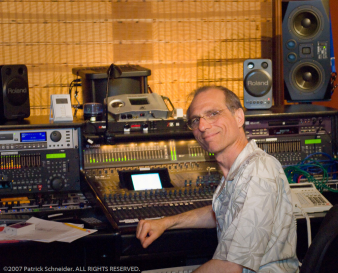
The art of jazz may be alive and well in the twenty first century, but the business of jazz is another animal entirely. In fact, you could say its on the endangered species list. Like the polar ice cap, audiences (at least in America) are melting away while the overall music industry has been battling a paradigm shift in technology and market trends.
Rampant pirating, unauthorized duplication, personal digital devices and a dicey global economy are all factors taking their toll on established record companies. To combat shrinking customer bases and declining revenues, traditional jazz labels like Blue Note have fallen back on re-releasing gems from their archives while seeking out new crossover artists to attract a broader audience. There are very few opportunities for new musicians, especially those without a pedigree (i.e. played with So and So) to get recognition. Its even tougher for a new record company to survive, much less thrive, in this turbulent environment.
Well, now theres a new sheriff in town, pilgrim: Los Angeles-based Resonance Records, the dream child of an idealistic mainstream jazz proponent from New York, who is also one of the recording industrys pioneers.
Back in the turbulent, swinging sixties New York City was the place to be for jazz disciples, who could hear the crme of the avant garde, trailblazers such as Ornette Coleman, Cecil Taylor, John Coltrane, Bill Dixons October Revolution in 64 magic and musical history were being created, night after night. In the thick of it all was a young Columbia student and mainstream jazz enthusiast named George Klabin, who ran jazz programming for WKCR, the universitys radio station. Although his sensibilities remained firmly in the mainstream, George recognized the importance of this brave new whirl and wanted to help give it more exposure.
As luck would have it, Bernard Stollman, founder of ESP Records, called him to do some engineering and subsequently brought him into contact with some of these avant garde players. Seeing an opportunity to move beyond the university stations standard format, George began inviting emerging icons such as Keith Jarrett, Charles Lloyd and Gary Burton into the stations studio, where he recorded their sessions on a professional quality two-track tape machine. His love of the recording process had been ignited- soon he was expanding his efforts beyond the studio, recording the musicians at their gigs. He captured the first Vanguard performance of Thad Jones-Mel Lewis on tape and would later record performances of Bill Evans, Keith Jarrett, Les McCann and Charles Lloyd with Gabor Szabo. George Klabin had found his calling.
In 1968, George graduated Columbia and started recording for Don Elliot, who had a small and, at the time, state-of-the-art eight track recording studio in midtown Manhattan. Don Schlitten, the head of A&R for the Prestige label was impressed with the young engineers work and put him in charge of recording such artists as Dexter Gordon, James Moody and Barry Harris. Less than two years later he met violinist Harry Lookofsky, who had recorded the amazing album, Stringville for Atlantic. Together they created a studio on Broadway and 48th Street, which they expanded to 12 tracks with the purchase of the very first API console [Automated Processes, Inc., a pioneer in the development of multi-track recording consoles] ever made. That studio became Sound Ideas and recorded everything from commercial jingles to motion picture soundtracksand, of course, jazz.
When Capitol Records pulled out of their studio on 46th Street in 1973, George and Harry rented the facility, which had one of the few orchestral-sized recording spaces in the city at that time. It was there George recorded the commercial mega-hit, A Fifth of Beethoven, five James Brown albums, as well as LPs with jazz greats Sonny Stitt, Archie Shepp and Frank Foster. He also mixed the first Brecker Brothers album and many of the Strata East jazz releases. Established jazz labels ECM, A&M and ENJA took advantage of the studio and he worked with Quincy Jones on two projects, including the eminently listenable album Smackwater Jack.
The sixties may have represented an apogee in jazz evolution, but George Klabin considers the decade of the seventies to be a zenith for jazz recording. He makes a salient point; it was a time of a near-perfect union between musicians and the technical people responsible for preserving their performances. So many groundbreaking musicians were recorded in this period, their work captured in brilliantly mixed sessions and released to an enthusiastic record-buying pubic: Chicks Return to Forever,Weather Report, Herbies Headhunters and VSOP, McLaughlins Mahavishnu Orchestra, Creed Taylors CTI releasesthe list goes on and on. And then, along came digital technology.
In the latter seventies, Denon of Japan chose Sound Ideas to record their series of jazz releases, employing their proprietary 8 track Digital PCM recording system. This was the first time that multi-track digital was used to record jazz in the United States. At the end of the decade Sound Ideas became the first recording studio on the East Coast to install a 3M 32-track digital system, on which they recorded a broad range of artists from Billy Joel to Barbra Streisand. Nowadays its easy to forget just how revolutionary digital recording really was in the seventies and what staggering implications it would have for the recording industry and its potential for the art of jazz. Buddy Richs breathtaking digital LP, Class of 79 had been recorded live, direct-to-disc, in one take, portending digital technologys limitless role in capturing the energy and joy of great performances.
But, if the seventies were the best of times for recorded jazz, the worst of times were soon to follow. 1980 began the decline of the jazz audience, George laments. Lest we forget, the eighties became know as the Me Decade, when Reaganomics ushered in an era of unprecedented conspicuous consumption, while the conservative administration slashed public funding for the arts. The dumbing-down of America had begun. Coke-snorting Wall Street raiders marched to the beat of synthetic drummers at Studio 54 while live jazz venues began to dry up and jazz audiences began to disappear. Ironically, digital recording, heralded for its potential for capturing the integrity of jazz virtuosity, became the vector of mass-marketed, cookie cutter smooth jazz, touring the elevator-supermarket circuit. It also enabled the proliferation of small studios offering bargain-basement rates, which seriously imperiled the economic survival of the larger, fully-equipped professional studios.
Disillusioned, George closed the doors to Sound Ideas and went on to pursue other things. With the advent of the personal computer explosion, he went into IT, eventually moving to Los Angeles in the early 1990s. But he couldnt stay away from the music he loved for long. Striking up a friendship with the owner of Santa Monicas popular jazz mecca, The Vic, he began recording some of their acts live, using a 24 track portable studio. I was able to get amazing recordings. The sound was very good in the room. Soon he was building a new studio and was back in business.
Unfortunately, the legacy of the eighties remainedcutbacks, limited budgets for music education in public schools and a street culture which generally rejects the more cerebral forms of expression have contributed to the marginalization of U.S. jazz. Its dying man, George says frankly, when asked about the state of the art. Thats not to say there arent great jazz musicians, composers and arrangers out there now. Indeed, amazing talent emerges every day, in some unexpected places- Sweden, Romania, Japan, Norway people all over the world are playing and digging modern jazz. But in post-millennium America, too many musicians starve and struggle for recognition.
This was George Klabins impetus behind the creation of a non-profit corporation as the foundation of a new jazz label, which, in itself was a real stroke of genius. I started this to protect and nurture the quality of the art form. And so, the Rising Jazz Star Foundation was launched.
This is the end of the first part of Bill Barnes blog article. For part two of this article, click here.
Tags:

I'm pretty sure that the 70's were the "Me Decade" not the 80's. Also, I think of Studio 54 as more of a 70's thing (the Rubell/Schrager era ended in Feb. 1980)...though it did survive in a second incarnation to the mid-80's.
While its true that Tom Wolfe had coined the phrase in his 1976 New York Magazine feature, "The 'Me' Decade and the Third Great Awakening," the hedonism of the 1980s far exceeded that of the late seventies, a period when many young Americans were recovering from a long, brutal war and adjusting to the social and political changes of the sixties. Studio 54 was indeed at its zenith in the late seventies, but was still a place where yuppies did their white powder-enhanced networking. (Sad to say, I actually attended one of Jerry Rubin's mixers there in 1981!) But, technically speaking, John Mc is correct.