The Jazz.com Blog
October 29, 2008 · 0 comments
Milton Nascimento in New Jersey
Tim Wilkins, who covered Toninho Horta’s recent concert in this column earlier in the week, returns below to the subject of Brazilian music. Many concerts and CDs are celebrating the fiftieth anniversary of the birth of bossa nova this year, but one of the finest tributes comes from Milton Nascimento, who has released an exceptional CD featuring a number of classic Jobim songs. (A track from this release, "Chega de Saudade," is currently featured as Song of the Day at jazz.com.) Wilkins reports below on Nascimento’s Sunday performance at NJPAC and his conversations with the band. T.G.
So what exactly are "novas bossas?" Well, if bossa nova was the "new thing" from Rio in the fifties, then Novas Bossas, the name of Milton Nascimento’s new CD, suggests there's more than one thing from Brazil worth listening to these days. But rather than speculate, I wanted expert advice—so I caught up with Milton Nascimento and the Jobim Trio after their concert at the New Jersey Performing Arts Center (NJPAC) on Sunday, October 26.
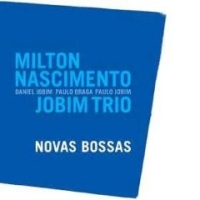
"It's a desire for new things to happen," said Paulo Jobim. "When we got together with Milton, it inspired us to have new ideas, and to think of bossa as something that's not strict or closed off." Nascimento and the trio of Paulo Jobim on guitar, Daniel Jobim on piano and Paulo Braga on drums, thus chose the phrase to title their new album, just released by Blue Note. The disk includes subtle reworkings of bossa nova classics as well as songs by Milton and Daniel.
Novas Bossas, like much of Brazilian music, is a family affair. Daniel, thirty-five, is the son of Paulo, who is the son of Tom Jobim, bossa nova's greatest composer. Paulo played with his father frequently, as did Braga, Tom Jobim's drummer of choice in the last twenty years of his life.
Braga has known Nascimento since 1963, when they played together in the Berimbau Trio, a samba-jazz group, with Milton on upright bass. Paulo Jobim toured with Nascimento in the seventies, at times with Daniel in tow. Nascimento once dedicated a concert to the three-year-old boy as a birthday present. More often than not, they would all end up at Nascimento's beach house in the summertime.
Tom Jobim held Nascimento's voice—with its compelling power in the bass range and affectingly fragile falsetto—in high regard, and once asked him to record his compositions as a guide to how they should be sung. Tom, who died in 1994, also asked Braga to help convey the spirit of his music to a new generation.
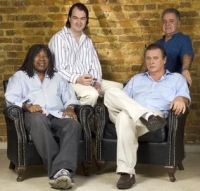
The opportunity to fulfill these promises came last year, when the Trio performed with Nascimento in Rio's Botanical Garden. That set off multiple musical lightbulbs, and they began looking for more opportunities to collaborate. They recorded Jobim's "Samba do Avião," which is on the CD, for a popular soap opera, then convened at Milton's house to pick other songs to record.
The result, recorded in Milton's basement, is Novas Bossas. The songs are essentially live takes, with minimal overdubs and production. This may surprise some, given the sophisticated air of the recordings, which is more the result of the relaxed atmosphere of these sessions than of studio magic.
Milton wanted to record Tom's songs, while the Jobims wanted to record songs by Milton—so they compromised on a slate of eight by Tom, three of Milton's hits, two more bossa nova classics and one by Daniel, which Milton overheard playing from his laptop, and liked. That song, "Dias Azuis," communicates the central idea of Novas Bossas: the feeling is entirely bossa, with a relaxed, lilting pulse and wistful lyrics. Yet here and there are touches which might clash, but don't: electronic keyboards, and Braga's powerful brushwork, drawn from his years playing with Brazilian funk and soul stars.
"You can make whatever mixture you want in bossa, because it's open," said Daniel. "Just like jazz embraced bossa, bossa can embrace all kinds of other things. . . . Yes, I'm a bossa musician, but it's a natural thing. "Whatever I do turns out that way – it's a sensibility, a way of playing gently, which is a different sound."
Like another young Brazilian with a famous last name, Moreno Veloso, Daniel's career will be worth watching. He has a fine, understated singing voice, which Nascimento gently balances with harmonies and counterlines drawn from his own identity as a musician from the landlocked state of Minas Geraes, not Rio.
Some say Minas musicians were inspired by Gregorian chants, and in Nascimento's case this makes sense: his minor-key compositions, such as "Cais" and "Tarde," are modal and atmospheric in their exploration of intervals more than harmony. Yet this sensibility, too, feels at home here: the deep longing and sense of loss in his voice are pure bossa. As are Ben Webster's ballads. Or Billie Holiday singing "God Bless the Child."
But even Minas has more than one musical identity, as Nascimento explained. This is evident on the album's opening track, his 1973 hit "Tudo Que Voce Podia Ser" by his close collaborator Lo Borges, which demonstrates their affinity for, among other things, The Beatles' "Fool on a Hill." Like Brazil, Milton said, "Inside Minas, there are multiple Minas: each place you go is unique, with its own, different thing – but every so often they get together."
To further emphasize the idea that bossa can include more colors than we might expect, the album includes "O Vento" by Dorival Caymmi, which is in a similar minor mode, and "Medo de Amar," an often overlooked composition by Vinicius de Morães, better known as Jobim's finest lyricist, sung in a heartbreaking duet by Paulo Jobim and Nascimento.
On Tom's songs, Nascimento is best where the vulnerability of his voice illuminates the lyrics, on songs such as "Esperanca Perdida" and "Chega de Saudade." On this last, both on disk and in concert, he wishes sadness away with a potent incantation. But for every moment of minor melancholy, Novas Bossas offers an uplifting counterpart, such as Milton and Paulo Jobim's playful duets on "Brigas Nunca Mais" and "Trem de Ferro." In concert, Braga's propulsive, funk-inspired drumming kept the repertoire bubbling, and Nascimento threw in a few anthems, like "Maria, Maria," to satisfy pop-hungry Brazilians in the crowd from Newark's nearby Ironbound district.
But what about those novas bossas I was wondering about?
"It's just bossa!" Daniel explained. "But a bossa that's changing… maybe you can call it bossa nova nova." Paulo Braga agreed. "Cabe tudo!" he said with a smile. Or, in other words, "There's room for everything!" in bossa nova. "Just as jazz has room for new things, bossa has room for the novas bossas, and for all of the new things we'd like to do."
This blog entry posted by Tim Wilkins
Tags:

Comments are closed.