The Jazz.com Blog
October 06, 2008 · 0 comments
The Future is Punkt
When I heard the name, I knew it was a different kind of jazz festival: Punkt. You can tell right away that this is not your white-wine-and-brie type of jazz event. When the jam sessions start at Punkt, youre likely to see more software jockeys than saxophonists on stage. And who better to describe this iconoclastic event than our frequent contributor Stuart Nicholson, who covers more territorymusical and geographicalthan any other jazz scribe on the scene. T.G.
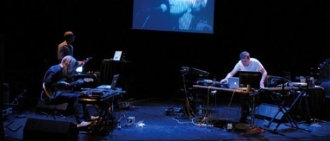
People dont just go to Punkt for the music, they also go there for a glimpse of the future. Artistic directors and DJs Jan Bang and Erik Honor subtitle the festival Live Re-mix, meaning a live concert followed by a live re-mix. And the re-mix is the essence of the festival, revealing the creative potential inherent in the interaction between musicians, DJs and electronic technology.
Held in the Agder Teater in Kristiansand, a town with a population of some 75,000 in the south of Norway, the concerts are performed live on the main stage and within ten to fifteen minutes, or as long as it takes for the audience to move downstairs to the Alpha Room, a segment of the concert (usually around 30 to 45 minutes) is re-mixed live by DJs, often with guest musicians interacting as well.
Welcome to the digital age. Science and technology is now transforming our lives in ways unimaginable ten or even twenty years ago. Today the average cell phone utilizes more digital technology than the spacecraft that put the first man on the moon. Punkt is a response to these changes, showing ways in which technology can change our very perception of what music is and what it might become in the future. It is also a sobering reminder that jazz did not evolve in a vacuum but was shaped as much by technological as cultural and social forces.
You only have to look at Billie Holidays art for an example of this, which would have been impossible without a major technological advance of the early 1930s, the electric microphone. Or look at how jazz changed when the LP broke through the three minute barrier of the old 78 rpm disc, to get a sense of this. Fast-forward to today where DJs argue that if music is stored on multi-track tape or on a hard disc, then there can be no such thing as a final mix, only an infinite number of possibilities. It is these possibilities Punkt sets out to explore.
Talking to Jan Bang over breakfast coffee, I put it to him that the DJs art is not so much about the means used to achieve an end, but the end it achieves and whether it commands are attention or moves or fulfils us in any way. I think the art lies not so much in revealing everything you can do as an electronic artista DJ if you like, he responded. Its more about using electronics in a way that is organic. Electronics can often sound overworked, theres lots of gadgets and boys like gadgets, but it is not about gadgets, its a way of finding what is right for the music.
When Erik [Honor] and I originally talked about our ideas for Punkt, we saw it as instead of sampling live music on stage, we said, What would it be like to sample a whole concert and work with different musicians deconstructing what has happened at the concert? So you had Concert A and Concert B, and Concert B starting with elements of Concert A, and that pushes you forward into places you would never have gone, creating something entirely new from what has just gone on before.
No longer, then, the DJ laboring long into the digital night in the privacy of the studio to arrive at a re-mix, but working in the moment to spontaneously select and reorder the flow of audio data. This futuristic manifesto was underlined by the appearance of Rafael Toral on the Agder Teater stage, who walked on looking like the cybernetically enhanced Steve Austin from the hit 1970s sci-fi TV series the Six Million Dollar ManGentlemen, we can rebuild him, we have the technology. Toral had thick wires and shiny electrodes strapped to his torso and head plus gloves with gleaming electrical contacts and each movement of his body triggered an electric tone. By doing a kind of underwater dance, he managed to produce an improvised electronic symphony of bleeps, buzzes and hums which he calls, post-free jazz electronic music shaped by physicality, movement and gesture.
But the fascination lay not so much in his performance, but what it became in the Alpha Room just minutes after he finished his concert. Here the electronic impulses of the concert were reduced to distant sonar-like pings as three soundmixers and guitarist Eivind Aarest created a total re-conceptualisation of what had gone before. It was pure sonic legerdemain, a sound-on-sound creation in the moment that took on a life of its own.
Toral was followed by a concert by Gavin Bryars, once a pioneer of free improvisation with guitarist Derek Bailey and drummer Tony Oxley. He has since moved in an equal and opposite direction to experiment with chamber music in a contemporary context. His hour-long concert with a string ensemble augmented by an electric guitar and two voices was the only concert of the weekend that was not subsequently re-mixed. A series of compositions outstanding in their beauty of conception and performance, the Medieval ambiance, haloed by sustained chords from the guitar was heightened by the voices of Anna Maria Friman (of Trio Mediaeval) and John Potter (formerly of The Hilliard Ensemble). At one point during soprano Anna Maria Frimans recital her voice appeared so pure and angelic that on closing my eyes I suddenly felt as if some terrible misfortune had overcome me and I had arrived prematurely at the gates of St. Peter. Arve Henriksen on trumpet was also featured on two pieces, his beautiful tone complimenting the voice and string ensemble.
Subsequent concert highlights and remixes on the Friday night programme included J. Peter Schwalms powerful set remixed by DJ Strangefruit, Jan Bang and Erik Honor, where the explicit backbeat in his music was removed and replaced with eerie, ambient sounds that seemed to hover in the air. The Nik Brtsch concert, perhaps the best of the weekend, was remixed by Nils Petter Molvaer and Eivind Aarset who looped some of Brtschs minimalist riffs to bring sharp definition to tiny musical gestures.
The Saturday night program included a concert by the promising young Norwegian piano trio Splashgirl, thoughtfully remixed by trumpeter Arve Henriksen and a concert by the British duo of electronic artist Leafcutter John and drummer Seb Rochford remixed by Unni Lvlid. However, the climax of Punkt 08 was Jon Hassells Maarifa Street concert. Hassell is a Godfather to Punkt, his influence felt as much through albums such as Power Spot on the ECM label as his musical philosophy which has influenced artistic directors Jan Bang and Erik Honor, and musicians such as Nils Petter Molvaer and Arve Henriksen. His set with Jan Bang on live sampling and Kheir-Eddine MKachiche on violin plus bass and tablas created music that, like so much at Punkt, was resolutely non-genre specific, an effect heightened by J. Peter Schwalms remix. It contributed to the mystery and allure of this remarkable event whose reputation as one of the must see festivals on the European circuit is growing all the time.
This blog entry posted by Stuart Nicholson.
Tags:

Comments are closed.