The Jazz.com Blog
November 17, 2008 · 3 comments
The Spirit of Django Haunts Birdland
Bill Barnes is jazz.coms resident expert on Gypsy jazz. Regular readers may recall his intriguing three-part article here on life at a Gypsy jazz camp. Now he turns his attention to the ninth annual Django Reinhardt festival, that one time each year when a little bit of jazz Manouche comes to New York. T.G.
Its been said that, in New York clubs and bars, there really are no strangers and Birdland is no exception. I find myself sitting at a table with one such un-stranger, a nice, if somewhat eccentric lady of a certain age, as they say, with whom I am engaged in lively conversation before the first set. Despite the awe inspired by the history of all the great players and singers who have graced Birdlands stage over the decades, this is still the friendliest, classiest and most comfortable jazz room in New Yorkdue in no small part to owner John Valentis constant and tireless personal attention.
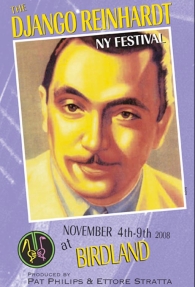
Its the first week of November and, once again, this hallowed temple of jazz reverberates with the siren song of the Gypsy caravan as the ninth annual Django Reinhardt NY Festival returns. This year producers Pat Philips and Ettore Stratta have assembled a stellar international roster representing the latest generation of Django-inspired musicians they have dubbed the Young Lions of Gypsy Jazz.
My newfound friend turns out to be the only person in the room who isnt aware of tonights program and our lively conversation has become a detailed interrogation as she asks why Gypsy jazz? What do Gypsies have to do with it? I try to give her a thumbnail sketch of the history of jazz Manouche, but she isnt letting me off the hook. Who was Django Reinhardt? she asks. I have her write down the name of Michael Dregnis comprehensive Django biography, along with a list of material and CDs which could help bring her up to speed. Why do you spell his name with a D? Mercifully, the first set begins, perhaps saving me from the inevitable water-boarding.
What do Gypsies have to do with it? Who is Django Reinhardt? she asks. Why do you spell his name with a D? |
Producer Pat Philips introduces the program with a comment on the election. I feel that this is a very special night because tonight, we can celebrate America. It is the day after the historic Obama landslide and the crowd roars in approval. But, of course, we have come for the musicthe audience is crackling in anticipation as bassist Brian Torff, the festivals musical director, takes the stage, followed by Philadelphias top hot swing guitarist Kruno Spisic and Andreas berg, Swedens rising jazz guitar star.
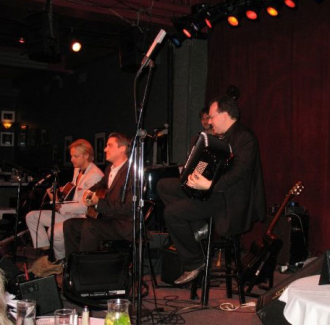
The trio opens the set with a moderate swing, Coquette, both guitarists displaying their extensive command of Djangoese while getting a feel for the sound of the room. Krunos playing is firmly anchored in the disciplined Gypsy style, while Andreas is more eclectic in his approach, integrating elements of straight-ahead bebop with Django-rooted phrasing. The contrasting solo styles actually work well together.
Coquette is followed by a languid ballad based on a Grieg melody, Danse Norvgienne. bergs solo intro is an elaborate display of arpeggios incorporating a few well-placed false harmonics, a technique perfected by the late Lenny Breau, but mastered by few guitarists since. I have followed the career of this remarkable young jazzman for several years; in fact, his playing was the catalyst which sparked my initial interest in the Hot Club Swing revival. If anything, tonights performance has increased my respect.
French accordion virtuoso Ludovic Beier now joins the onstage trio for an electrifying rendition of Bernies Tune, demonstrating the power of an instrument which, in spite of ample evidence to the contrary, is still not taken seriously by many in the U.S. jazz community. His fingers dance across the changes in rapid-fire triplets. Kruno takes his chorus with the crispness and energy that has helped forge a reputation as one of the top jazz Manouche guitar players in North America. Andreas follows suit, scatting along with his solo ( la Benson) before the quartet trades fours in a whirlwind of ideas that seem to connect each others thoughts.
But waittheres moreharmonica master Howard Levy! Simply put, Levy is a shock. Im not normally prone to exaggeration, but what this cat does with an ordinary diatonic harmonica may be beyond the science of modern physics. A veteran of the Bela Fleck ensemble, as well as years of session work on both sides of the Atlantic, Levy is considered by many as the most advanced harmonica player in the world. Tonight his version of Djangos celebrated anthem of occupied France, Nuages, brings down the house.
Up to this point, all the players on stage have been Gadje, or non-Gypsies. With the introduction of Samson Schmitt and his younger brother Jean Baptiste, we are about to hear the real Magilla. Sons of the legendary Sinti guitarist, Dorado Schmitt, they provide the only element so far missing from the nights display of virtuositythe heart and soul of the Romani musician. Sampson galvanizes the crowd with a full-throttle, authoritative version of Djangos swing classic, Daphne. His eighteen year old brother Jean Baptiste leads the other guitarists pumping out a powerful la pompe rhythm.
Brian introduces the extraordinary French violinist Timbo Merstein, who frequently plays and records with Sampson. Suddenly the group is transformed into the quintessential Hot Club lineup as the fingers fly into a furious, blistering arrangement of the perennial swing favorite, Stompin at Decca. Stephane Grappellis influence is obvious in his quotes and phrases.
Another surprise: Ludovic brings out an odd-looking free reed wind instrument from France, the accordina, which appears to be the unintended result of a clandestine tryst between a harmonica and a button accordion. It has been making somewhat of a comeback in recent years due to its potential for subtle expression, as Ludovic admirably demonstrates in the poignant ballad Souvenirs, played in a duet with Sampson Schmitt. With the solid backing of Toriffs bass, the intimate exchange between Sampson and Ludovic is intuitive and delicate. In the middle of his solo, Ludovic suddenly leaves the stage and walks through the audience, wielding the accordina like a Jaipur snake charmer. Freed of the microphone, the notes waft through the air as if they were part of a film noir soundtrack, transporting the mesmerized audience back in time to a 1930s Parisian caf.
After a spirited Lady Be Good the whole ensemble caps off the set with a bouncing, up-tempo Minor Swing, perhaps the most ubiquitous number in the Django archives. As the first set audience leaves the room, you can still feel the energy from the steady pompe rhythm. I say farewell to my inquisitive new friend, who is now clearly becoming a fan of Gypsy jazz.
This is the end of part one of Bill Barness two-part report on the Django Reinhardt jazz festival. Click here for part two, in which Bill takes us behind the scenes.
Tags:
Why do musicians want to play another man's work? Django would not approve. this is not jazz, this is cheap imitation
Will there be a video or cd of this? I'd love to hear Howard Levy's interpretation of Nuages. I've seen him live a couple of times here in Germany and I can say without any doubt that he is the greatest harmonica player ever and a great musician, too.
I played guitar years ago. I would go to the music shops near UC Berkely campus. There, I discovered Django's style. I found it wonderful then. Today I still feel the same way. Thanks for re-awkening the experience. Lionel