The Jazz.com Blog
November 19, 2008 · 0 comments
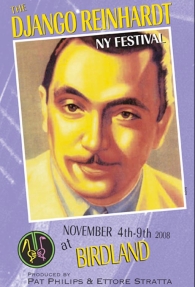
Backstage at the Django Reinhardt Festival
In part one of this article, Bill Barnes reviewed the ninth annual Django Reinhardt jazz festival at Birdland. In this second, and final installment, he takes us behind the scenes for conversations with the performers and Gypsy jazz advocate Pat Philips. T.G.
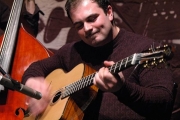
Offstage at the Django Reinhardt NY Festival, guitarist Andreas berg allows me to noodle a bit on his $30,000 Benedetto archtop. His recent release on Resonance Records, My Favorite Guitars, has him squarely back in the mainstream, where his formidable bebop chops are in full swing. For much of tonights sets he opted to play the archtop, rather than his more traditional Selmer-style AJL acoustic. As the author of Gypsy Fire, one of the best instructional materials on Django guitar, he is a dedicated advocate of the Gypsy technique, but lately has been increasingly drawn back to his earlier influences, mainstream players such as George Benson and Pat Martino.
berg admits that he isnt doing as many Hot Club swing gigs as he was a few years ago. Still, he remains a proponent. Theres real power in the Gypsy technique, he says. You can play so much faster, with greater clarity. He will be expanding access to his experience and knowledge in the near future with an interactive instructional website, in partnership with AOL. For now, Im content to observe and attempt to steal bits and pieces of his remarkable technique.
While hanging out in Birdlands green room between sets, I had the opportunity to sample the Selmer-style guitars the Schmitt brothers have been playing, courtesy of Manouche Guitars North Americas representative, Barry Warhoftig. These are just stock production models but, in Sampsons hands, they sound like vintage Selmers. Everybody is plucking away backstageits interesting to hear the different approaches to the guitar during the interplay between Kruno, Sampson and Andreas. Kruno suddenly breaks into song, demonstrating a surprisingly good voice, as he renders a lovely, poignant ballad in his native Croatian. I recognize the tune, Letch Gurgo, written by violinist Schnuckenack Reinhardt, a cousin of Django. Ludovic joins in with the accordion, followed by Sampson, providing the perfect guitar embellishment. This wasnt on the program, but Im thinking it should have been.
Producer Pat Philips and her long time partner, Ettore Stratta are by the bar, waiting for the second set. Arguably New Yorks most ardent supporters of Gypsy jazz, they had actually built their reputations working with a broad array of major talent (a very long list, trust me!) from Lena Horne and Count Basie to Lew Tabackin and Joshua Redman. Ettore has produced, arranged and conducted for so many prominent artists, including the Royal Philharmonic Orchestra, Tony Bennett and Eddie Daniels. So what has made them so passionate about Django Reinhardt and jazz Manouche? Pat responds, It makes me feel good. I just fell in love with the music and with the artists.
|
|
I ask for her take on why there is such a resurgence of interest now, after all these years. Its the hippest music out there, at least in my opinion. . . . I dont think theres any comparison. Its very romantic, melodic, very swinging; it gets inside you and makes you feel greatand Im talking kids, all the way to old people. I just think its hip and cutting edge forever.
They have been involved in the jazz Manouche revival ever since 1988, when they produced Stephane Grappellis 70th birthday concert at Carnegie Hall, featuring Yo-Yo Ma, Michel Legrand, the Juilliard String Quartet, Maureen McGovern and Toots Thielemans. Since then, they have produced regular Django-inspired events at Lincoln Center, Carnegie Hall, Birdland and other venues, getting to know many of the key players in the processDorado Schmitt, Angelo Debarre and Stochelo Rosenberg, to name a few.
Pat Philips loves the Romani musicians esthetic. Half of the people we bring here live in caravans or cottages. They could afford to buy big houses but they dont think that wayits all about the music, its all about the family. They grow up with the musicthey play for the joy of the music. That is the difference. Thats why you feel it. You feel what they feel. If they were home tonight, theyd be sitting in the living room playing music. When they get up after breakfast, theyre going to play music. The search for the heart and soul of Gypsy jazz has led her to Romani camps across Europe. Weve gone there, weve been in their caravans, its all guitars, putting them in the hands of a three year-old. . . . Its in the culture; its in the family.
While the second set audience is not quite the overflowing capacity crowd of the first, theyre every bit as enthusiastic. Among the repeats of the first sets tunes, the group offers some more classic Django numbers: Troublant Bolro, which is actually more of a rumba, and the popular Swing Gitan. The performance ends with an exuberant, buoyant crowd pleaser, I Cant Give You Anything But Love.
Thats pretty much summed up the feeling when, at three oclock in the morning, Birdland finally closed its doors behind the last of the stragglers and turned us out into the misty November nightwe couldnt feel anything but love. Latcho Drom and long live Django!
This blog entry posted by Bill Barnes.
Tags:
Comments are closed.