The Jazz.com Blog
November 09, 2008 · 1 comment
Bobby Sanabria Celebrates the Legacy of Tito Puente
Eugene Marlow, who recently conducted an in-depth interview with Bobby Sanabria for jazz.com, now shares his report on an exciting performance by Sanabria devoted to the music of the late Tito Puente. As we have to come to expect from this artist, Sanabria brought plenty of fireworks: he had a 25 member orchestra on hand and almost as many charts to play. Read on! T.G.
Tito Puente, also known as el rey, the king, was a man whose whole was greater than the sum of his parts. A major figure in the evolution and acceptance of Latin-jazz in the United States, Nuyorican-born Puente was a master drummer, percussionist, pianist, saxophonist, vocalist, composer, arranger, and conductor. No doubt, Puente was a leading icon in the Latin jazz community, as well known worldwide as he was in the culture that nurtured him.
In 1993 I met Puente briefly at the conclusion of a concert his big band gave at Baruch College as part of the then annual Milt Hinton Jazz Perspectives concert series. At the time I was a junior member of the committee that hosted these concerts (since 2000 I have had served as senior co-chair). It was the second year of the series. Puente's fame was so widespread we had to open the theater balcony to accommodate the hundreds of people who stormed into Baruchs Mason Auditorium. And true to form, his music was so infectious, so moving, there were, quite literally, people dancing in the aisles. His personality was electrifying. He could have played on chopsticks and the audience would have loved it. They certainly loved him.
On May 31, 2000 Puente died from heart failure. He may be gone, but he is far from forgotten. Another icon of the Latin-jazz community, Bobby Sanabria, whose heroes include, among others, Tito Puente and Buddy Rich, is a master percussionist and drummer, composer, arranger, producer, and educator, in his own right, in addition to being a deft Afro-Cuban and Latin-jazz historian. One could call him a keeper of the Afro-Cuban/Latin-jazz cultural flame.
On April 1, 2008, Sanabria mounted a 50th anniversary celebration of the 1957 recording of Machito (who together with Mario Bauz fathered Latin-jazz) and the Afro-Cubans jazz masterwork Kenya. This was not merely a legacy re-enactment of the album, but a re-visit of the Kenya albums 12 cuts, with contemporary arrangements of the original charts.
Seven months later, on November 3, 2008, Sanabria mounted a full concert dedicated to Tito Puentes little known big band masterworks composed and arranged by the master. The program was as prolific as Puentes career; a reflection also of Sanabrias predilection for audience-exhausting performances. On the program were the following scores:
• Elegua-Chang: A piece that pays tribute to the rhythmic roots of Afro-Cuban music in West Africa.
• Havana After Dark: This piece by the legendary Cuban trumpeter, composer, arranger Arturo Chico OFarrill, showcases how Tito would often take someone elses composition and make it his own.
• Autumn Leaves: Tito would often perform this tune during a midnight set of boleros at the famed Palladium Ballroom.
• Bohemia: Composed by jazz bassist Oscar Pettiford in 1955, this piece appeared on the album Puente Goes Jazz in 1956.
• Ran Kan Kan: One of Titos first hits with dancers and one of his most enduring compositions.
• Cuban Nightmare: This chart appeared originally on a 78 rpm record and featured Puentes regular percussion team of Willie Bobo on bongo and Mongo Santamaria on congas.
• Picadillo: Originally titled the Arthur Murray Mambo, this composition is completely based on one chord.
• Mambo Buddha: This piece is strongly influenced by Puentes travels to Asia at the end of his military service during World War II. It features generous use of a Chinese tam tam.
• Ritual Fire Dance: This is one of Manuel De Fallas most renowned compositions. Puentes version opens with a percussion salvo mixing conga de comparsa, mambo, and rock.
• Yambeque: This is a hard-driving, up-tempo jazz mambo that showcases the dynamic range of the orchestras and takes no prisoners.
• Alegre Cha Cha Cha: Originally played in Cuba in the charanga formata small group featuring violins and baroque wooden flute, timbales, guiro macho, piano and bass with vocals.
• Mambo Beat: This piece is jazz mambo in all its glory that specifically features the baritone sax.
• Me Recuerdo De Ti: Composed by Cubas Pepe Delgado, arranged by Puente, and sung by Celia Cruz, this lamented bolero, with interludes of cha-cha-cha and a final son montuno section, is an ode to the memories Celia had of Cuba with its famous nightclubs and beautiful cities, like Havana.
• Mambo Adonis: This piece was composed specifically for the purpose of being played when the Puente Orchestra performed at the Palladium Ballroom alongside the Machito Afro-Cubans.
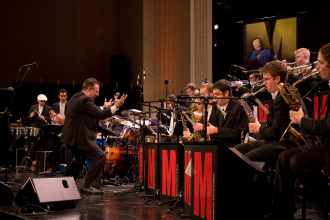
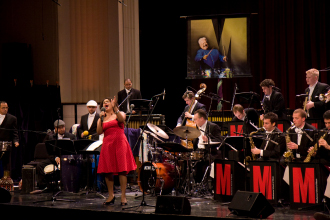
The white-tie clad 25-person Afro-Cuban Jazz Orchestra also reflected the prolific tenor of the evening. In addition to the usual five-man saxophone section, four trumpets, four trombones, piano, bass, and drums, Sanabria agglomerated a veritable army of percussionists, including timpani. With Sanabria serving in his usual capacity as orchestra director and master of ceremonies, he also played the drums, timbales, vibes, and marimba. Add to this a platoon of players on bongo, congas, even Chinese gong.
Imparting another touch of authenticity to the proceedings was flautist Frank Fontaine. Add to this MSM opera major vocalist Rachel Kara Perez who sang Me Recuerdo De Ti towards the end of the concert. Perez's re-creation of this extremely rare number which Celia Cruz recorded on the Cuba Y Puerto Son disc, Celia's first collaboration with El Maestro in 1966, brought down the house with an incredible roar. It is only the second time the piece has ever been performed because of Celia's emotional connection to the song. Another connection: Rachel was the recipient of the Tito Puente Scholarship from 1994 thru 2000. Celia Cruz was in the house.
Just like the Puente concert at Baruch College in1993, just like the Kenya Revisited recreation of April 2008 at the Manhattan School of Music (MSM), the November 3 concert was filled to capacity, Standing Room Only at the schools Borden Auditorium. And true to form, Sanabria was the central ringleader of the celebration. He understands innately that a concert of this kind is a tribal, group experience, especially because the music makes you want to dance and, as Bobby puts it, to shake what your mama gave you. Sanabria encourages everyone to become part of the proceedings: Everyone in the tribe must participate, he announces from the stage. This means everyone in the audience and on the stage who is either not playing or taking photographs (videographers wandered all over the stage during the performance) must clap the clav.
And those not clapping were dancing in the aisles. At one point Sanabria brought the entire saxophone section to the apron of the stage and had them dance (with Sanabria leading) to the music. Renowned cha-cha-cha dancer Louis Hernandez was in the audience. Bobby invited him to the front of the orchestra to dance with his wife.
There were other notables in the house: Rene' Lopez, Joe Conzo Sr., Harvey Averne, pianist Larry Harlow, Annette Aguillar (MSM alumni), Michael Wimberly (MSM alumni), poet Sandra Maria Esteves, Hostos College faculty Jose' Encarnacion, film-maker Ivan Acosta, saxophonist and Tito Rodriguez alumni Gene Jefferson, Puente saxophone/flute sideman for 25 years Mitch Frohman, Abacua expert Dr. Ivor Miller, ethnomusicologist Dr. Roberta Singer, folklorist and cultural anthropologist Elena Martinez, Frontline PBS producer Oren Jacoby, Dean of Jazz Studies at MSM, Justin DiCioccio, the associate director of the Centro archives Dr. Alberto Hernandez, vocalist Jorge Maldonado, and Candido Camero, who fondly recalled his work on Tito's first full length album for RCA in 1955, the ubiquitous, Cuban Carnaval. MSM's President Dr. Robert Sirota cut his trip to China short to return to attend the concert. And last, but certainly not least, Margie (Titos wife), Ronnie, and Joni Puente. It was a celebration, indeed.
A final comment. There is always a perception that school bands, how shall I put it, cannot compare to bands with so-called professional personnel. The prevailing attitude is How can these student bands stand up to the quality of professional players? I have had the pleasure of listening to the MSM Afro-Cuban Jazz Orchestra now for over three years in rehearsal and performance. There are three reasons why this orchestra stands up to most if not all non-student bands: first, and foremost, is the standard of professionalism demanded by Sanabria. I have watched many rehearsals. In addition to the music, he gives the players a background on each piece of music. Its a history lesson in addition to rehearsing the music. More importantly, if even one person is out of synch, if one percussionist is playing the wrong rhythmic pattern, if a section loses focus, or if the orchestra doesnt play with consistent energy throughout, he makes the entire orchestra go back to the beginning of the chart and do it until its right. Time and time again he raises the level of the players play. He is unrelenting. He expects a professional attitude and he gets it, or youre out.
Second, are the players themselves. MSM doesnt fool around in its selection process. It attracts quality students who can cut it and it shows. Last, but not least, is the leadership of longtime faculty member and eminent jazz artist and educator Justin DiCioccio who runs the overall MSM jazz program. The program can be characterized as systematic and rigorous conservatory training combined with a myriad of performance and networking opportunities. DiCioccio has created an environment in which masters such as Sanabria can bring the best of the tradition to the students and bring the best out of the students. Combined, the result are performances that are way beyond minimal standards of quality, concerts that rival the most famous jazz orchestras in terms of repertoire and performance virtuosity.
Puente would have enjoyed the November 3 concert, not merely because all the charts had his name on them, but also because he would have seen that one of the talents he influenced, namely Bobby Sanabria, and the young musicians Sanabria is influencing in turn are carrying on the traditiona tradition of reaching for cultural authenticity and high standards of musical quality.
Yes, Tito Puente was definitely in the house.
This blog entry was posted by Eugene Marlow.
Tags:

Just read your review. I am the father of Rachel and a big fan of Afro Cuban music. Mr. Sanabria is certainly a task master. I watched him work with the students during one rehearsal. He brings a lot of emotion, and history into the studio. It was a terrific concert. At home Rachel was taught that it is not the lone singer that makes the band, but the band with all its components that make the music. David - proud dad