The Jazz.com Blog
December 14, 2008 · 2 comments
South Asia's Leading Jazz Festival Tilts Toward Europe
India has enjoyed a long and fruitful relationship with American jazz. I recently wrote in this column on The South Asian Tinge in Jazz, and now Brian Dwyer reports on Jazz Utsav, centered in Delhi, which has been one of the leading festivals in world since the late 1970s (when it was known as JazzYatra).
But where are the U.S. jazz musicians? Here we see another example of a jazz festival reducing its dependence on American acts. We have reported on many recent examples in this column of European jazz festivals relying more and more on European talent. But what does it say when the leading Indian jazz festival imports most of its acts from Europe? T.G.
When officials in the U.S. State Department tried to brief Dizzy Gillespie in 1956 on the eve of his first jazz ambassador tourspreading the message of nuclear families and democracy through the freedom of homegrown American jazzhe responded, I've got 300 years of briefing. I know what they've done to us and I'm not going to make any excuses.
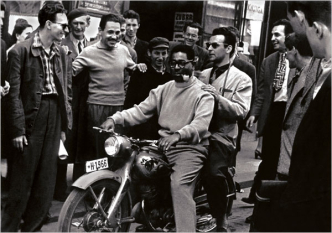
Dizzy the Diplomat (1956)
In some ways Dizzy's declaration answers many hanging questions from this year's Jazz Utsav festival in New Delhi. It seemed odd the world's second largest democracy was only represented by one act in its country's most renowned jazz festival. After 30 years, the members of Capital Jazz and West Coast Jazz, two organizations responsible for Jazz Utsav in New Delhi and Mumbai respectively, offered few excuses to their audience.
In its infant years, Jazz Yatra (as it was known until 2004) was host to mostly American musicians with help from the U.S. State Department's sponsorship of musicians like Sonny Rollins, Max Roach and Freddie Hubbard, Woody Shaw and Cedar Walton, and Stan Getz. When the department reduced their initiative to spread democracy, the quantity and quality of American musicians began to slip from legends to a lack of any this year.
Since Jazz Utsav was established as an annual festival in 2004, the lineup has been dominated by European acts. Out of the nine artists who participated in Delhi this year, all but two were from Europe, representing eight different countries: Austria, Ireland, Poland, Germany, Norway, Canada, The Netherlands and India.
And purists who scrutinize the word jazz would help leapt out of their chairs when they heard the tonk of two Django Reinhardt inspired folk bandsone playing Norweigian folk tunes and another led by a former heavy metal guitaristand Wojciech Konikiewicz, a Polish composer playing two keyboards hooked to a visualizer.
When Mumbai's Global Untiy stopped their set midway through to introduce a song entitled, The Only One in Town, they seemed to justify the Capital Jazz programing board's choices. Guitarist Sanjay Divecha composed the tune about Blue Frog, among the most prestigious and hip clubs in Mumbai. His point became one the audience already knew: much of India's cities are starved for a communal environment like the kind created at Jazz Utsav. Divecha made the point several times he was thrilled to play for a crowd that was listeningcrowds without chatter are often a commodity in Indian jazz clubs. Think Birdland, more networking.
As their name may suggest, Global Unity is a not strictly a jazz band, which was both refreshing for the audience and difficult at times. The group, led by Divecha, displayed incredible skill but occasionally disconnected on form, like on a thoughtful version of Wes Montgomery's Thumb. On its own composition, the band seemed to revert to its natural state, a moderately paced series of cohesive progressions.
Experimentation is much of what drives Jazz Utsav, not its purity. The crowd of over 200 that sat patiently and suddenly erupted wore suits or long beards. They gave standing ovations only when deserved. There were families or those who came alone. With such a city depleted of jazz as Delhithe clubs filled with deaf earsthe audience was a uniform of appreciators who sought a decent crowd and very up-tempo grooves, no matter whether it was jazz or not.
As a good plot should, the festival climaxed late the second day with self-proclaimed gypsy acoustic guitarist Harri Stojka. Hailing from Austria, Stojka's Gypsy Swing Ensemble, consisting of double bass, snare, and accompanying acoustic guitar, played rapid chord progressions. Stojka fueled the band's fervor with a technique of relentless picking complementing an efficient left hand. He moves always in semitoneshis solos incorporate the entire neck and toy with tempo, moving from slow to fast and back again in seconds.
Norway's Hot Club de Norvege were another folk act who's tinny sound and crisp improvisation made the transition appropriate from street players to touring experts. The first night concluded with Irish singer Honor Heffernan, backed by pianist Phil Ware and his trio. Heffernan's singing suffered from dramatic phrasing and featured almost as many sour notes as ones rehearsed.
From The Netherlands, the Henk Muegeert Quartet put on an informal seminar about George Gershwin alongside Germany's Miett Molnar, an original member of Europe's Glenn Miller Orchestra. Muegeert on piano created classically crafted solos in absence of band accompaniment, saying most in the structured space between his notes. On Fascinating Rhythm, Simon Rigter provided an appropriate Gershwin romanticism in the spirit of Stan Getz on tenor saxophone, and his interplay with the energetic Molnar drew her from spinning away from the band on tunes like Who Cares. Muegeert's insistence on sing-alongs throughout the set celebrated the experimentation European bands are allowed at Jazz Utsav and revealed that those in attendance in no way knew the lyrics to I Got Rhythm.
The festival's final night suffered its first reminders of the attacks in Mumbai; The Netherlands' Ploctones were not able to fill the final performance slot. Members of Global Unity and Wojciech Konikiewicz and his trio participated in a jam session to close the festival.
But fans were still left with a taste from the Francois Bourassa Trio sweet enough that it may tide them over until next November. Losing their singer Jeanne Rochette to laryngitis, the trio of Francois Bourassa on piano, Adrian Vedady on 5-string electric bass and Philippe Melanson on drums dissolved the boundaries created by a singer. The percussive interplay between Bourassaplaying keys muted by his right handand Melanson worked in polyrhythms that transitioned well between their sometimes overly-ambitious compositions. When the band hit a rhythm they enjoyed, all three joined the same wavelength and stumbled into melodies more engaging than those rehearsed.
Jazz Utsav lives modestly at times, as many of its touring musicians do as well, but remains a convergence of like-minded people doing free-minded things.
This blog entry posted by Brian Dwyer
Tags:

There are two reasons: 1 most of the Europeans jazzmusicians are as good as American jazzmusicians 2 some Europeans governments sponsor their best jazzgroups to play at international jazzfestivals. Something your government is not very often doing. Maybe it's time for change. Best, Han Schulte www.jazzpress.org
I think what you're doing is great!I often am concerned with the vitality and audience for jazz> Your work assures me that the Music is alive and well aboard. Maybe the local scene will be revitalized by avid practioners from the rest of the world.Way to be!