The Jazz.com Blog
December 07, 2008 · 0 comments
Wayne Shorter's 75th Birthday Concert
Jazz icon Wayne Shorter celebrated his 75th birthday with a mini-tour, including his first concert performance in Boston in more than five years. Roanna Forman, who covers the fertile Boston jazz scene for jazz.com, reports on the saxophonists appearance at the Berklee Performance Center. T.G.
In yoga, one speaks of ones mountain. When the chest is open and elevated, you are there, on your mountain. Last Wednesday, Wayne Shorter led his quartet from his mountain, unleashing and sharing an extraordinary distillation of his five-decade career in an uninterrupted set of abstract but highly visceral music with an audience that did not want to let him go.
Though it was billed as a Wayne Shorter 75th- Birthday Concert, this was by no means a rundown of greatest hits by one of the most influential composers of contemporary jazz. Actually, the band, which had a loose set list, could later barely remember the order of the tunesSanctuary, Zero Gravity, Myrrh, Smiling Through, She Moved Through the Fair, and Joyride. Thats no put-down, its as it should be. Shorters music is constantly evolving, and though there were echoes in the performance from as far back as the Coltrane heritage, Speak No Evil, Super Nova and Weather Report, this new music, with the breathtaking ensemble playing of Danilo Perez, John Patitucci, and Brian Blade, pushes ahead in feel, ensemble synergy and musical interpretation.
Floating from one solo, groove, and effect into another, the tunes had meter and structure, lead sheets and improvisation blended imperceptibly into each otheryou couldnt tell where one ended and the other began. (Witness the groups CD Footprints Live!, where Valse Triste, a Shorter arrangement of the Sibelius composition originally written and recorded in 1965, had only traces of a three-quarter feel, and hints of the original theme.)
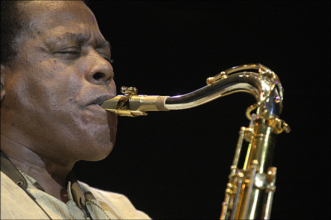
Shorters musical leadership is effortless, almost offhanded, yet firm. He actually does wave his hand slightly to call for a solo. Watching him youd think youre reading baseball signals. He listens intently to the groove set up by the band, and enters when the spirit moves him, with a seemingly endless melodic sense. His lines, generally short, subtly direct the dynamics and feel of the whole band. As he develops them and builds his solos to a wail or squawk, the intensity of the rhythm section moves furiously along with him. Then he brings the band down by simplifying phrases, leaving out notes, and adding rests.
If jazz is about listening and conversation, these musicians approach telepathy. You can hear that on their recordings, but to see it is an education. They use spaces to listen, look and exchange ideas, pick up riffs or chromatic fragments. They are each playing many notes, patterns, and chords, but except during their solos, you hear not their chops but the total effect. They create more than the sum of their partsthats what you aim for in jazz.
But each man played his part pretty well. Danilo Perez, sometimes picking up on another musicians phrase, pulled the stops out with a Chick-Corea influenced solo ending in alternate powerhouse left and right-hand chordsand then what seemed to be his entire group of students erupted like a cheering squad at a touchdown. At other times, Perez would throw polyrhythms over a Latin groove, fall into an Erik Satie-like interlude, or change the mood with a dark two-chord vamp. Using a lot of displacement, Perez got the whole band doing it on the last tune, before they came back to play Prometheus Unbound for an encore. Brian Blade played inside the beat, adding the accents and colors he felt in the music around him. Likewise, John Patitucci listened, felt, and played. By turns fat, feathery, or grounding a groove with a heavy repeated note, Patitucci threw himself into the music. At one point he looked spent, like an athlete whos run his best race.
Actually, the physicality of these players was electric. Swaying into phrases, plucking off final notes like archers, whapping accents, they were working on such a high level, in technical, musical, and yes, spiritual, terms, you were glad to be up there with them. At this beautiful mountaintop dance, led by a master who seemed to blow the music of the universe out of his horn.
This blog entry posted by Roanna Forman
Tags:

Comments are closed.