The Jazz.com Blog
February 12, 2008 · 0 comments
Herbie Hancock, Chris Anderson & the Chicago School of Modern Jazz Piano
The last time a jazz recording earned the Grammy for album of the year was 43 years ago. Can you guess the album? Yep, Getz / Gilberto , which beat out the Beatles back in 1964. But jazz got the nod again on Sunday evening, when Herbie Hancocks River: The Joni Letters walked away with the top honors. No one looked more surprised than Hancock himself as he accepted the award.
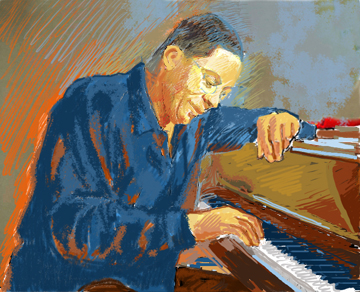
The choice was an inspired one, and much applauded on these pages. Jazz.com featured Court and Spark from this CD as Song of the Day on its very first day on the web (December 10, 2007), and followed it up by selecting the title track from River two weeks later. The former song stayed on the jazz.com playlist until this week. (Two other recordings with high marks from jazz.com also walked away with awards: Maria Schneider's "Cerulean Skies" was honored as best instrumental composition for a large jazz ensemble, and Michael Brecker's posthumous Pilgrimage won for best jazz instrumental album.)
It is sobering to remember that Hancocks honor comes only a few days after the death of his mentor and teacher Chris Anderson, the unheralded Chicago pianist. And though we rightly celebrate Hancocks award as a victory of sorts for jazz, Andersons under-the-radar career is far more typical of the state of jazz music today.
Few pianists of his generation had a more acute musical mind than Chris Anderson. You could savor his chords big, thick, rich with overtones the way a wine connoisseur enjoys a Napa cabarnet. They had a firm body, with a lingering aftertaste. And was it Andersons fault that most listeners didnt have big enough ears to hear what he was doing? (Check out a review of Andersons Where or When here.)
I will coin a useful term here . . . the Chicago school of modern jazz piano, and I will anoint Anderson as its most representative figure. Of course, a more distant starting point might be Lennie Tristano (another Chicagoan) and his 1946 recording of I Cant Get Started. The essence of this music is a judicious balance between the linear momentum of bebop and the vertical conception of Tatum and Hines. These Chicago keyboardists were two-handed players, with an ear for lush, resonant harmonies, and a knack for balancing the cerebral and emotional components in their music. When most players were emulating the spare left-hand work of Bud Powell, the Chicagoans had a more orchestral approach in mind.
In addition to Hancock, Anderson and the early Tristano, we need to include Chicago native Denny Zeitlin in this group. Zeitlin also stands out for his acute harmonic sense and complex voicings. Sometimes he digs up his own finger-busting variants I've even seen him play two notes with a single finger, sliding his pink across two black notes, finding a way to strike six notes with a single hand. At Juilliard, this might count as breaking the rules, but in the jazz world it gets you a thicker sound than the other cats on the scene.
And we should also make room on our list for an artist even more unheralded than Anderson, the Chicagoan Billy Wallace, who makes a brief appearance in Max Roachs 1957 band, then drops almost entirely from view. Do a quick search for Wallace on Google, and you will find that the adjective obscure invariably shows up in the same sentence whenever his name is mentioned. But, like Anderson, he was a big time player even if he left behind a small time discography. Wallace perfected a dramatic two-handed piano attack during an era in which virtually every other modern jazz keyboardist was playing single-note bebop lines.
So lets enjoy Herbie Hancocks award, and the luster it casts on the jazz world. But here at jazz.com, we will dedicate this honor to the unheralded members of the Chicago school of modern jazz piano, who made more than a small contribution to the Grammy winners success.
This blog entry posted by Ted Gioia
Tags:
Comments are closed.