The Jazz.com Blog
February 13, 2008 · 1 comment
Jazz Vocals in the New Millennium
Music critics tend to move with ease from review to review, but it is often harder for them to get a grasp of the big picture. And the endless hype of labels and publicists, the constant noise from the media, the churning and burning of talent so characteristic of the music industry - well, these don't make the task any easier.
A few months ago, I decided to plunge into the world of jazz vocals and try to take its temperature. Of course, I hoped to assess individual artists, but even more I wanted to sense the direction of the art form itself. Quo vadis? so to speak. After a hundred years of Satchmo and Sinatra, Lady Day and Ella, O'Day and McRae, where do we stand? Where are we heading?
Over and above my regular listening regime - based on a lifelong habit of trying to hear some new music every day - I began tracking down additional jazz vocal CDs. Eventually I found myself surrounded by piles of them, probably a couple hundred or so, each one contributing to broaden my perspective of the state of jazz singing in the new millennium. I hunted down hard-to-find imports, indie releases and self-produced projects. I ran up an Amazon.com bill that sent shivers down my spine, pestered friends and acquaintances to tell me about the hot singers I might have missed, sometimes sent cold-call emails to vocalists themselves, asking them to share their music with me.
Little did I know what I was getting myself into. There were more singers out there than even I had suspected, a lot more. But if I was sometimes overwhelmed by the variety of what I heard, I also was delighted by the great music I encountered that I would otherwise have missed. Today I am publishing the first half of my report on the current state of jazz vocals. To complete the picture, I am also providing reviews of a representative playlist of more than 60 tracks - roughly five hours of music that will let other fans survey the scene without investing the months of ear action it took me to complete this project.
The opening of "The State of Jazz Vocals Today" is below. The full text can be found here.
THE STATE OF JAZZ VOCALS TODAY by Ted Gioia
How do we assess the current state of jazz singing? Of course, you can’t judge a CD by its cover, but . . . well, let’s just say that jazz vocalists have never looked better. Perusing the CD covers of releases by Diana Krall, Jane Monheit, Roberta Gambarini, Madeleine Peyroux and others, I am overwhelmed by the sheer amount of pulchritude on display. Has Vogue magazine, perhaps, entered the jazz CD business?
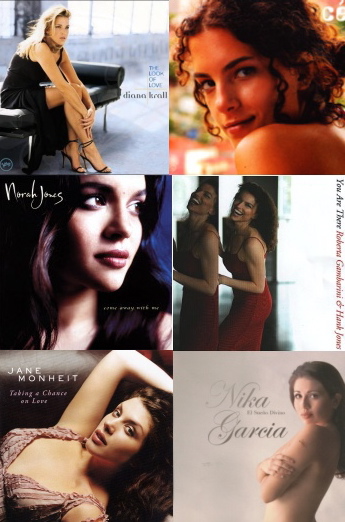
How to Sell Jazz CDs in the New Millennium
And the guys are providing as much eye candy as the ladies. Following in the footsteps of Harry Connick, newer faces such as Peter Cincotti, Matt Dusk and Michael Bublé seem to have stepped out of a Hollywood movie and into a recording studio. What a shame to keep such good looks hidden behind a grand piano. They should be on billboards, or selling their own brand of cologne, or (as they no doubt have at the top of their five year plans) stepping back inside that Hollywood film.
But these special effects do not come easily. The liner notes to Diana Krall’s 2006 release From This Moment On include credits to two hairdressers, two makeup artists and one wardrobe assistant – all of them given higher ranking than Steinway (for the piano) and Krall’s husband, Elvis Costello. Jane Monheit’s record label, not to be outdone, points out in her official bio, the “indisputable fact” that Monheit is a “stunning, raven-haired beauty” – and then goes on to mention, almost as an after-thought, her singing.
No wonder the record companies hate downloading. How do you pitch a “stunning, raven-haired beauty” in a MP3 file? How do you get a return on your hairdo investment on iTunes? Ah, how times have changed . . . how did Billie Holiday get by with just that gardenia? Where was Ella’s entourage? Bessie’s beautician? Sarah’s stylist?
And how do we deal with the plight of the aging female jazz singer in this environment? The jazz world has usually celebrated its elder statesmen (and statesladies). But things have changed. Diane Schuur was building a large Grammy collection back in the 1980s, but her 2006 Live in London finds her working for the GR2 Classics label. A check of the GR2 Classic web site – which is so well hidden even my well-honed Googling skills were almost stymied in my efforts to find it– indicated that Schuur is the only artist listed in their “classics” roster. The Amazon ranking for Live in London, the last time I checked, showed it sitting at number 133,997 on their charts – ouch! Schuur's new CD comes out in a few days, and let’s hope it finds a larger audience. Or consider the case of Sheila Jordan, one of the most talented jazz singers of recent decades, who recently ranked among the top five female jazz singers in the Down Beat critics’ poll. Yet her newest release sits at number 196,435 on the Amazon ranking. In comparison, Krall, Jones and several other younger jazz singers are firmly entrenched in the top 100.
Let us next consider Cassandra Wilson, who is now in her early 50s and continues to produce work of outstanding merit. Unlike many celebrated voices half her age, Wilson retains an experimental zeal and innovative spirit that keeps her music vital and pleasingly unpredictable. Wilson’s collaborations with Canadian guitarist Colin Linden on her 2006 Thunderbird release deserve to be much more widely heard. Wilson and Linden are an effective songwriting team – check out their composition “Poet” -- but they can also revamp traditional material, such as “Red River Valley” and “Easy Rider” into strange, new forms. Wilson has always been a great blues singer, and her “Easy Rider” is majestic and oceanic, a mini-miracle in twelve-bar form. It would be a shame if listeners missed out on this music because it didn’t come packaged like a product from L’Oreal.
Don’t get me wrong, I love displays of glamour on my CD rack, but I also admire the latest recordings of all-too-easily forgotten fifty-somethings like Dianne Reeves and Diane Schuur, sexagenarian Andy Bey, septuagenarians Abbey Lincoln, Mark Murphy, or that indefatigable octogenarian Tony Bennett. But even more to the point, I have suspicions. I am dismayed to think that record companies might be choosing artists on the basis of their looks. (In the words of Captain Renault, as the croupier hands him his winnings: “I'm shocked — shocked to find that gambling is going on in here.”) This is worse than the Titanic, my friends. Not only are the aged and infirm left behind, but also less glamorous vocalists of the current generation, who are denied record contracts because they fail to live up to the A&R department’s pre-conceptions of what a star looks like.
For the rest of "The State of Jazz Vocals Today" click here.
This blog entry posted by Ted Gioia
Tags:

Thanks Ted for that article. I know I feel the same way as well as many of my jazz colleagues. I think it's not only disrepectful to the female jazz vocalist it is also very disrespectful to the music we take so seriously and deeply. Let the music stand on its own and don't try to sell the music with tasteless and provocative glamour shots. I was waiting to see something written that covred that topic. I cancelled my subscription years ago from Down Beat after I saw a picture of Diana Krall with her leg prominently featured on the front cover.