The Jazz.com Blog
February 17, 2008 · 26 comments
The Nightfly Revisited
When jazz fans look back at the fusion music of the late 1960s and 1970s, they tend to see only half of the picture. They remember the jazz musicians who crossed over to the rock and pop charts, but they forget the other side of the equation— the rock and pop acts who embraced the jazz idiom.
Yet for every Miles Davis, there was a Frank Zappa. For every Weather Report, there was a Blood, Sweat and Tears. For every Grover Washington, there was a Joni Mitchell. And though it is easy to dismiss the long-haired hippie types who dared mess with jazz, the fact is that the rockers had at least one big advantage.
Perhaps it was only a psychological advantage, but (as Yogi Berra once said) the mental half is ninety percent of the game. When rock or pop musicians tackled jazz, they usually believed they were raising the level of their music. Embracing jazz was their way of aspiring to a higher degree of artistry.
The jazz musicians who took on rock-and-roll rarely had such high and mighty notions. True, there were a few jazz cats who moved into fusion for aesthetic reasons, but the vast majority did it for baser motives—a chance at a bigger payday or a larger dose of fame.
When Sonny Rollins recorded "Disco Monk," he certainly had some goals in mind, but I doubt that one of them was a plan to raise his music to a grander level of expression. When Count Basie started covering songs by the Beatles, he may have had his reasons, but who dares claim that he had decided that the Liverpool sound was cooler than Kansas City swing?
The rock and pop acts who embraced jazz, in contrast, often did so despite commercial considerations. When Joni Mitchell released her Mingus LP, it proved to be her poorest selling release in a decade. To some extent, Joni never regained the mass market audience she had enjoyed before this move. Zappa had his best sales when he squeezed the jazz out of his recordings, and opted instead for "Valley Girl" shtick. The band Chicago sold more records, the less jazz they put into them. In short, when the rock-and-pop folks added jazz to the mix, it invariably hurt their marketability and compromised their prospects. For this reason, I like to champion the rock side of jazz-rock fusion, give a nod to the commercial artists who elevated their music during this turbulent period despite the costs.
No band epitomized turbo-charged pop-jazz better than Steely Dan. The group was formed around the nucleus of Donald Fagen and Walter Becker, who met at Bard College in 1967. They played together in various groups (one of which, The Bad Rock Group, featured future comedian Chevy Chase on drums). But the success of their LP, Can't Buy a Thrill brought the duo fame as Steely Dan, and during the 1970s they released a series of albums marked by smart song-writing, lots of attitude, and impeccable musicianship. Becker and Fagen brought in the best studio musicians for their projects—so much so, that being asked to participate on a Steely Dan LP became a sign that a studio player had reached the top rung of the ladder. The material was perfectly suited for displaying jazz chops. These songs had some bite, helped along by juicy chord changes and clever arrangements.
But this music also succeeded because of the sly lyrics. The words to these songs were sassy and in-your-face, sometimes a little ambiguous. (What was that number that Rikki was supposed to send off in a letter to himself? Or is it herself? Is it a number between one and ten? Nowadays could you send it off in an email to yourself?) I especially liked the way the lyrics combined macho bravado with raw vulnerability. This was a paradoxical mixture, but Becker and Fagen pulled it off. Even a stand-alone couplet could play on both tough and soft angles—for example, on "Deacon Blues," where Fagen sings: "I cried when I wrote this song / Sue me if I play too long." Hearing that made me wish I could write a line that combined "I cried" and "sue me" in a single burst of poetry.
The breakup of Steely Dan in 1981 signaled the end of an era. The great age of fusion was over, for all intents and purposes. The formula had become formulaic. Yet Donald Fagen followed up with a solo project the following year, The Nightfly, which showed that the idea of mixing pop and jazz still could produce one final masterpiece.
And The Nightfly is definitely a masterpiece. Everything about this project clicks. The musicianship is outstanding throughout. (Of course, when you can bring in the Breckers, Larry Carlton, Jeff Porcaro, and other top drawer talent, you can rest assured that the beat will be happening even if the tune is "Mairzy Doats.") But these songs are also a cut above, displaying some of Fagen's deepest lyrics, along with the great chord changes and infectious grooves that distinguished his Steely Dan efforts.
Even Fagen's singing, which is not his strong suit, works wonderfully here, and when he overdubs his own voice on "Maxine," he charms me both with the vocal arrangement, and even more with a rare moment during which the he lets down his guard. Instead of the tough boy after school attitude, so characteristic of Steely Dan, he gives us a glimpse of sweet high school love, all the sweeter for its confusion of reality and dreamy hopes. This is one of the most endearing pop-fusion ballads, and pulls at the heartstrings because (for once) the listener knows more than the narrator of the song, knows that these early spring loves rarely survive the winter.
And then there is the peculiar, yet strangely affecting theme that pervades the project. For The Nightfly is a theme album, even if it is hard to articulate the thematic content with precision. Let's say that Fagen tried to combine a nostalgic look at the past with an optimistic look at the future. Or, to be more precise, Fagen fixates on the shallow concepts of the future that were the common currency in the 1950s and 1960s. How else could you justify a song about the "I.G.Y."? (I.G.Y. stands for the International Geophysical Year, which was 1957-58. And if you want to learn more about it, don't ask me; email a geophysicist or visit Wikipedia.) Who else would write a song about the New Frontier?
These songs are full of odd references to what naive youngsters in the Eisenhower-Kennedy years would expect from the future. Fagen sings about wearing spandex jackets, listening to Brubeck, and traveling undersea by rail. Everything is "graphite and glitter." And even when he tackles a darker topic, as when he hints at an island revolution on "The Goodbye Look," in a setting that just might be Havana, the mood is airy and light. This is more "Don't Worry, Be Happy" than the Godfather II.
I think that this strange angle on the 1950s and early 1960s is one of the reasons for this album's lasting appeal. After the Kennedy assassination, America lost its innocence. We became a cynical nation. My friend Ken Engelhart will even tell you that the violence in American motion pictures starting in the late 1960s comes mostly out of the sublminal impact of the Zapruder film. And he may be right. This is the ominous clock that Fagen tries to roll back, and this is his genius. While other works try to evoke the old days by focusing on sock hops and malt shop—think Happy Days or Grease -- Fagen understands that these were the most superficial aspects of the era. What we lost after the Zapruder moment was not our past. It was our future. The Nightfly recaptures that very element, in all its elusiveness. These are songs about the future we lost back in the past, and in that convoluted way resonate with tragedy behind their happy, optimistic facade.
An album as perfect as The Nightfly seemed to promise a great solo career for Fagen, and his fans eagerly waited for the follow-up recording. And they waited . . . . and waited. Finally Kamakiriad came out in 1993. Under different circumstances, this project might have made a bigger impact, but after eleven years, even a strong offering from Fagen was bound to seem anti-climactic. And the theme of Kamakiriad, which is still future oriented, but now in a more cartoonish sci-fi manner, didn't help. Even the MTV video for the release seemed to take delight in cheesy animation effects. But though the CD lacked have the resonance of The Nightfly, the songs were still well-crafted and impeccably played. Fagen fell short only because he had led us to expect so much.
With the release of Morph the Cat in 2006, Fagen completed what now proved to be a trilogy of solo CDs. Certainly Fagen knows how to put closure on a project. With its themes of old age and death, this final release moved a world away from the New Frontier attitudes of The Nightfly. This is a daring move for a pop musician, but Fagen has never been one to play it safe. And though the angle may jar some listeners, it is an honest one. Above all, the grooves are still happening. Tracks like "H Gang," "Security Joan" and "The Great Pagoda of Funn" show that fusion can still blow a fuse or two. These performances also make clear the stylistic unity linking Fagen's work from the early 1970s to the present day.
Rhino Records has released a boxed set, Donald Fagen; Nightfly Trilogy. It includes the three projects, as well as a disk of bonus materials. Those familiar with these songs, will enjoy the opportunity to revisit them, and hear some additional tracks (for example, a fine live version of "Green Flower Street"). Jazz lovers who don't know this music—or maybe even look down on it without having heard it—should use this as an opportunity to check out one of the best examples of that other side of fusion.
This blog entry posted by Ted Gioia
Tags:

this was a good review of a great musician and songwriter. I wish I could sit down and chat with Donald.
EDUCATED REPORTING THANK YOU !
Steely Dan fan here. What a great article! Thanks so much...for understanding.
You hit the nail on the head. A cracking album!
I can't remember how many copies of the "Nightfly" I've owned: vinyl, cassete, several CDs--when it's issued as a hologram, I'll buy that, too. It's the album I've played most often in my life; its themes, lyrics, chords, and magic are hardwired in my brain. I suppose "masterpiece" is accurate, but hardly seems sufficient to describe what is to me the practically perfect musical creation.
with jazz and conversation ! thanks for the great words, hope it tunes in some new nightflies into the new frontier
Kirk You hit the nail - Magic is the word!
The Nightfly is the album I have played more than any other by far, since it was first released. I actually got to see Donald play almost the entire thing up close and personal when he was on solo tour in 2006. A dream come true, and a night I will never forget. Perfection!
Great article. His lyrics truly are sly mixing tough guy with sensitive guy in one couplet. You are also right in that Morph the Cat is an honest album, which makes it deep, respectable, and special. It is unnerving and courageous to see Fagen take such a daring move to write Morph with so many dark but honest themes. In Morph, Fagen is trying to come clean and let people know that things in life that seem great aren't always so great. And he seems to tell us to not get sucked in by Morph the Cat-an unexamined life, like he may have at once, judging by those depressing and serious pictures of him in the album booklet. This album is a reality check to what we do with our lives. This is heavy work, almost spiritual, which shows us how stupid we are if we don't know ourselves, and that there is much bullshit that needs to be seen through. Very Platonic. Fagen is putting big heat on skanky things unseen in this album by asking other people what they are singing about, and if it is not honest and sad like this, then it should be, because if it is not, it's a lie and not very representational and "realistic" of the zeitgeist.
Hardwired in my brain - it definitely is in mine! I was stationed in Japan when I fisrt got the vinyl, and I truly can listen to it often (still after 24 years) and NEVER get sick of it. In fact, I feel a different emotion each time I listen to it. One word - CLASSIC
Trying locate and some good quality music videos of Steely Dan and/or Donald Fagen performing. Something that would sound great in a 5.1 home theater environment format. Thanks. Reply direct to: syoung32708@gmail.com
Excellent article, Ted. I have enjoyed either Steely Dan or Donald Fagen in concert virtually every year since they began touring again in the '90s. For those who have not experienced the Nightfly, it is certainly their loss.
I was playing "Nightly" as I chanced upon this article. I've play it every Sunday morning for years. A great article. Thanks.
I'm a high school Juornalism teacher. A couple of my 16 year old students were talkimg about Steely Dan. I told them about Donald Fagan. We went online for info about The Nightfly and eventually found this piece. I think it's a great article and a couple young kids are new Donald Fagan fans. Good work!
I agree with Caroline..I danced around like a happy puppy, when I wasn't weeping openly at Fagen's 2006 concert..I was just amazed and TKO'd that he performed most of The Nightfly,as if he knew how much it would mean to the fans..and that it was still so fresh and timeless. The author's article on The Nightly sizzles journalistically...a great contribution to listeners who thought Donald Fagen's brilliance couldn't be put into words..thanks very much! I would like to hear from the author, or see more writing of this caliber....
Yes, truly a great article. I have gone through many copies of The Nightfly, myself, and it resonates with me, in a pleasantly sneaky way. That is to say that it gets under my skin, but not like a bad rash. I was about seventeen when I first purchased the vinyl version of The Nightfly, in a record shop, in an old strip mall. That shop had a large poster of The Nightfly's album cover, hanging high on one wall, for the longest time. Also, I lived in a crackerjack suburban home, not entirely unlike the one on the album's back cover. I always felt that the video for the track, "New Frontier", resembled a devastating take on a similar scene from Grease II. Remember, "Let's Do it for Our Country"? Conversely, instead of taking a girl into his old man's bomb shelter, and convincing her that something amorous should go down for the sake of the good old USA, I think Fagen's character was going to do it for Brubeck. That's just my opinion, folks.
I'm not the least versed about jazz. I don't play, write, or sing music. I'm from the "pop" angle of things. And this album is masterful for pulling us "lowbrows" into the action, even if we don't know what we're hearing most of the time. Loved it on the radio, loved it when I bought it on c.d. 15 years ago, love it still. And recently I've become a serious deep house fan. When I returned to "The Nightfly" recently, I noticed that the rhythms of this album have very much leaked into dance culture. In particular, the classic mid 00's mixed sets of Andy Caldwell and Jay J could easily contain "Greenflower Street" and no one would be the wiser for it's age or origin.
Great piece. The nightfly is an album I know better than any I found your thought most interesting. What an album it is.
I echo the feeling of most of the bloggers here, as "the Nightly" is my all time favorite album ever recorded. I own 2 copies of the CD, and the DVD audio copy that was remastered to 5.1 surround. (If you have the 5.1 surround sound system, BUY THIS DVD, NOW!! GO TO EBAY!!) The creamy closeness of the Fagen vocals, the mind blowing arrangements, the harmonies and chords that is a musical viagra to any audiophile. Thank you Donald Fagen for caring enough for the music to create the "Mona Lisa" of all albums!!
A brilliant article totally kept me involved. I am a devoted Steely Dan fan and also love all of Donald's solo work. I was first played the Nightfly in the womb and all through my early years. Imagine how I felt when, having never known what this music was during my adolescence I chanced upon Steely Dan through a friend in my early 20's. The gush of emotion bringing back my past life, in a different country, with a different father floored me. And what beautiful sounds the harbingers of these memories were! Maybe one of these days I will be able to compose something which makes people feel like this. Reading the responses was just as much fun: Now more than ever I feel part of a 'community'. Its so rare to see a set of responses with no bickering, no bullying and no hate. Just single-minded appreciation. It's all very much against the spirit of the internet but subversion is our bag, is it not, brothers and sisters? P+L
Don Fagen is a gift to American culture. He is the Cole Porter (as a composer, at least) of our generation. I was on a return flight from Europe last year, dozing over Newfoundland, and was jerked awake by Donald's voice, singing his gorgeous ode to Ray Charles, 'What I Do', from Morph The Cat, coming through the headphones. The song never got airplay, but it serves to remind he has the strokes to produce classic material even to this day.
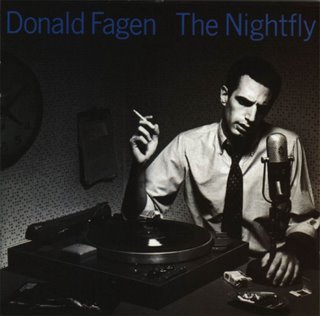
The thing I love so much about The Nightfly is pretending to be the character. From Fagen's picture on the front, I can immediately turn myself into this guy who's sitting up all night, maybe playing jazz records, maybe taking a few calls (respect the seven second delay we use), and generally reveling in the geo-political chili pot of 1962.
Great text: I have a blog ... unfortunately it's written in swedish, but you can at least look at the pictures. It's about my favorite album covers - and "The Nightfly" is up there among the best!
Bit of a silly "off-topic" question, but does anyone know what LP cover that is laying next to the turntable on the Nightfly cover picture?
The album on the Nightfly cover is Sonny Rollins and the Contemprary Leaders, released in 1958 on the Contemporary label. Wonderful LP(s), wonderful article.
Bobby, naming the LP cover is the easy part. Now the hard part: what record is on the turntable? It's obviously not Sonny Rollins & the Contemporary Leaders, since Contemporary records always had yellow labels with black printing.