The Jazz.com Blog
February 20, 2008 · 3 comments
The Legacy of Ella Fitzgerald
Jazz.com concludes its two-week focus on jazz singers with Stuart Nicholsons feature on Ella Fitzgerald. Nicholson, author of an excellent biography of the vocalist, selects twelve essential Ella tracks, and also contributes a biographical essay on Fitzgerald to the jazz.com Encyclopedia.
Ella was one of the few Swing Era stars to adapt with ease to the brave new world of bebop. When the boppers started reshaping the jazz vocabulary in the mid-1940s, most of the older generation looked on with disdain, if not outright anxiety. And even when swing stalwarts made the plunge, as Benny Goodman attempted when he formed a bebop band at the close of the decade, they typically failed to master the intricacies of the new style. Yet Ella not only survived, she thrived in the hothouse environment of modern jazz.
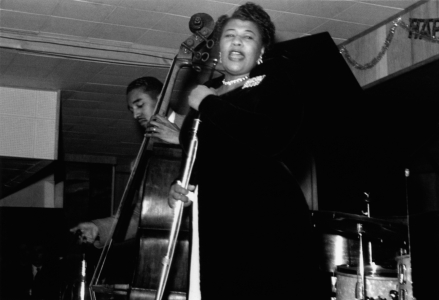
Ella Fitzgerald and Ray Brown at Birdland, photo by Marcel Fleiss
Chicago school drummer Dave Tough spoke perhaps more honestly than most of his contemporaries when describing his first exposure to the new sounds of 52nd Street: As we walked in, see, these cats snatched up their horns and blew crazy stuff. One would stop all of a sudden and another would start for no reason at all. We never could tell when a solo was supposed to begine or end. Then they all quite at once and walked off the stand. It scared us. And Tough proved to be more adaptable to the bop idiom than most of his generation, fitting in admirably with the modernistic sounds of Woody Hermans post-war band.
Yet if Ella struggled with the new style, one never heard it in her recordings. Rather, she seemed liberated by the wider freedom offered by the bebop vocabulary. This amazing lady, who never took a singing lesson in her life, had more than just a great voice; she possessed superhuman ears, and they guided her flawlessly through the trickiest changes and most intricate passages. One can hear this in her recording of Flying Home from 1945, a Swing Era classic made famous by Lionel Hampton and Benny Goodman, but now updated for the modern era by this brash vocalist. As Nicholson writes: It was the product of over two years experimentation during live performances in extending the boundaries of jazz singing, and remains among the finest jazz vocal records of all time.
Her scat singing was now moving well beyond anything previously done in the art form. When Louis Armstrong started singing wordless melodies back in the 1920s, the effect was entertaining and swinging . . . but hardly prepares us for what Ella would do with the concept a quarter century later. Even today, one listens to her classic versions of Mack the Knife or How High the Moon or St. Louis Blues (each recorded during that golden period from the late 1950s and early 1960s) and can only marvel at the dynamo on stage, propelling these songs forward with endless creativity and impressive virtuosity.
Despite her huge talent, Ellas popular success is somewhat surprising. She was a musicians singer, with more in common with the saxophonists and trumpeters in the band than with the other star girl singers of her generation. One always got the sense that Fitzgerald sang for the sheer fun of it, and not to win popularity contests or sell records. And if songs are a compromise between music and lyrics, no one had any doubts which side Ella preferred. Sometimes she forgot the lyrics, or made up new ones on the spot. In mid-performance of the W.C. Handy classic, one of Ellas lines is People are wondering what Im singing. Believe it or not its St. Louis Blues." Mack the Knife became one of her biggest hits in no small part to her charming way of messing up the words. Even from the start of her career, she could take lyrics that were little better than doggrel A-Tisket, A-Tasket or Chew, Chew, Chew and make them into something magical.
But dont think that Ella was ever disrespectful to the songs she sang, even when she jumbled up the lines. Her Songbooks still stand out as the single best starting place for a listener who wants to make the acquaintance of the American popular song tradition. Here, in a series of in-depth exploration of the leading tunesmiths of the century Cole Porter, George Gershwin, Jerome Kern, Irving Berlin and others she left behind a legacy that has lost none of its luster, even after more than a half-century. Perhaps Ira Gerswhin summed it p best when he said, I never knew how good our songs were, until I heard Ella sing them."
This blog entry posted by Ted Gioia
Tags:

hey mannnn this singer is great!!!! i think shes the best
Ella Fitzgerald is an amazing singer. I wish I could've been alive when she reigned supreme and saw a concert. my mommy always talks about her and I think she sounds great.
ella is super cool, dude! ithink she is bomb!