The Jazz.com Blog
February 06, 2008 · 2 comments
Can Minimalism and Jazz Co-Exist? Nik Brtsch Says Yes!
The golden age of minimalist music lasted a quarter of a century, by my measure. The premier of Terry Rileys composition In C in 1964 signaled its starting point, a moment when the throbbing repetitive patterns of this music were like a jolting dose of digitalis to an arteriosclerotic classical music establishment benumbed by the terminal prognosis of serialism. The new style became central to the musical currents of the 1970s, and by the close of the decade, works such as Steve Reichs Music for Eighteen Musicians and Philip Glasss Einstein on the Beach were exerting an impact that no contemporary classical compositions had achieved in a long time. The success of John Adams's Nixon in China in the late 1980s represented a late blossoming, a work that could still surprise us something which minimalist music has been less and less capable of doing in more recent years.
The success of these works is perhaps best gauged by measuring their impact outside the inward-looking circles of academic classical music. During the 1960s, even intellectuals and the cultural savvy proletariat began to feel justified in ignoring the world of contemporary classical composition. In the first half decade after Rileys In C, the Pulitzer Prize in music had gone to
Variations for Orchestra, by Leslie Bassett
Quartet No. 3, by Leon Kirchner
Echoes of Time and the River, by George Crumb
String Quartet No. 3, by Karel Husa
Time's Encomium, by Charles Wuorinen
Synchronisms No. 6, by Mario Davidovsky, and
Windows, by Jacob Druckman
Say what you will about these compositions but, love 'em or hate 'em, no one can pretend that people outside the academy paid much attention to them. In contrast, Philip Glass could strut like a rock star and, as leader of the Philip Glass Ensemble, play in the same venues that featured the hottest acts of the day. Everything from film music to punk rock felt his influence; heck, he was even mentioned on The Simpsons and lampooned on South Park. I almost expected to see Philip Glass as a half time act on the Super Bowl. Reich and Adams, for their part, were only a half-step behind Glass on the fame-o-meter, and also found themselves lauded by audiences who couldnt tell George Crumb from R. Crumb if their lives depended on it.
But the jazz world never successfully assimilated minimalism. Oh, a few brave souls tried, but never with much impact. The rhythmic essence of a jazz performance is usually built on surprise and syncopation, while the rhythms of minimalist music are typically marked by predictability and on-the-beat phrasing. True, these two styles have sometimes intersected. Reich recorded his Music for Eighteen Musicians for the ECM label, and even brought in some musicians with jazz pedigrees. But no one would ever mistake this for a jazz performance. Similarly, Terry Riley can play jazz-oriented piano music (listen to his highly recommended Lisbon concert or his delightful experiment in untempered piano tuning on The Harp of New Albion); but it is worth noting that he moves away from his minimalist orientation when he does so.
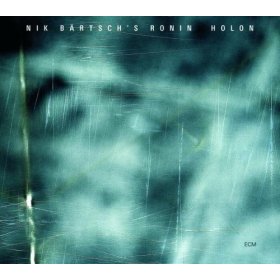
Nik Brtsch, who released his new CD Holon yesterday, is one of the few believers in the potential mixture of such opposed musical idioms. Brtsch himself seems to acknowledge the paradoxical nature of this pursuit for example, when he describes his music with the oxymoronic rubric zen-funk. A sense of an unobtainable truce between opposites also comes across when Brtsch quotes Morton Feldman: I always leave the concert hall when I start tapping my foot.
The previous ECM release by Brtschs ensemble Ronin, Stoa generated radically conflicting responses, sometimes within the course of a single review. One critic asked what the hell is this? and followed up with the pronouncement: ECM has been pushing the envelope for nearly 40 years, but with Ronin, theyve pushed it beyond the pale into God knows what. Then the same writer annointed Ronin as the band of the future, and praised its compelling, curious, maddening and provocative music.
I find myself similarly torn in two directions by Brtschs new project. And this whole strange trip validates my belief in the wisdom of reviewing tracks, not entire CDs. I have given one track from Holon a dismal grade of 79, while another performance from the same disk gets an A with a score of 90. Rarely do I encounter a CD with such variability from track to track.
Repeated rhythmic patterns can be boring or hypnotic, mechanical or funky. Brtsch seems to want to find that meeting point where all of these attributes balance out in some dreamlike equilibrium. There are long stretches on his new release that fall far short of such aspirations, but at times (especially in the last half of the CD) he somehow proves that his seemingly irreconcilable goals can all be met. During those interludes, his music is zen-like and funky.
The most exciting composition on Holon is Modul 45 where all the pieces fit together. Accordingly, it has been selected Song of the Day at jazz.com. You can find the full review of this track here.
This blog entry posted by Ted Gioia
Tags:

thanks much, bro
Essentially, it comes down to using rythmic phrasing and restraint.