The Jazz.com Blog
March 04, 2008 · 0 comments
Does a Piano Perspective Now Dominate Jazz? (Part 1)
Critic Thierry Quénum who covers the global jazz scene from his home base in Paris, contributes these thought-provoking reflections on the emergence of a new instrumental focus in jazz. Below is the first installment of a two-part article. T.G.
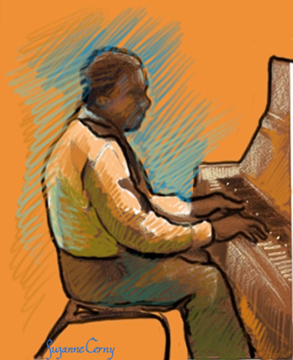
If you follow the history of jazz, decade after decade, it doesn’t seem exaggerated to say that different instruments have had the leading role in turn. These shifts, driven by various factors, tell us much about the evolution of the music.
The first decades were obviously dominated by the trumpet (or its sister instrument, the cornet). Its loud, clear sound -- at a time when orchestras often played in the open air or in noisy indoor locations-- may explain this leadership. But the fact that the instrument was played by charismatic personalities, who happened also to be bandleaders, such as King Oliver and later Louis Armstrong, no doubt contributed to its immense popularity.
In the case of Armstrong, his musical personality strongly appealed to his fellow instrumentalists, and his charisma touched audiences as well as musicians. So much so that Earl Hines’s way of playing the piano – influenced by Armstrong’s – was termed “trumpet-piano style”. Indeed few musicians were insensitive to the way Satchmo made jazz soloing evolve by way of his own creativity and technical virtuosity.
During the 1930s, though the trumpet was still popular, the clarinet now took the lead. Again, immensely popular bandleaders like Artie Shaw and Benny Goodman were decisive in this change of reign. The fact that the big bands became the favorite type of ensemble during this period, and that their repertoire consisted in great part of Broadway standards played for dancers is another reason. The clarinet is not as loud and outspoken as the trumpet, and its register is closer to that of a singer’s voice. As a result, it enjoyed a success with audiences who may have been more drawn to its vocal-like mellower sounds than to the trumpet’s bravado.
Then came the saxophone. Most would agree that Coleman Hawkins introduced the tenor as a major solo instrument through his memorable 1939 version of “Body and Soul.” But in lots of big band performances the tenor solo had already emerged as effective climax for a swing tune. The tenor battles and chases were to be found in big bands such as Count Basie’s – where Lester young and Herschel Evans were rivals and partners – as well as in later combos, such as those of Gene Ammons/Johnny Griffin, Dexter Gordon/Wardell Gray or Clifford Jordan/John Gilmore. This tenor fashion endured for a long time. The Mobley + Coltrane + Sims + Cohn “Tenor Conclave” as well as Rollins/Coltrane’s “Tenor Madness” bear witness to it. In the 1950s and 1960s, the tenor was also a staple in most of those popular organ combos that roamed the “chitlin circuit” and other clubs from Coast to Coast.
The alto sax, through Charlie Parker, had its real king from the mid forties to mid fifties, but he was a leader whom other altoists could hardly follow without copying – Lee Konitz being one of the few exceptions. Parker was a king who (much like Armstrong two decades earlier) was influential on almost all other instruments. Of course one can argue that in Bird’s case, a musician and his style became “king” rather than an instrument. But could the swiftness of phrasing attached to bebop have been brought to perfection on any other instrument than the alto sax? I don’t want to revive the debate about “did man become more intelligent when he could use his hands to do something else than climbing up trees, or did he use his hands to make tools because he had already become intelligent?”, but one must notice that few other instrumentalists played fast, harmonically challenging lines before Charlie Parker, and those who did it after Bird were all influenced by him.
After Bird passed away, virtually unchallenged by his peers, in the mid fifties, the alto had a hard time finding another champion as persuasive as Parker. On the contrary, the reign of the tenor – that never really ceased after ’39, and was reinforced after Dexter Gordon adapted Bird’s alto technique to the bigger horn – carried on through the fifties by way of competition between several challengers, the most prominent being Rollins and Coltrane. The latter developed a concept, a musical personality and personal charisma that allowed him to reassert the tenor as the reigning instrument, which it has more or less remained until recently.
You can see it from the general point of view of advertising or cinema, where the image of the tenor is often considered as the symbol of jazz at large, or simply viewed as “sexy”. You can also see it from a more restricted point of view, simply by focusing on the global musical milieu: Michael Brecker, like many of post sixties tenorists, was deep into Coltrane, then Brecker’s sound and licks were universally admired and copied in the seventies and eighties. It was Joe Lovano’s turn from the nineties on. But all of these stars played tenor. No other instrument displayed such an uninterrupted line of prominent role models at the same period and, as far as the alto sax is concerned, the main reference remained Charlie Parker, in spite of Ornette Coleman’s or Cannonball Adderley’s rise to prominence.
And today? Gradually, over the course of the final decades of the 20th century, the piano became what I claim it to be now: the new king of jazz instruments. Unlike its predecessors, it took the piano some time to establish its reign. Of course there were great pianists right from the start. But they were either part of a combo, like Earl Hines; or confined to a specific style, like the stride pianists; or singers at the same time, like Fats Waller or Nat King Cole; or bandleaders rather than pure virtuosos on their instruments, as with Duke Ellington or Count Basie. The first who could have taken his instrument to the top place was of course Art Tatum, but his virtuosity was so stifling that he stood alone as a genius, with no imitators. The bop piano virtuosos, Bud Powell leading them, could never challenge the supremacy of the horns, and only Thelonious Monk might have been a potential crowner of the piano. But his style and personality were too idiosyncratic and disturbing for that, and his talent for composition may have obscured the purely pianistic aspects of his artistry.
And why is the piano now the king of instruments? The short answer: Bill Evans. He never meant to be in the forefront and was definitely not an outspoken character, but he was a virtuoso, developed a “concept”, and, even before he became a renowned leader, was highly visible through the various bands that he played or recorded with as a sideman. Indeed, his playing always added a distinct imprint to these bands’ essential sound.
When he launched his first trio the magic soon started to work, first on the following generations of musicians and on the audience, then through the enormous amount of piano trios that flourished in his wake all over the planet. I have not traveled to Japan, but I have heard that record shops there often have a special “piano trio” section, with lots of CDs, hardly available elsewhere, recorded by Evans disciples! What Evans started is a triple trend that has contributed to the emergence of the piano as king of the jazz instruments: first, a focus on the trio, conceived as a unit wherein each member plays an almost equal part; second, an unprecedented focus on the melody, and on a way of improvising that has its roots in the Romantics of the 19nth century and the Impressionists of the early twentieth; and, third, a piano technique based at least as much on the European classical tradition as on the jazz heritage, as far as touch and voicings are concerned.
In other words, Evans shifted the balance of the jazz piano by introducing more overt European influences into the jazz idiom than anybody before him, including Lennie Tristano. This helps explains the impact and influence Evans has enjoyed in academic institutions, and in Europe, as well as the number of European pianists who started their career as followers of his visionary approach to jazz. Enrico Pieranunzi – who wrote a great book about Bill Evans – offers a striking example. In addition to his jazz career, Pieranunzi was a long-time classical piano teacher in Rome, and he often plays with Evans’s former bassist, Marc Johnson. This growth of the “Evans trend” and, parallel to it, of the number of piano players among Europe's leading up-and-coming jazz musicians, provide additional evidence that the piano has now become the king of jazz instruments.
END OF PART ONE
This is the first part of a two-part article by Thierry Quénum. For part two, click here .
Tags:
0 responses so far
There are no comments yet...