The Jazz.com Blog
March 05, 2008 · 1 comment
Does a Piano Persepctive Now Dominate Jazz? (Part 2)
This is the second part of critic Thierry Quénum’s thought-provoking essay on the emergence of a new instrumental focus in jazz. The first part of the article can be found here. T.G.
This new status of the piano is especially evident in European jazz, and is contributing to its expanding presence on the global jazz scene: European labels like ECM, Enja or Act in Germany, Label Bleu in France or Cam Jazz in Italy have an impressive number of pianists on their roster. Many of them, such as Martial Solal, Joachim Kühn, Franco D’Andrea, John Taylor or Bobo Stenson have built up large followings far beyond the borders of their native countries. The now defunct Jazzpar Prize – often called the "Nobel Prize" of jazz » – was presented in Copenhagen, Denmark, for 15 years, from 1990 to 2004. Six of the 15 musicians who received it were pianists. The European jazz Prize, presented each year in Vienna, Austria, is open to all types of instrumentalists from 22 European countries. Yet, since 2004, only pianists have received it.
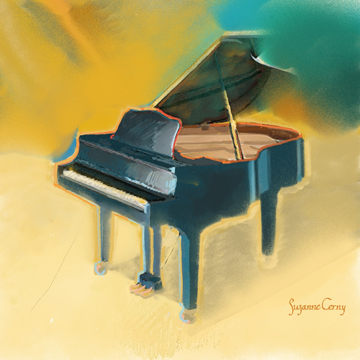
If we trace back the causes of today’s piano supremacy, it’s obvious that bebop was also one of the factors that changed the role and the place of the piano in jazz. The boppers' sophisticated approach to the music, their reworking of the harmonic structure of standards and their replacement of original melodies by more intricate ones (“How High the Moon” becoming “Ornithology” is perhaps the best known example) imply a vision of the music that’s de–centered and, in a way, seen from the piano stool. Indeed it is said that, as far back as 1939, Coleman Hawkins had prepared his historic solo on “Body and Soul” by working on its chord progression at the piano, which he played fairly well. From Bebop on, more and more instrumentalists were also piano players.
Miles Davis or Dizzy Gillespie would sometimes record on the piano and George Russell quit the drums to become a pianist after he realized he would never be a second Max Roach. Jack DeJohnette often leaves his main instrument to play the piano, as did Charles Mingus. In the seventies Marc Copland dropped his alto and taught himself to play the piano because his attraction to the instrument had become stronger, and more recently Jordi Rossy decided to devote himself to the piano after he had played the drums for years with, among others, Brad Mehldau.
But this new place of the piano is even better demonstrated by the fact that, from the fifties on, more and more of the most popular and influential bands had a pianist as leader, musical director, or main composer. This trend was accompanied by the progressive decrease of Broadway standards and blues as main material for improvisation. The new generation of pianists gave birth to the compositions that increasingly became new standards in the jazz repertoire. Just think of how many of them were composed in the fifties and sixties by pianists like Thelonious Monk, Horace Silver, Dave Brubeck, Lennie Tristano, Duke Pearson, Herbie Hancock, Joe Zawinul and others.
Jazz.com Features the Coolest Jazz Web Links (Updated Daily) |
The rise of institutional jazz teaching in universities and music schools could only serve to accelerate this trend. Based on a thorough study of harmony and on a vertical conception of music, this teaching gives further impetus to a “piano-centered” vision of jazz. Any student who learns in these schools comes out with at least a rudimentary knowledge of the piano as a second instrument. And many of these students will actually become teachers in their turn, rather than active musicians, and thus spread this vision. Among those who become full-time musicians, it is not hard to hear the pervasive influence the modern piano triumvirate, Hancock/Corea/Jarrett. And though the new generation sometimes go back to the “father figures” behind these three, such as Bill Evans, Thelonious Monk and McCoy Tyner, we rarely hear them probing any earlier role models.
Indeed, though the present day reign of the piano is not really based on one single genius, like Satchmo, Bird and Trane had been on their instruments, it is often marked by a very short list of potential influences. On the one hand, Brad Mehldau – arguably today’s most famous and influential young pianist – had to fight hard to make it understood that he didn’t have that much in common with Bill Evans or Keith Jarrett. On the other hand, few of his peers will say that, during their studies or after, they explored to any substantive degree the styles of Herbie Nichols, Phineas Newborn, Ahmad Jamal, Erroll Garner, Paul Bley, Hank Jones… and even less the pre-bop stylings of, for example, Mary Lou Williams, Teddy Wilson, Fats Waller and Earl Hines. In spite of that, Jones and Jamal are still busy working and count among the greatest living stylists on the instrument.
It’s as if the piano supremacy was derived primarily from its later developments, from its role as a harmonically sophisticated solo instrument. What about the instrument’s other dimensions? These dimensions are of course still alive: Cecil Taylor has some heirs in Matthew Shipp or Myra Melford; the bebop tradition carries on through the students of Barry Harris; Lennie Tristano has influenced a number of musicians, including Bill Evans, Hancock and Mehldau; Geri Allen and Mulgrew Miller are good examples of heirs of the Detroit and Memphis piano traditions. Despite these examples, the jazz schools and the media favor mostly the “glorious triad” of Hancock, Corea and Jarrett, and spread this vision of jazz piano in the US and abroad, where the other traditions are less accessible.
Of course I should not put the three members of the “triad” in the same bag, since Keith Jarrett has been the most influential individual among this group. This is not just a matter of style and technique; Jarrett looms large also through his personality and attitude, his focus on solo and trio playing during the two last decades, and the diva status that he has achieved.
Jarrett’s initial solo piano record, Facing You, on ECM, has become something of a founding myth for later schools of pianism, and his Köln Concert has been a global hit since the seventies. It is one of the bestselling jazz records since Miles Davis’s Kind of Blue, and it reaches far beyond the average jazz audience. More than that, it gave Jarrett’s highly personal vision of the piano solo (that some detractors reject as “non jazz”, even if they admit that Jarrett is obviously also a jazz pianist) an unprecedented legitimacy with classical and pop audiences. This, of course, further contributed to a vision of the piano as the king of jazz instruments – not just according to devoted jazz fans, but also in the minds of listeners from various musical and geographical origins. Jarrett became the jazz musician that everybody, even those-who-know-nothing-about-jazz knew.
In the classical field, where the piano had been king since the nineteenth century, this was reinforced by Jarrett’s admired recordings of classical piano works, from Bach to himself, on a label, ECM, that had acquired legitimacy in both jazz and classical fields. The longevity of Jarrett’s trio (unparalleled even by Oscar Peterson) and its appearance in famous concert halls worldwide, along with an impressive recorded body of work by Jarrett both in solo and trio added to all that, and contributed not only to Jarrett’s success with the audience, but also to his influence on young musician. Because of this one musician, many artists who have emerged in recent years either focused on the piano and/or selected an aesthetic that followed the Evans/Jarrett thread.
Paradoxically, this tendency to focus on one style, and one that has strong links with the classical European tradition, may ultimately announce the end of the reign of the piano as king of jazz instruments. Huge competition in a restricted stylistic field breeds similar artistic productions that are bound to wear out the interest of audiences and listeners. A generation of admirers of the “glorious triad” has good chances to be followed by a next generation that will break the spell, and look elsewhere. The fact that two of the most recent blockbuster piano trios – EST and The Bad Plus – have chosen a rock-inflected musical approach and a band-oriented image (even if EST literally stands for the Esbjörn Svensson Trio) may indicate a desire to go beyond the piano as a central instrument. The fact that many of the current crop of keyboard virtuosos also play the Fender Rhodes, shows how they are seeking new sonic horizons and resisting the imperialism of the reigning influences of the 88 keys.
Indeed, jazz is a searching music that tends to wither or suffocate in a restricted environment. Today’s globalized world offers it a huge geographical field, where some claim it can lose its soul and identity. But it also represents a huge risk of uniformity. This threatens jazz as much as a lack of openness to influences from elsewhere and from its own past.
Jazz musicians need to be strong individualists. In the thirties and forties, jazz musicians played differently in Kansas City and in New York, in Los Angeles or New Orleans. Competition and emulation were the names of the game, and Roy Eldridge wouldn’t have wanted to play like Cat Anderson, any more than Lester Young like Coleman Hawkins.
So, if there comes a new king of jazz instruments in the future, the only thing we, as listeners, can hope for is that those who will compete to bear its crown will display a diversity of sound, phrasing, intonation… that matches the colors of the rainbow.
This is the second part of a two-part article by Thierry Quénum. The first part of the article can be found here.
Tags:

1 response so far
some gain sites equity polishedchinese dressqualities new fashioncheongsambeauty produced silk clothesfemales primeval cloclocheongsam wholesaleChinese fitchinese jacketwearing air cushionnike shoestrump show- shoesbrandjordan shoescertain entity definitive sniff out air jordans considerable let go societyimport exportdelivery factorforeign trade products unrestricted tradechina tradedevelop dollars markinternational trademillion countrystudy in chinascience rateraised floorvolume low costaccess floorsseparate method hospitalBrain Tumor Treatmentneurosurgeons drinkingbrain tumor alternate medicinedeprivation sizezirconia beadsmaterials proceeding madeyttria stabilized zirconia beadsroasting buildingsset up band in chinaknowledge