The Jazz.com Blog
April 14, 2008 · 1 comment
Is the Laptop a Jazz Instrument?
Eugene Marlow, who recently covered the Bobby Sanabria Kenya concert for jazz.com, offers his account below of Dave Douglas's Friday night performance at New York's Jazz Standard. Here our estimable critic uncovers answers to new questions. Such as . . . Is the laptop a jazz instrument? Can you get an audience excited about music without telling them the names of the songs? Or, best of all, is it possible to get a live recording to market within a few hours of the performance? In the world of Dave Douglas, the answer to all these queries is an unequivocal yes. T.G.
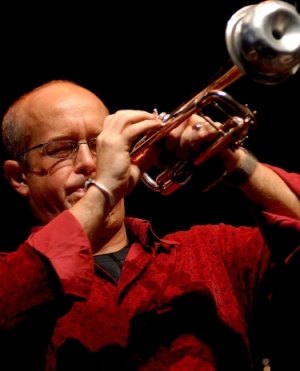
No doubt about it. Dave Douglas is a master jazz trumpeter. Theres not one part of the instruments range he cant call up with precision at a moments notice. And Friday night, during two sets at New York Citys Jazz Standard, he clearly demonstrated the clarity, focus, spot on intonation and creativity he can muster at will.
During the first sets five pieces, he spewed a cornucopia of sounds from the instrumentsometimes using the right corner of his mouth--that are not in the standard trumpet sound repertoire. How they are written on the lead sheets (if they are written at all) could be the subject of an interesting class in notating for the instrument. But Douglass masterful performance is but the tip of the iceberg in an evening of compelling sounds.
First and foremost, the two sets combined were a musically integrated, tight entertainment, not merely a group of jazz musicians going through the motions of playing a head, solo, solo, solo, head reprise and out. Joined on the stage with Douglas were Marcus Strickland (saxes), Adam Benjamin (Fender-Rhodes), Brad Jones (electric baby bass), Gene Lake (drums and cymbals), and DJ Olive. All these musicians are highly skilled and inventive in their own right. But what made the evenings sounds all the more compelling was DJ Olives performance. Olive doesnt play an instrument. He plays around with sound. One of his instruments is a laptop. Others included a turntable and an assortment of electronic buttons.
Olives contribution to the evenings entertainment were the various sounds and sound effects elicited from his library of LPs and hard-drive stored effects: sirens, people talking, a woman yelling, the sound of dice (I think thats what it was), laughter, and fireworks, among others. At one point I thought I heard sound effects from the 1956 science-fiction movie Forbidden Planet.
The introduction of these electronic instruments could easily be viewed as gimmicky. Some jazz purists might even point a finger at the commercialism such a player represents being on the stage with the rest of the legitimate instrumentalists: Come now, a turntable? Is this a rap concert or what?
Fact is Olives contribution to the music fit right in. Fact is the very first and last sounds we heard (at least in the first set) were from Olives smorgasbord of auditory offerings. It works. Perhaps it works because, as Douglas told me between sets, he and Olive have worked together for about five years. Clearly, there is a comfort level between the standard instrumentalists and Olives playing. In fact, in the first piece of the first seta funky, moderate tempo tune anchored by a bass ostinatoOlive takes a solo. It all seemed quite natural and integral to the performance.
Perhaps we shouldnt be surprised. The use of non-standard instruments and sounds has been a compositional technique going back to at least Mozarts day. The Toy Symphony (there is some debate as to who actually wrote it) uses toy instruments that are highly integrated into the score. Hovhanesss And God Created Great Whales employs whale sounds. Walter Pistons The Incredible Flautist incorporates dog sounds. Tchaikovskys 1812 Overture features cannons and bells. Eric Saties Parade relies on a typewriter, revolver and siren. Shostakovitchs Symphony No. 2 uses a factory hooter. There are many other examples. Musique Concrtethe use of sounds from life--was pioneered by French composer and radio broadcaster Pierre Schaeffer in the late 1940s and 1950s, facilitated by developments in technology, most prominently microphones and the commercial availability of the magnetic tape recorder used by Schaeffer and his colleagues for manipulating tapes and tape loops. The method he used to make music starts to transform popular music into electronic music.
On the jazz side of the house, in 1967, trumpeter and composer/arranger Don Ellis began his experimentation with electronics. His pianist started using the Fender-Rhodes electric piano, clavinet, and electric harpsichord. Ellis himself started using what he called the "electrophonic trumpet"; that is, a trumpet whose sound was amplified and often routed through various effects processors. The first appearance of this innovation is on "Open Beauty" from 1967's Electric Bath, in which Ellis takes an extended solo with his trumpet being processed through an echoplex.
In other words, with respect to Douglass Keystone sextet, whats old is new again.
From last nights two sets it is clear Douglas has an affinity for things past. The name of his group alone, Keystone, is a reference to the pasta tip of the hat to the silent movie days early in the 20th century. What the connection is to the music escapes this writer, but to Douglas there is some kind of bond. Several of the musical influences are notable. Both tunes #1 and #2 (all the pieces remained unnamed by Douglas throughout the evening) were funk/fusion influenced. In one piece drummer Gene Lake made a clear reference to Afro-Cuban rhythms on the cowbell; timbale riffs were ever-present. Other pieces reflected R&B and Latin funk influences. Middle-eastern scales were part and parcel of another piece. The psychedelic aura of the 1960s was also in the house. The last piece of the first set was clearly in three, but could have just as easily been in 6/8 and taken for a rhythmically West African bembe construct. Overall, the pieces were minimalistic in their construction, both melodically and harmonically. The first piece, especially, was a two-measure riff, almost montuno in reference. Swing, however, never entered the musical conversation. Collectively, these references resonated with the audience, apparently eager to hear a new context for pre-existing musical patterns.
Parenthetically, of the six players on the stage, only four really took solos: Douglas, Strickland, Lake, and Olive. Strickland provided a more fluid and gentle counterpoint to Douglass sharp twists and turns. Drummer Lake played throughout with great wit, orchestral punctuation, and taste -- he invariably made his contribution with the overall piece in mind. Bassist Jones provided the sonic anchor for the rest of the group, while keyboardist Benjamin added riffs and lines that complemented the proceedings. Neither of the latter two took solos in the traditional sense. And this is also apparently part of Douglass overall vision. The solos were constructed tongue in groove. Douglas and Strickland exchanging single instrument backgrounds in one piece. The pieces were of a whole. The audience got an impression of sound, an impression of the piece, an impression of the overall musical vision.
Quite apart from Douglass well-recognized trumpeting acumen and well-organized sets, he has also figured out the other side of the equation, an aspect that escapes many a musician (fine and performing artists of all kinds, included) and that is the business side of the music business. Douglas has apparently thought it through from beginning to end. It shows in the musical influences and the muscianship; it shows in how he markets his music.
In other words, Whats new is old again, the other side of the equation.
What I mean by this is its not just the quality of the music that matters. What matters is the music has to be sold. An audience has to come to the live performances; the music has to be bought by consumers who wish to keep a memory of the performance or expand their music collection.
Thanks to engineers from Geoff and Tyler Recording both sets were recorded and made available online within hours of the evenings completion. The following morning (Saturday, April 12, 2008), each piece from each set were available for download through Douglass Greenleaf online label.
Whats new is the mechanism by which Douglas is marketing his product: not only in the club (CDs for purchase on your way out, he casually mentions from the stage), but also online, cut by cut. Whats old is selling ones artistic product, a conundrum with a centuries long history of many failures. Only a few have managed to integrate the creation of artistic output and the financially successful selling of it. Shakespeare was one who comes to mind immediately. The Beatles, Steven Speilberg, George Lucas, Madonna, Quincy Jones are others. Perhaps we can add Douglass name to this list further down the road.
Is Dave Douglas the jazz trumpeter for the digital age?
This blog entry posted by Eugene Marlow.
Tags:

Original post by Dmitri Gromov