The Jazz.com Blog
April 03, 2008 · 2 comments
Bobby Sanabria Recreates an Afro-Cuban Classic
Jazz.com recently published a fascinating interview with Bobby Sanabria conducted by Eugene Marlow. Today, editor Tim Wilkins follows up with an in-depth review Sanabria's Tuesday night performance with the Manhattan School of Musics Afro-Cuban Jazz Orchestra. T.G.
What kind of fool would try to update a bona fide jazz classic? And what if the musicians who created that classic were your audience? Who would have the cheek to try this with a band of students, no less?
If this is heresy, then Bobby Sanabria is a heretic, of the best kind - he accomplished this and more when he premiered his Kenya Revisited suite with the Manhattan School of Musics Afro-Cuban Jazz Orchestra on Tuesday night. The suite is Sanabrias take on Kenya, the legendary 1957 album recorded by the all-star band assembled by FranciscoMachito Grillo and Mario Bauz for Roulette Records, with Cannonball Adderley on alto sax and trumpeter Joe Newman on loan from the Count Basie band.
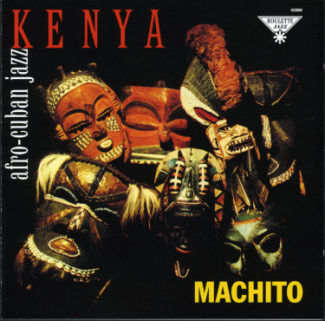
Machito's Kenya
The Kenya LP has such status amongst lovers of Latin music that to remake it with new arrangements and instrumentation, no less is akin to trying to redo the magic of Miles Daviss Kind of Blue, Coltranes A Love Supreme, or Ellingtons Black, Brown and Beige. No task for the timid.
Adderley and Newman are gone, but veterans of the original session were there, watching Sanabria like a hawk. Trombonist Eddie Bert -- who played with everyone from Coleman Hawkins to Thelonious Monk -- was in the audience, as was Ray Santos, Machitos lead tenor saxophonist and arranger. Even Machitos son Mario, an accomplished bandleader in his own right, was there. Tough crowd.
Fortunately for Sanabria, he was joined on stage by one of the key contributors to the 1957 sessions: conga player Candido Camero, who at 86 has more fire in his fingertips than most drummers can ever hope to muster.
It didnt take long for a verdict to come in: by the end of the first number, "Frenzy," Bert, Santos and Grillo, along with the rest of the crowd, were on their feet. The cheering rarely stopped for the next two hours. Those kids played this stuff better than we did! said Bert, beaming, after the show.Man, coming from him - thats the biggest compliment you can get, Sanabria added. Grillo, too, came up to congratulate Sanabria. My fathers idea was for this music to last forever. Tthank you for envisioning that.
Sanabria, a Puerto-Rican native of the Bronx, is a tireless advocate for the recognition of Latin musicians in jazz, and especially of Machito and Bauz, who in 1939 created the Afro-Cubans, the first band to successfully combine the undiluted West African rhythms of the Caribbean with the the eras most sophisticated big-band harmonies on compositions such as Tanga.
Without realizing it, the two childhood friends from Cuba had started a conversation amongst the musical traditions of the African diaspora, a conversation which continues in New York to this day, thanks to musicians like Sanabria. These guys still havent gotten the credit they deserve! Sanabria said. What we want to do is to keep expanding the rhythmic possibilities, so that there are no boundaries.
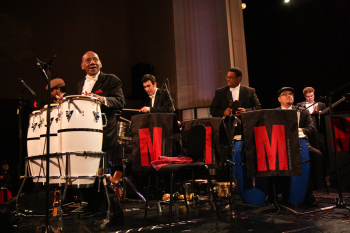
Candido at the Kenya concert
Photo by Brian Hatton
In great measure, the original Kenya compositions sought to demonstrate, once and for all, that that Afro-Cuban rhythms are indeed compatible with jazz. While these two syncopated sensibilities share a strong kinship, they are indeed distinct, and navigating the waters between then is not always easy, whether for a soloist or an arranger.
Bauz and Grillo must be smiling in heaven, if they could hear what we heard on Tuesday night. Sanabria honored the structure of the original twelve songs on the album, but in each case, imaginative touches were added to the arrangements either by himself or by his talented students. Joe Fiedler, a trombonist who plays in the big bands of both Sanabria and Charles Tolliver, wrote the arrangements for Frenzy, Congo Mulence, Holiday and Tin Tin Deo. Danny Rivera, a saxophonist and undergraduate at the Manhattan School, did versions of Oyeme and Minorama. Trumpeter Andrew Neesley contributed his takes on Cannonology, Conversation, and Tururato.
Sanabria could have scored the show himself, but preferred to let these talented young players in on the action, much as as elder musicians like Bauz and Tito Puente did for him. Their updates, in his view, are in line with with the the original philosophy of Machitos Afro-Cubans and the Kenya sessions.
When Ray was writing for the Machito orchestra, Mario just told him to make it as hip as possible, musically, Sasabria said. Thats what were trying to do, too.
The original Kenya compositions drew deeply on the blues, thanks to the masterful arranging of Chicago native A.K. Salim and the superb solos of Adderley and the New Orleans-born Newman on tunes such as Oyeme, which in Spanish means listen to me. Rivera added chord progressions borrowed from Miles Daviss Tune Up and John Coltranes Giant Steps to create a broader palate for improvisers.
Of course, Cannonball and Newman left very big shoes to fill, but alto saxophonist Justin Janer and trumpeter John Stanko, both Manhattan School students, were among the evenings outstanding soloists. Other names to remember from the evening include drummer Norman Edwards and pianist Sylvester Sands, who did a fine job updating the work of keyboard virtuoso Ren Hernandez, who also wrote four of the songs from the original Kenya suite with Bauz.
The 1957 version of Congo Mulence was a funky twelve-bar blues, spiced up by the rhythms of son, son montuno, and cha-cha-cha. Fiedler added to this mix with a new introduction and ending in the mambo style, and a some sections with the 6/8 bemb rhythm superimposed, just for fun.
Bemb, a West African ceremonial rhythm that survived in Cuba, returned in Neesleys take on "Conversation," which featured solos by tenor saxophonists Pawan Benjamin and Michael Davenport. Among Neesleys other outstanding contributions to the evening was his version of "Tururato," which reimagined the mambo as funky New Orleans second line dance, all with a Bronx accent. This prompted Sanabria to don a porkpie hat and raise his umbrelle in an impromptu parade around the stage, dancing and clapping with the audience to make sure the five-pulse clave, which is the heartbeat of Cuban music, ended up back in the second line, where it belongs,
Fiedler offered the evenings most imaginative arrangements, taking Bauzs trademark antiphonic section work and adding harmonic layers to it, such as chorale sections for the trombone section on Tin Tin Deo and for the saxophones on Frenzy. Fiedler is also a master of metric modulations, contributing a 5/4 center section to the original cha-cha-cha rhythm of Holiday, which adds fire to the tune without ever losing its cool.
In the midst of all this metric mayhem, Sanabria presided with a cool head, clapping with the audience and band whenever he wanted to make sure that the downbeat, or the clav cycle, was heard. Sanabrias background as a drumkit drummer, and his additon of a kit to Machitos original lineup, enabled him to lead the band to one rhythmic precipice after another, only to execute the bands the next surprising turn with absolute precision.
The evenings greatest virtuosity was contributed by Candido, who took the stage for four numbers, including Kenya. A master of tonal drumming and the first to three conga drums simultaneously, he had many oustanding moments, including a reprise of the theme to Dizzy Gillespies Manteca on the drums. Candido, who turns 87 on April 22, allowed himself the liberty of playing Happy Birthday to himself to which the band responded, laughing, with a full fanfare.
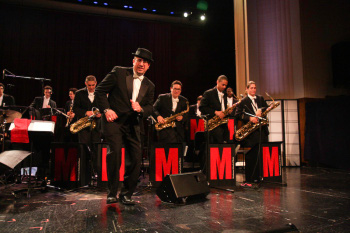
Bobby Sanabrias Kenya concert
Photo by Brian Hatton
Bronx bonhomie and good humor enveloped the evening, but dont be fooled: this music is as serious as it gets, even as it shakes your booty. One thing I like about this music is the way that it brings old and young people together, said Sanabria, because it gets you dancing.
If you did not have the good fortune to catch this show, itry to track down the CD, which will be released in June to benefit a scholarfhip fund Sanabria started for Latino music students. Sanabria will perform some of these same charts again at Dizzys Coca-Cola club in New York on April 14, and in Verona, Italy on June 19th.
Sanabria hopes the CD will qualify for a Grammy nomination. While not a first for a student ensemble, this would indeed be a great achievement and one which in this case would be well-deserved.
This blog entry posted by Tim Wilkins.
Tags:

I was present at this monumental concert last week!!! Mr. Sanabria kept to the roots and tradition!!!! Can't wai til the CD & DVD come out!!! Louis Oreamuno
Oh yes oh yes! An electric excitement that just about blew the roof off! Wow! the spitit was in the house! I go to A LOT of concerts and this was by the far the BEST one of the year to date! Bobby is a uniquely gifted bandleader...and sure knows how to pick his players! Bravo!