The Jazz.com Blog
May 14, 2008 · 1 comment
Jazz's New Gold Standard: More Bull Than Bullion
Is jazz experiencing a new golden age? Certainly one journalist thinks so. But Alan Kurtz, jazz.com's resident curmudgeon (who recently took on National Record Store Day in this column) cautions jazz fans not to pop open the champagne bottles quite yet. He offers his dissenting views below. Readers are invited to share their own opinions by adding their comments or emailing them to editor@jazz.com. T.G.
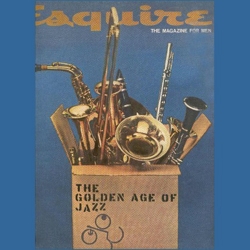
Fifty years ago this summer, a popular men's fashion magazine began preparing its annual Holiday issue. Well-written articles and fine photographs within would document what Esquire's January 1959 cover proclaimed as "The Golden Age of Jazz." In Esquire's view, the late 1950s marked "the most exciting, most creative, and perhaps most crucial age through which our native music has ever passed."
Fifty years later, New York writer Martin Johnson reveals now on TheRoot.com that jazz is "On the Cusp of a New Golden Age." On its surface, this may seem like dja vu all over again. But Mr. Johnson counts carats very differently than Esquire did.
Esquire was effusive about the jazz audience. "Its presence is loudly attested to by the ringing of cash registers in night clubs, concert halls, record stores, and music schools; by the subscription lists of the half-dozen magazines entirely devoted to jazz, and the dozen others which feature it regularly. Its purchasing power is as much evidenced by the 12-record Encyclopedia of Jazz that was recently offered to supermarket customers across the nation as by Norman Granz's multimillion-dollar concert-and-record empire, built wholly out of the marketing of this kind of music." Over the past year, Esquire noted, to satisfy an "enormous" and "diverse" audience, new jazz albums had appeared at the rate of one a day, with sales sometimes surpassing half a million. As for the airwaves, jazz occupied "an incalculable amount across the nation," part of "the gradual recognition, in books and television and movies, that this music is perhaps the most indigenous expression of our national life."
Occupying an incalculable amount of the airwaves was no doubt wishful thinking, and sales of half a million for a jazz album in those days seem inflated by one or two zeros. But there's no denying that the pop charts did sometimes get jazzy, as when Canadian flutist Moe Koffman's "The Swingin' Shepherd Blues" swung for three months among the Cash Box Top 60 Singles in 1958. Even TV caught the bandwagon. During 1957-59, jazz buff Steve Allen emceed four one-hour Timex all-star jams on NBC, CBS telecast its historic special The Sound of Jazz, and local stations from New York's Channel 13 to L.A.'s KABC featured weekly jazz bashes.
As Martin Johnson sees it, however, popularity is no longer the right scale upon which to weigh gold. "Sales of jazz recordings are down," he acknowledges, "making up a meager 2% of all record sales worldwide." At the same time, most young adults can't afford to attend a "high-end jazz club," where, he writes, "admission is $30, drinks are $10 and even a burger will set you back $15." Nevertheless, Johnson insists, "A new and enthusiastic audience for jazz is sprouting up." His evidence? "Several times in the last few years," he has found himself squeezing into standing room "amid a crowd full of twentysomethings" at one of Manhattan's small jazz nightclubs. If this seems less than convincing, no problem. "The new golden age," Johnson reckons, "reflects the new scaled-down economy of the music industry in general."
But again, not to worry. This downsizing of the industry and outsourcing of its audience are offset by the many "interesting and exciting new recordings and concerts" whose "run of excellence is more than a statistical blip. It is a product of structural change in the jazz world." Simply put, today's artists are "embracing and interpreting more popular repertoire." With their covers of Radiohead, Soundgarden, Oasis, Bjork, Prince and Joni Mitchell, performers are gilding "jazz the music" (as opposed to jazz the industry). "Even Wynton Marsalis, once the leading jazz purist," Johnson reports, "is about to release a pop-oriented recording of duets with Willie Nelson."
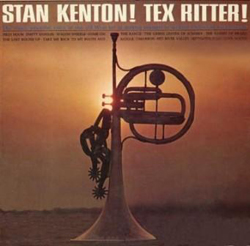
The more things change, the more they stay the same. In 1962, progressive jazz-meister Stan Kenton roped singing cowboy Tex ("Do Not Forsake Me, Oh My Darlin'") Ritter into recording traditional songs of ranch and range backed by Kenton's ponderous Mellophonium Orchestra. To freethinker Kenton, all music was equally valid. If he could sufficiently "Kentonize" country & western, he could lasso disbelieving fans from both sides of the musical fence.
Thus did Stan & Tex rustle up jazz versions of a dozen C&W staples such as "Empty Saddles" and "The Last Round-Up." The resulting album, released hopefully by Capitol Records as Stan Kenton! Tex Ritter!, proved to be High Noon for Kenton, not to mention Ritter's Last Round-Up in Hollywood. Forsaking Stan at the deserted corral of jazz and C&W, Tex sagely skedaddled to his country music hideout in Nashville, Tennessee. Kenton stuck to his gunsor at least to mellophoniums. But after this disgrace, he'd never again be on any real Hipster's Wanted Poster. A cautionary tale, perhaps, for Wynton Marsalis.
In any case, there is something profoundly depressing about Martin Johnson's claim that jazz is "smokin' at a level not heard in a long time." Have we really reached the point where a saturation of self-produced CDs, which serve more as polycarbonate business cards than as a medium for artistic expression, heralds a new Golden Age? Where a tiny bar crammed with twentysomethings schmoozing to jazzy chad recycled from pop has-beens signals anything other than cynical pandering?
If this be a Golden Age for jazz, then devaluation of our beloved currency has reached a new low. All of us who cherish this musicartists, fans and writers alikeneed to get a grip. Jazz is more of a minority interest than ever. Fortunately, since there are more people than ever, even a diminishing market segment means that jazz still appeals to tens of thousands, possibly hundreds of thousands across the globe. Can't we celebrate the golden anniversary of jazz's last Golden Age without scratching for the fool's gold of another such era? It ain't gonna happen.
By all means, let's enjoy and encourage jazz's latest developments. But enough already with the hype. Leave that to the pros who shill for Clay Aiken and Miley Cyrus. There really is gold in them thar hills.
This blog entry posted by Alan Kurtz.
Tags:

Hi, Your observations about where jazz is headed is interesting. As a producer of a online jazz entertainment news show "Jazz it Up!" I take an offense to your pessimism on where jazz is in our culture. Hmmmm did I watch Herbie Hancock win a 2008 Grammy for "Best Album of the Year". For those million+ viewers from around the world who watched Jazz it Up! an online jazz news and entertainment show, I thank you. Make sure you subscribe for FREE! Season 2 is really going to Jazz it Up!