The Jazz.com Blog
May 15, 2008 · 1 comment
The Dollar Declines Overseas . . . And U.S. Jazz Does the Same
Paris-based jazz critic Thierry Qunum, a frequent contributor to this column, has just returned home from Mai Jazz, a Norwegian festival that is celebrating its 20th anniversary this year. His report below raises interesting and controversial issues about a European jazz scene that increasingly sees itself as independent of US trends and influences. Readers are invited to share their own opinions by adding their comments or emailing them to editor@jazz.com. T.G.
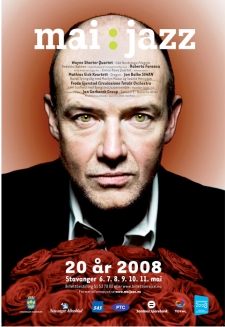
The people of Stavanger, Norway have good reasons to be proud that their city was elected Cultural Capital of Europe (CCE) for 2008. This harbor city of 120,000 inhabitants, on Norways South Western coast, thus acquired an international recognition that supplements tourist interest in its fjords and exquisite countryside, and the economic value of its offshore oil industry.
All this was explained by the radiant deputy mayor of Stavanger to a group of some 30 jazz journalists, festival directors and club owners from around the world during a lunch held in a beautiful early 19th century royal manor overlooking the city. But why so many jazz professionals in Stavanger on this exceptionally warm and sunny spring weekend? Actually most of them come to this part of Norway every year or so, because the Vestnorsk Jazzsenter (VNJS, Western Norway Jazz Center) invites them to Jazz Norway in a Nutshell (JNN), a showcase that allows them to discover local jazz musicians that are not necessarily publicized around the world by famous labels such as ECM or Jazzland.
Last year JNN was coupled with the Natt Jazz Festival in the neighboring city of Bergen. This year it was an obvious choice to hold it in Stavanger, the newly appointed CCE, and to couple it with its home-grown Mai Jazz festival, which was celebrating its 20th anniversary.
Norway is a small, affluent country of about 4.5 million people, and it has a number of great music schools with jazz departments whose output of young, talented musicians is remarkably high. The comparatively small size of the country, and even of Scandinavia at large, compels them to look for an international career early on. The idea behind JNN is to help these musicians do so, and the generous Norwegian policy as far as culture is concerned be it the State, the regions or the cities allows the VNJS to contribute to this. By bringing the rest of the world to see young Norwegian musicians, it hopes to trigger some gigs abroad.
According to Bo Grnningsaeter, chief executive of the VNJS, this export process works fairly well. As a result, the party of some thirty jazz professionals from Asia, Europe and North America had an opportunity to hear a significant number of Norwegian musicians that havent traveled abroad much yet, as well as enjoy more familiar international artists. Significantly, Mai Jazz featured very few Americans just as the difficulty foreign bands face trying to get engagements in the USA may explain the absence of promoters from the US.
Some local promoters, like Grnningsaeter, even say that they dont need the Americans anymore since what they propose is rarely original, whereas the level and diversity of European jazz and Norwegian jazz particularly has enormously increased in the past few decades. One Norwegian festival promoter went so far as to declare that he and his team realized, after they had finished booking their program a couple of years ago, that they hadnt even thought of including one single US group! For whatever reasons, this years edition of Mai Jazz offered a few major American artists, such as Wayne Shorter, Oregon, and John Scofield playing with the Stavanger Conservatorys Bjergsted Jazzensemble and a Norwegian rhythm section.
One of the most impressive musicians on this last concert was certainly bass player Ole Morten Vgan. He is definitely the next man from the North to watch on this instrument, that has seen the rise of a number of talented artists made of Norwegian wood in recent decades. Mai Jazz also showcased famous names and rising stars from the rest of the world, such as veteran trumpeter Enrico Rava, surrounded by his latest choice of brilliant young Italian sidemen, the Neil Cowley Trio, the new piano sensation on the British scene, and Roberto Fonseca, one of the latest piano wonders from Cuba.
But most of all, when youve flown all the way up to Norway and are not outdoors enjoying the exceptionally warm spring weather, you and your international mates will want to listen to local bands you wont hear elsewhere. Among them, the Zanussi Five (alto, tenor and baritone saxes, plus bass and drums) played in a former 19nth century brewery overlooking the North Sea, and displayed their fine art of arranging, drawing on the diverse timbres of their reeds and their great sense of construction and dynamics.
Trumpet player Mathias Eick who just released his first CD for ECM is another man to follow. His virtuoso playing differs from that of most Nordic trumpet players. He likes long phrases and has a taste for lyricism as well as for energetic blowing in an electric context, revealing that he has digested Miles Daviss 70s period in an utterly personal way. The Stavangerer, a club set in a large wooden building close to the city center, was the perfect place for the intense performance Eicks quartet delivered.
In the Country is the name of a ensemble comprised of pianist Morten Qvenild, bassist Roger Arntzen and drummer Pl Hausken. But this band is not just one more piano trio, since its members sometimes sing or use electronic devices and miscellaneous instruments to broaden their range. Still their approach is typically Nordic in its use of song formats as well as baroque or classical cadenzas, and in its concern for sound textures and space. Having them play in an ancient cloister about half an hours drive from the city was a good way to immerse the audience in the half conceptual, half organic atmosphere that this trio builds.
Apart from these already existing groups, some of Mai Jazzs concerts were projects financed with the help of Stavanger 2008. Sax and clarinet player Frode Gjerstad could thus present three groups of improvisers from several countries on the same evening, including vibist Kevin Norton, drummers Louis Moholo and Paal Nilssen-Love, fellow reed player Sabir Mateen, bassist Ingebrigt Hker Flaten and cornetist Bobby Bradford. They all played together two days later, under the collective name Circulasione Totale Orchestra 2008, and their performance, featuring two bassists and three drummers, stood out as the most original and powerful event of the whole festival. It showed how lively, trans-generational and trans-national free jazz still can be, even if it doesnt always attract huge audiences, and often has little room in festivals that are not entirely devoted to this genre.
Keyboardist Jon Balkes composition Siwan, also commissioned by Stavanger 2008, was exactly the opposite. Performed in the beautiful St Peters Church, it brought together trumpeter Jon Hassel, some baroque strings players, Asian musicians, and Moroccan vocalist Amina Alaoui. Though some jazz hues could be felt in it, the main influence in this syncretic oratorio was Arabic-Andalusian music. It confirmed that Balkes interests range from jazz to classical through folk music from different parts of the world. In some ways, he is following in the path of his Viking ancestors, who also traveled over many continents, centuries ago.
The final concert had to be something big, and though Jan Garbarek has often played Mai Jazz in the past, his following doesnt seem to fade. His quartet filled a 1500 seat auditorium on the outskirts of Stavanger, and was a huge success. Garbarek didnt rest on his laurels. Of course, Nordic and Celtic folk themes are still the main vehicle for his lyrical soprano sax. Yet perhaps because Manu Katchs driving drums was ever present beside him, Garbarek indulged in a couple of lighthearted calypsos and delivered some fiery tenor solos that conjured up the memory a fellow horn player, the late Michael Brecker.
Mai Jazz obviously tries to reach a consensus between popular tastes and innovative proposals. The quality of local bands fully justifies the part they take in the program. On the other hand, the low profile of US jazz here suggests the spread of an attitude that views the homeland of jazz music as just one option among many, as a single aspect of what the jazz world has to offer. In truth, high quality jazz can have its roots anywhere. But while a multicultural attitude is spreading widely throughout the Europe jazz scene, many here wonder when the USA will open up its ears to jazz that is not bounded by its two oceans.
This blog article was posted by Thierry Qunum.
Tags:

Hello. Thank you so much for your thoughts. I am ashamed to call myself a U.S. Musician these days. It seems that these days art and culture have all but dried up out here in the United States. The Jazz heros of the day like Benny Goodman, Louis Armstrong, Gene Krupa, Buddy Rich, Duke Ellington (just to name of few) have all been replaced by current trends like Rap Music (that is, if you call that music!) Unfortunately, we live in a day when class and style have all been replaced by the current down trend fashions. The sloppier the look, the better it is, at least this is true in the U.S. these days A little about me: My name is Randy Caputo and I am a professional U. S. Jazz drummer. I have some credits to my name as I was inducted to the Jazz Legends Hall of Fame (2006). Im 50 years old and within the last 10 years (or so) its been harder and harder to get jazz bookings here in the states. The promoters just dont see a need to keep class and jazz culture alive or in the publics eye anymore. Unfortunately, (out here), the promoters do call the shots. As for me, it would be an honor and a privilege to perform for a Norwegian festival or anyplace outside of the US. Unfortunately, because I not connected with outside agencies, I (like so many other jazz musicians) am stuck out here where jazz and talents like mine are considered too old-school to be utilized. Anyway God Bless you and Norwegian or any other country that appreciates and supports jazz music and culture. I hope that you do email me back and that perhaps we can join forces. Thank you so much for your post. Most sincerely, Randy Caputo Contact Information Web Site: WWW.RandyCaputo.com Email: krupacaputo2@aol.com Cell Phone: 714-721-0775 YouTube links: http://www.youtube.com/watch?v=w0BrnCak4fs http://www.youtube.com/watch?v=CeBHCcb4cMk