The Jazz.com Blog
May 28, 2008 · 2 comments
Latin in Manhattan: The Sounds of Brazil
Jazz.com regular Eugene Marlow, who recently covered Dave Douglas and Bobby Sanabria in these virtual pages, reports below on last Saturdays Jazz at Lincoln Center concert featuring Trio da Paz, the Ivan Lins Sextet, and the NY Voices. T.G.
The concert was introduced in English and Portuguese. Appropriately so. May 23-24, 2008 the Frederick P. Rose Theatre at Jazz at Lincoln Center (JALC) hosted a trio of musical talents: the New York-based Trio da Paz, the Brazilian jazz/bossa/pop composer-singer Ivan Lins, and the Grammy-award winning New York Voices (NYV) all featured as part of its Latin in Manhattan series.
On May 24, the virtual full-house audience got its moneys worth during the three-hour performance of music dedicated to the Sounds of Brazil. And other than the obvious Brazilian/bossa/samba/Jobim love-in and the virtuoso playing of many of the players, the concert was also a chapter out of the textbook devoted to stage presence choreography and musical theatricality.
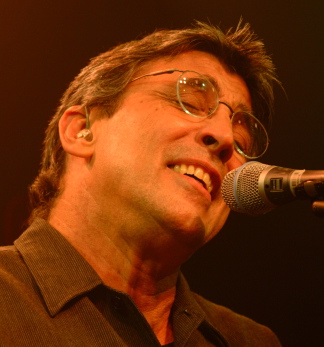
Noted Brazilian Singer-Songwriter Ivan Lins
First up was the New York-based Trio da Paz, formed in 1990 by guitarist Romero Lubambo, bassist Nilson Matta, and drummer Duduka da Fonseca. All three are seasoned masters of both jazz and Brazilian music with impressive resumes. A sampling includes guitarist Romero Lubambo's work with Dianne Reeves, Michael Brecker, Grover Washington, Jr. and Kathleen Battle; bassist Nilson Matta's work with Joe Henderson, Don Pullen, Yo-Yo Ma and Paul Winter; and Grammy nominee drummer Duduka da Fonseca's work with Astrud Gilberto, Antonio Carlos Jobim, John Scofield and Tom Harrell. Trio da Paz as a group has recorded and performed with Charlie Byrd, Herbie Mann, Lee Konitz, Kenny Barron and Nana Vasconcelos, among others.
Guitarist Romero Lubambos virtuosity reminded me from time to time of the flamenco players, direct from Spain, who hit New York in the early 1970s. I didnt have a metronome on me while sitting in the audience, but Im fairly certain Lubambo was playing at least 64th notes at 200 plus tempos. In one piece he incorporated Bachs "Prelude in C Minor" into the improvisation. Not an easy piece to play on a keyboard at normal speed, Lubambo dropped it in with the ease of someone strolling through New York Citys Little Brazil. But speed is one thing. Tasty musical choices is quite another. Combining the two at both moderate and fast tempos without breaking a sweat is a transcendent accomplishment and an aural musical treat.
Bassist Nilson Matta is the perfect match for Lubambos melodic explorations. His playing reminded me of Eddie Gomez on several Bill Evans albums and certainly Chip Jacksons virtuosic clarity with the Billy Taylor Trio. To play with pizzicato and arco with articulation at speed without breaking a sweat shows a mastery of the instrument that goes beyond just showing off. Drummer Duduka da Fonsecas subtle and sensitive playing behind Lubambo and Mattas says something about the trios musical conceptualization. Whereas too many drummers in your average jazz club setting play with the listening sensitivity of an 800-pound gorilla, Fonseca added percussive hits sparingly and only on the last tune of the Trio da Pazs first half set did he let loose with a driving, rhythmically engaging solo.
All in all, Trio da Paz played with sophistication and musical theatricality. It was not just virtuoso playing. There was theatre and drama in their playing and, most of all, their musical choices. The first piece was of moderate tempo, starting with an explorative Lubambo solo. Slowly and quietly the other players joined in. It was a gentle beginning to a concert set that drew the audience in from the very first note.
The interruption to this beautifully framed set was the introduction of Ivan Lins, the highly successful Brazilian vocalist/self-taught keyboardist/composer who joined the trio for a pair of songs. The camaraderie was clear from the groups interaction, at one point Lins putting his arm around Lubambo as they sang a few lyrics together. What was not clear was whether or not Lins was demonstrating a deep affection for these fellow Brazilian players, or if he was looking for support. His presence during the Trio da Paz set was, of course, a way of giving the audience a taste of things to come. But Lins stage demeanor seemed somewhat self-conscious, although animated.
The second half of the concert began with the Ivan Lins sextet, including Teo Lima (drums), Leonardo Amuedo (guitar, acoustic guitar), Nema Antumes, (electric bass), Marco Brito (electric keyboards), and Marcelo Martins (tenor and soprano saxophones). Right off, the set was somewhat suspect. Within moments of the first tune it was clear the level of musical theatricality had dropped a few notches. The real giveaway was the pop-rock rhythmic pattern offered by the drummer. While the first half of the concert had offered a grande bouffe of virtuosity and musicality, the opening of the second half became a dumbing-down of musical sophistication.
Even at 62 Mr. Lins strutted the stage with the intensity of a pop-rock star. Somehow it all seemed a bit out of place. The contrast between the virtuosity of the Trio da Paz set and the opening of Ivan Lins set was palpable and seemed disjointed from Mr. Lins storied career. Lins has been an active performer and songwriter of Brazilian popular music and jazz for over 30 years. His first hit, "Madalena," was recorded by Elis Regina in 1970. Testifying to Lins' importance as a composer is the frequency with which tribute albums and new covers of his compositions appear. His jazz classics have been recorded by many notable international artists, including Sarah Vaughan, Ella Fitzgerald, Barbra Streisand, Quincy Jones, George Benson, The Manhattan Transfer, Diane Schuur, Carmen McRae, Nancy Wilson, Eliane Elias, Patti Austin, Toots Thielemans, Take 6, Lee Ritenour, David Benoit, Carlos do Carmo, Mark Murphy, Dave Grusin, Srgio Mendes, Michael Buble, and countless others.
Clearly, Mr. Lins is a highly established singer/songwriter with an international reputation. Which is why the jazz/pop/bossa (mostly pop) sound that welcomed the audience back to the second half was not so much a shock to the system as it was a puzzlement. Thankfully, within moments of the beginning of the second tune of the set the New York Voices (NYV) appeared on stage.
Formed in 1987, the NYV (Peter Eldridge, Lauren Kinhan, Darmon Meader, and Kim Nazarian) are the epitome of a singing group not only of great musical talent and taste, but also stage choreography. In addition to totally engaging harmonies and arrangements, the group takes great care to block (to borrow a theatrical term) its performance from moment to moment while entering the stage, performing on the stage, and leaving the stage.
Of all three groups, the NYV was the only one to acknowledge members of the audience in front of and in back of the stage this is the way the Rose Theatre at JALC is constructed; a tip of the hat to theater in the round. They know how to get out of the way gracefully when another musician is soloing. They show collegiality, not only to each other, but also to the other musicians on stage. Often, the smiles among musicians during a performance feel more like an inside communication of approval meant only for the musicians to understand. The NYV, on the other hand, project that approval to the musicians and invite the audience in on the communication. It is, perhaps, one of the distinguishing characteristics of the NYV: every note and harmony is worked out to perfection, but so, too, is the stage choreography. Perhaps this is one of the reasons the NYV is a Grammy-award winning group.
Further, the NYV was billed as Special Guests during the Ivan Lins Sextet set. It seemed more the other way around. The addition of the NYV to Lins set raised the level of the evenings performance. Mr. Lins deserved compositional reputation nothwithstanding, the NYVs contribution was more than welcome. The musical theatricality and sophistication of the Trio da Paz, presumably a taste of things to come in the anticipated second half, was elevated again when the NYV appeared on stage.
The set was a combination of Lins originals, NYV originals and a tribute to Antonio Carlos Jobim. Other than the penultimate piece of the set (co-composed by NYVs Peter Eldridge and Lins Marco Brito), the highlight of the second half was the NYVs a cappella rendition of "Modinha," a Jobim ballad. With Lins joining in to form a vocal quintet, this lushly harmonic piece with deliciously arranged moving inner voices brought the longest sustained applause from the audience.
The close of the evenings performance brought all three groups to the stage for a final rousing samba. It brought the audience to its feet with a demand for an encore. After a well-timed delay, the entire musical troupe returned to the stage for a final number.
This blog entry posted by Eugene Marlow.
Tags:

Wow. One of the greatest singers of all time, Ivan Lins, got hammered pretty bad by this report. It is a bit offensive to say that there was an interruption by his presence. "Thankfully" the NYV appeared? Please. Lins can carry everything by himself. And to say that Ivan Lins should be titled as guests for the NYV? Preposterous. Whoever wrote this seriously needs clarification on jazz and bossa nova. I disagree strongly with this report.
I agree with Jeff Brandt. The reviewer is an idiot. I saw Ivan Lins (with new York Voices) just last night at the Blue Note (11/23/08) and he was great.