The Jazz.com Blog
May 04, 2008 · 0 comments
Brooklyn Remembers Max Roach
Tim Wilkins contributes this first hand account of a tribute to the late Max Roach, part of a series of Brooklyn based events in honor of the legendary drummer. T.G.
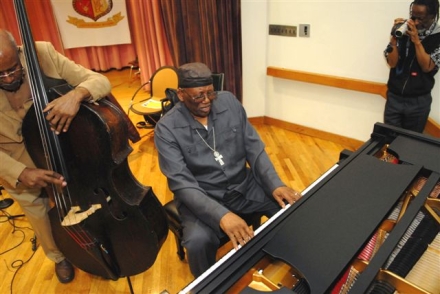
Pianist Randy Weston (photo by Randy Waterman)
If people don't like what you're doing, you're probably doing the right thing, Max Roach once told trumpeter Cecil Bridgewater. Max Roach challenged himself every night to do something that he hadn't done before, Cecil recalled. And obviously. he challenged the rest of us, to get up to his level.
Cecil and other jazz greats, including pianist Randy Weston, bassists Leonard Gaskin and Sam Gill, and percussionist Montego Joe shared memories of Max with those who gathered at Brooklyn's Medgar Evers College last weekend to reflect on the drummer's legacy.
Many of these musicians grew up with Max in Brooklyn's Bedford-Stuyvestant neighborhood. As teenagers in the 1940s, they made trips to Harlem to catch the new sounds being played by Charlie Parker, Dizzy Gillespie and Thelonious Monk at Minton's and Monroe's Uptown House. At sixteen, Max once drew himself a mustache with an eyebrow pencil to get past the doorman.
Gaskin played at Minton's, and Max soon followed. Before long, both were playing on 52nd Street - Roach with Bird, and Gaskin with Dizzy, creating the music that would come to be called bebop. But it all started in Brooklyn, with the solid musical grounding the budding boppers received in the borough's public schools and at churches like the Concord Baptist Church, where Roach, who passed away in August, was a lifelong member.
Now, movement is underfoot to bring Brooklyn's jazz history back to life. The Roach memorial was the high point of the month-long Central Brooklyn Jazz Festival, which held more than forty concerts in largely African-American neighborhoods to raise awareness about the borough's living heritage in jazz. 'We want to pass on all of the knowledge, the history, pride, and honor to a younger generation, who really doesn't know about this,' said Susie Anderson of the Andy Kirk Research Foundation, the weekend's organizers, who hope to open a jazz archive in Brooklyn. The weekend included free concerts by Weston, Bridgewater and other associates of Roach, including Fab 5 Freddy, Odean Pope, Lewis Nash and the M'Boom ensemble, which includes Ray Mantilla, Steve Berrios and Joe Chambers.
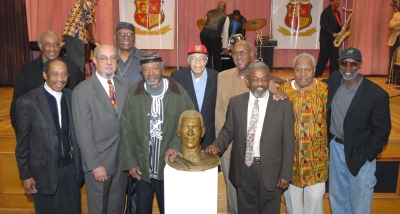
From L to R: Gil Noble, Herb Lavelle, Randy Weston,
Otto Neal, Leonard Gaskin, Sam Gill, Donald Sangster,
Montego Joe, and T.S. Monk. (photo by Randy Waterman)
The gathered musicians also shared thoughts on the fate of jazz and the challenges of bringing it to the attention of a younger generation. Today, we don't have music in the public schools, especially in the poorer areas where blacks live, said Gill, who started in jazz then spent nearly fifty years as bassist for the Colorado Symphony Orchestra. So my theory is that's why rap started, because they weren't getting any music in there.
Drummer Herb Lavelle agreed the generation gap has grown into a problem. With jazz not being played on the radio for 25 years, young people never knew what it was, he said. So they're doing their own thing now, and they don't understand what we did, and we don't understand what they're doing.
T.S. Monk, drummer and son of the bop pianist, added that Max always encouraged cooperation between the generations. Hip-hop ain't that far from bebop, or rebop, Monk said. This younger generation of musicians is looking to us for validation... so it becomes our responsibility to get back, stand back and dig exactly what they're doing.
Are you watching the kids, these hiphop kids? Roach once asked T.S. as they were working to create the Thelonious Monk Institute, now a leading force in jazz education. He said, 'You have to pay close attention to them, because they're actually very similar to us.
He always looking, and he was always trying to find the next thing, Bridgewater said of Max. On hip-hop, the two agreed to disagree. Max was really enthused about the rhythmic aspects about what they were doing, Cecil recalled. But I said, 'Well, but they're not really dealing with music, because they haven't had the theory, the melody, harmony, and so forth.'"
On the other hand, Bridgewater said today's jazz students today are often too academic in their approach. There's a spirituality to the music that you just don't get from theory. Charlie Parker did not play the 'bebop scale.' Charlie Parker played music. Dizzy Gillespie played music. Unless you can lift the notes of the page and make them personal, it means nothing.
Weston agreed about this importance of spirituality, and tradition, in jazz. As a teen, he and Roach would hang out at Brooklyn's social clubs to play cards with older musicians and listen to their stories. When Thelonious Monk played the piano, we hear a magic -- there's something that's mysterious in those beautiful structures, said Weston. But some of us have become so sophisticated that the blues don't mean anything to us... and that's the foundation of all we do.
The weekend closed with a concert of bebop classics by Weston, Gill, Rachim Sahou and others.
Roach's legacy, and his advice to future generations, can perhaps be best summed up in his own words. 'The instrument is in your mind, he said. You can take cardboard boxes and make them sound like dynamite. If you want to deal with the drums, you have to realize that the instrument is the human being.
This blog entry posted by Tim Wilkins.
Tags:

Comments are closed.