The Jazz.com Blog
June 12, 2008 · 0 comments
A Fitting Memorial for Eddie Harris
Jazz.com is delighted to introduce a new contributor, Neil Tesser, a leading jazz critic and broadcaster for more than three decades. Tesser has written for Rolling Stone, The New York Times, Jazziz and Jazz Times, among other periodicals, and was the first jazz critic for USA Today. Neil's liner notes have appeared on more than 300 releases, and he earned a Grammy nomination for his essay accompanying the Stan Getz box set Girl from Ipanema: The Bossa Nova Years. Below he shares his commentary on a recent gathering to unveil a new memorial stone and resting place for the late tenorist Eddie Harris.
On May 31, on the first really warm weekend of the year in Chicago, about 25 people gathered at a medium-sized cemetery on the south side of Chicago to celebrate Eddie Harris. Not that any of us who knew Eddie – or anyone else who just loved his music – ever needs an excuse to celebrate: with its contagious rhythms and unique technique, its glittering melodies and funky soul, Harris’s music is a celebration all its own. And for those who knew him offstage and remember his lacerating wit and tribal-elder advice, his presence still serves to counsel and advise. I don’t think a week has gone by since his death (in 1996, at the age of only 62) that I haven’t missed our conversations.
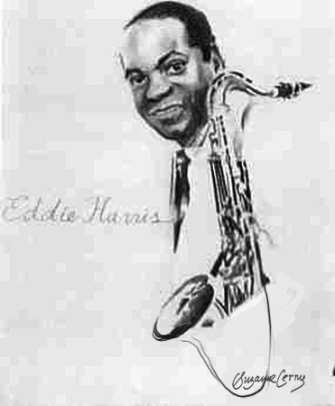
But this time, the occasion for remembrance was the unveiling of an elegant memorial stone to mark Eddie’s new resting place: a vault to which his remains had been moved, earlier that morning, from its crypt elsewhere on the grounds. The stone sits on a little rise at the Oak Woods Cemetery, 1035 E. 67th Street, maybe ten miles south of the city center: from the front office you walk toward a pathway named Sunrise within the cemetery, and it’s just ahead and to your left. Technically it is a mausoleum, since the body is above ground; but when I hear that word I think of a tomb as large as a small house, with pillars and an entranceway, and that image doesn’t really fit the smaller (and far more tasteful) medium-gray resting place. Eddie himself would have appreciated the fact that they used a word correct in its definition, but I’m guessing he would also have giggled at the use of such a high-falutin’ name.
The ceremony had been organized by Sally Harris (his widow) and his daughters, and the loosely structured proceedings had that easy lope that typifies both Eddie’s music and social events in Chicago’s African-American community. (No surprise there: Harris grew up on the south side of Chicago, where he lived here until the 1960s, when he moved to California.) At about the time the ceremony was to have started, workmen brought out a portable sound system, and a tinny reproduction of Eddie’s music began to fill the area – “Listen Here!”, “Hey Wado,” “Freedom Jazz Dance” – as a local disc jockey offered desultory commentary. The official event began about 30 minutes past its scheduled start, after various old friends had made their way to the velvet-draped temporary seating area. Journalists and unaffiliated onlookers were noticeably absent.
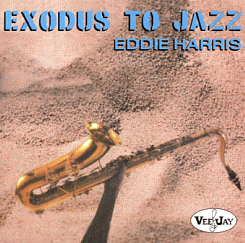
Eddie’s younger daughter welcomed the attendees, accompanied by the granddaughter Eddie never met (but whose impish behavior suggested that Eddie’s spirit has indeed been passed to future generations); a minister spoke; and then comments were solicited. Here came an older gentleman, in a worn, old-fashioned medium-blue suit and a small straw Borsalino hat, who’d known Eddie when both worked for the postal service in the 1950s; as he spoke about those days, he held the microphone stiffly in his hand, far from his mouth – as if it were a scepter that conferred upon him the right to speak, rather than a device for amplification. Redd Holt, the longtime Chicago drummer, and his wife both came up; they had worked and partied with Eddie and his wife before the Harrises moved to California, and they sketched a lovely portrait of the jazz life back then. The disc jockey, Gil Daspit, said the sort of things that disc jockeys say. Deep emotion won out over artful expression, and no one seemed to mind.
When they had all finished, Sally Harris spoke movingly about her husband, and thanked the assembled for their kindness, and then they pulled away the cloth covering the stone to unveil its craftsmanship. On the left, the inscription marking Eddie Harris’s final resting place; next to it, on the right, his widow’s name carved and waiting; and along the top and bottom, an exquisite embroidery of musical staff lines revealing the musical notation for “Freedom Jazz Dance.” Like the rest of the event, and like Eddie himself, it hit all the right notes.
This blog entry posted by Neil Tesser.
Tags:

0 responses so far
There are no comments yet...