The Jazz.com Blog
June 23, 2008 · 4 comments
Remembering Esbjörn Svensson (1964-2008)
Few jazz writers have demonstrated a deeper understanding and appreciation of the late Esbjörn Svensson than Stuart Nicholson, a frequent contributor to these pages. Nicholson was one of the first to sing the praises of Svensson, writing about the pianist and his group e.s.t. in The New York Times and elsewhere at a time when few fans in the U.S. knew about this exciting ensemble.
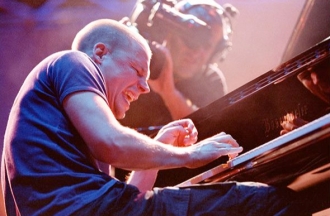
Following this band from afar was not easy at first. I remember having to hunt out From Gagarin’s Point of View during a visit to Italy – intent on finding this brilliant CD which, for whatever reason, hadn’t been released in the U.S. at the time. Stuart graciously sent me other e.s.t. releases that hadn’t yet made their way across the Atlantic – recordings that I found tremendously vital and exciting. I suspect that many other jazz fans first heard about this music through his smart commentaries.
Stuart was also the first to relate the tragedy, a distraught email arriving before the news services picked up the story, that Esbjörn Svensson had died in a diving accident at age 44. The jazz world is still reeling in the aftermath of this unexpected loss.
Below Nicholson contributes an eloquent tribute to this exceptional artist, who left us when he still had so much to share. T.G.
On a warm night in May, 2006 e.s.t., which had begun life as the Esbjörn Svensson Trio, played Lyon, the third largest city in France. For the past two or three years the group, with Dan Berglund on bass and Magnus Öström on drums, had been creating a rising buzz of excitement wherever they played in Europe. Standing ovations, countless encores and wild applause had become common. But this particular night it all seemed to come to a head.
As the group walked onstage it was as if the clock had been turned back to the days of Beatle-mania. Young girls in 1,500 audience, and there were plenty, burst out screaming. The rest of the audience were whistling, shouting, stamping and applauding. The noise was deafening. And they hadn’t even played a note of music.
e.s.t. were finally entering the big time. Years of constant touring --100 to 200 gigs a year were not uncommon -- were finally paying off and there was a universal belief among those involved in the European jazz economy that it could not have happened to three nicer and more hard-working guys. They were praised for their professionalism, their unfailing punctuality, their cheerful disposition whatever the circumstances (and things can and do go wrong at festivals), their rapport with audiences, and their willingness to stay on after concerts for as long as it took signing autographs.
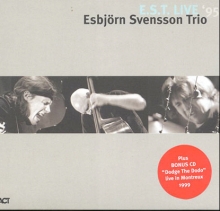
They had come a long way since their album E.S.T. Live '95, when as unknowns outside their native Sweden they were recorded performing during a tour of small towns such as Möndal, Nyköping, Uppsala and Århus (where Svensson plays an upright piano on two tracks). But even then the trio, which had been formed three years earlier, had already begun to forge a collective voice, a hallmark of their style.
It’s probably fair to say the success of e.s.t. may have taken some outside the jazz economy by surprise – such as the mainstream media who were forced to sit up and take notice at the remarkable success of a jazz group – but the one person who never had any doubt the band would make it was Esbjörn Svensson.
A dynamic and immensely personable young man, he was classical graduate of the Royal College of Music in Stockholm, who quickly established himself on the Swedish jazz scene as a rising star. His early influences were Thelonious Monk and Keith Jarrett (from his Facing You period) and, just as important, yet seldom remarked, were the influence of local heroes Bengt Hallberg and the visionary pianist Jan Johansson. Underpinning it all was his love and affinity for classical music – indeed, e.s.t’s 2006 album Tuesday Wonderland was inspired by Bach’s Well Tempered Clavier. All these elements together formed the basis of a wholly original style.
Svensson’s compositions often had more in common with the structure of contemporary pop tunes than the American Popular Song. Many contained beautiful, almost sensuous melodies that were imbued with the pensive melancholy of the Nordic Tone, an important if largely misunderstood voice within jazz.
A couple of years experience playing in pop and rock bands before he formed e.s.t. taught him the value of presentation, and from the very beginning they made financial sacrifices to carry sound engineer Åke Linton (known as the fourth member of the trio) with them whenever they could. Lighting was also an important consideration at their concerts, and a lighting engineer was added to their entourage when finances permitted. “Some musicians think standing in front of a microphone in a white spotlight is all that you need, and that’s okay. Not for us though,” said Svensson.
When the group signed with Siggi Loch’s ACT label and Burkhard Hopper became their manager, e.s.t. began to take off following the release of From Gagarin’s Point of View in 1999. With fresh, original material and imaginative presentation, the group began to win fans beyond the usual jazz constituency. As they built a broad fan base in Europe, the buzz surrounding them began to spread to the United States.
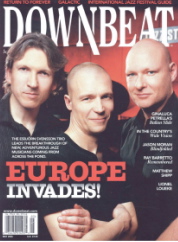
In 2002 they embarked on a three week tour of the US which was followed in 2003 by a tour playing support for k. d. lang. Subsequently, they toured annually, prompting Down Beat magazine to proclaim in 2006 that "Europe Invades": “The Esbjörn Svensson Trio Leads The Breakthrough Of New, Adventurous Jazz Musicians Coming From Across The Pond.” It was the first time in Down Beat’s entire 72 year history that a European jazz group had been featured on the magazine's cover.
On 21 June this year e.s.t. was due to appear at the JVC Jazz Festival in New York. At 44, Svensson had accomplished so much, yet he offered so much more. One of the most influential artists in recent jazz history, Jon Newey, editor and publisher of the UK magazine Jazzwise called him “The single most important artist to emerge in jazz in the last ten years.” A new album Leucocyte had been completed and plans were already in hand for extensive touring to support its release.
A devoted family man Esbjörn Svensson is survived by his wife and two young sons.
This blog entry posted by Stuart Nicholson
Tags:

Thanks for this wonderful articel. Let us remember his great work!
Thanks for the informative tribute. A huge loss for music and people with ears and hearts. His spirit will continue on in the recordings. Philip Jelatis Miami, FL USA
I was privileged to see EST in the UK on four occasions and since the late nineties used their music as a means of calming myself down during or after a heavy day at work, my i-pod has every album on it. EST's legacy is that jazz is all around us now in a way which was being stifled by it's own origins. With, acts like Tord Gustafson., The Bad Plus, Benjamin Moussay, The Neil Cowley Trio, Brad Mehldau, and Tom Cawley light and air shines through the windows of this music form. I hope Magnus Öström & Dan Berglund will find some inner strength and look to create more magic in the future. Clive McCarthy UK
I haven't heard about Esbjörn's passing away until today. I'm really shocked - what a loss! I've had the chance to hear e.s.t twice here in Switzerland, such fantastic concerts! It is unconceivable yet, not to hear the live anymore... My deepest sympathy to his family, Magnus Öström and Dan Berglund! Deborah Lehmann, Zurich, Switzerland