The Jazz.com Blog
June 25, 2008 · 4 comments
Art Pepper Lives!
The appearance of unreleased recordings by alto saxophonist Art Pepper is certainly a cause for celebration, but especially when they come from his triumphant comeback years. Art Pepper, who died in 1982, saved his best music for last. He was forced to do so, having spent much of the 1960s and 1970s in prison and rehab. Pepper was granted a short period at the end of his life to recapture his glory years of the 1950s, and he was determined to make the most of it.
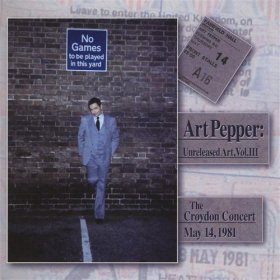
I saw the band featured in the new CD Unreleased Art: The Croydon Concert May 14, 1981 during the same 1981 UK tour, at an engagement at Ronnie Scott’s. I was finishing up my philosophy degree at Oxford and getting ready to return to California. This trip to London was a good way of celebrating the completion of my program. I made the journey to London with alto saxophonist John O’Neill –- we frequently performed together in a quartet during that period, and were both excited about seeing Art Pepper in the flesh. We rustled up a sympathetic friend who had a car, a local record store owner who also dabbled in producing jazz albums, and arrived early to secure seating close to the musicians.
Pepper had come to England the previous year and had created a tremendous buzz with his performances. He was experiencing a great resurgence of popularity among US jazz fans during this same period, but his following in the UK was, if anything, even more devoted. The word of mouth reports of his 1980 appearances were extravagant in their praise. Around this time, the British magazine jazz Journal featured him on its cover and, if I remember correctly, even named him jazz musician of the year.
I know how much these honors meant to Pepper. I had the opportunity to talk with him a few days before he died – in what turned out to be his last interview. He dwelt at length on his unfulfilled hope to someday see himself on the cover of Down Beat. For this artist, who received so little validation from the US critics during his life, the accolades garnered overseas, in the UK and Japan where he felt respected and even loved, were important to his self-esteem and sense of having made his way back into the limelight. Even more than most jazz artists, Pepper wanted recognition for his body of work, for a career that he had almost destroyed through his own excesses.
Pepper could only blame himself for his almost complete absence from the New York scene, where jazz reputations are (then as now) made. His first appearance as leader in a NY club did not take place until he was fifty-one years old! (However, this Village Vanguard gig from July 1977 resulted in no fewer than three brilliant albums, one for each night of the engagement, and a later boxed set.) Of course, during the prime of his life, this altoist hardly showed up on any scene. Pepper’s drug addiction and the criminal activity it required to support – outlined with exceptional candor in his autobiography Straight Life (highly recommended) – could easily have killed him back in the 1950s. The altoist survived, but spent too many years in prison or Synanon or out on the street scuffling for drug money.
When he tried to make a comeback in the late 1970s, all the odds were against him. Art Pepper was largely forgotten in the jazz world, his best known recordings almost two decades behind him. Even old fans of his were forced to confront a new artist, who had assimilated John Coltrane and Ornette Coleman, and now leavened his sweet alto sound with anguished, angular phrases that were completely unlike anything he had ever recorded back in the 1950s. Fans of Art Pepper Meets the Rhythm Section (1957) or Art Pepper + Eleven: Modern Jazz Classics (1959) would hardly recognize the soloist who now stood before them. But even as Pepper’s playing changed, so had the jazz world – and not for the better. Jazz on the West Coast had been in decline during all the years Pepper was off the scene. Clubs were shutting down. The audience was shrinking. In an age of loud rock, jazz was just a whisper.
Admirers also were shocked by his ravaged looks – you could make a convincing anti-drug scare message out of a side-by-side comparison of cover photos of the 1950s-era releases, featuring a handsome and dashing young musician, with the pallid, bloated visage on the front of Art Pepper Today (1978). Stay away from heroin, kiddies, or it might do this to you!
Despite all these obstacles, Pepper made a successful comeback. And for only one reason: he was playing like a man possessed. Very few jazz artists reach new peaks in their music and solo conception beyond the age of fifty. Jazz is an art form best suited for twenty-somethings and thirty-somethings, drawing on their vitality and ambition and irreverence. Yet here was a fellow ready for the AARP playing with fire and intensity night after night, on record after record. If you only heard the records, and didn't see the beaten-down looking man who made them, you would assume it was some young lion ready to take over the scene.
Much to my disappointment, I had not seen Pepper on his 1980 UK trip. But I would not miss him on his return. From his first notes, he mesmerized the audience at Ronnie Scott’s. (Not always easy to do – I have always been surprised and frustrated by the number of noisy tables at this famous club. For some reason, people who want to jabber or close business deals are willing to pay the high cover charge for the privilege of doing so with famous jazz musicians serenading in the background.) But Pepper was showered with love, and he responded by letting down his own guard. At one point, he even pulled out his clarinet, and performed an endearing old standard on this horn, even while admitting to the audience that he was hardly ready to play it in public.
But it was on the more intense combo numbers that Pepper took full flight. Apparently the altoist thought that pianist Milcho Leviev was too forceful in his comping. But the result was that Pepper raised his own energy level in response. You can hear that on the Croydon CD, where he starts “Patricia” as a dreamy ballad, but gets tougher and rougher in response to prodding from the keyboard. Pepper liked to impart an edgy quality to this song – check out the moving coda to his 1977 studio version – but Leviev would sometimes push Pepper over the edge.
There are many aural delights in late vintage Pepper. I can’t think of another altoist who is better at mixing gentle lyricism and bitter anguish in the same solo. Pepper’s ability to shift moods in mid-chorus is almost a calling card of his work from this period. I would also call attention to his masterful phrasing. Every Pepper phrase has a clear shape, and a memorable passage from beginning to end. This may sound like a truism, but many sax players today, even well known ones, could learn from Pepper. Shaping a phrase is almost a lost art, circa 2008. For his part, Pepper never tossed out mindless strings of sixteenth or thirty-second notes, or played practice room patterns.
Above all, I was struck back in 1981 -- and still today -- by the great emotional candor in Pepper's playing. I am not sure how he achieved this. Sometimes I have speculated that he had some personal technique, much like those who studied Method Acting under Lee Strasberg, of channeling feelings from intense moments in his past into his performances. This is just my suspicion. But Pepper's potent autobiography, a searing confession that makes no attempt to prettify a seamy life, seems to suggest that he could vividly re-inhabit incidents from his earlier years. Could it be that the power of a performance like "Patricia" is due to deep emotions triggered by his relationship with the daughter after whom the song was named? Perhaps I reach too far for an explanation, but the searing intensity of Pepper's performances and his frank personal disclosures in print and in person during these years, seem to invite this very type of speculation.
In the final analysis, we only have the music now, the artist now departed from the scene for more than a quarter of a century. The arrival of The Croydon Concert brings back many fond memories to those of us who had a chance to see Pepper during this period. And for those who never got the chance, this double-CD, a complete live performance, is the next best thing to being there back in ’81.
This blog entry posted by Ted Gioia.
Tags:

4 responses so far
As usual your account is beautifully done, but I have a question.I seem to read that you saw/heard Pepper in 1981 at Ronnie Scott's. Could you elaborate. I keep a discography and this date is important as it does not appear during the 1981 Tour. Pepper did two weeks at Scott's in 1980. Please clear that up for me. Thank you.
ive read the art pepper bio mentioned, are u going to publish the interview u did? great articles.
I read your article with great pleasure. I've been looking at a copy of Straight Life (on my bookshelf) for far too long. Time to do some reading... and more listening. Many thanks.
My interview with Art Pepper was published years ago in Jazz Times. Unfortunately we don't have the rights to reprint it here.