The Jazz.com Blog
June 09, 2008 · 0 comments
A Festival That Avoids the J Word
Stuart Nicholson reports below on a festival that breaks all of the rules. It presents Jason Moran and John Zorn, yet carefully avoids the word "jazz" in its name. It promotes its music on its own radio station, publishes a newspaper, and draws on an audience of campers who flock to a circus-type venue. But the result is a fresh program full of surprises, and thousands of young fans who tell our writer that they would never go to a jazz event. T.G.
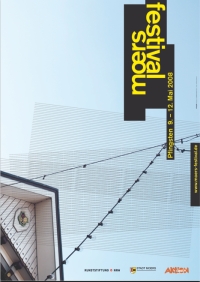
Set in Freizeipark Moers, a large public park on the outskirts of Moers town in northern Germany, the Moers Festival is presented in what is thought to be the biggest circus tent in Europe. Comfortably seating 2,500 the big top, or Festivalzelt, is hired-in annually for the event by Moers Kultur GmbH and rises up like a huge medieval castle amid a village of tiny tents, which house some 10,000 to 15,000, campers, dotted around the festival field.
Now in its 37th year, this is the third successive festival produced by Reiner Michalke, the internationally respected boss of Colognes Stadtgarten, one of the biggest jazz clubs in Europe, who has succeeded in reinvigorating the festival with new creative energy. One of his first moves on taking over was to drop the term jazz from the festivals title, so it became the Moers Festival as much to avoid arcane debates among the jazz police as to what is and what isnt jazz as to appeal to an audience beyond the normal jazz constituency (on the basis that labelling can exclude as many as it includes).
Its a strategy, in tandem with the festivals ambitious audience development program in schools and colleges, which seems to have worked -- resulting in a healthy proportion of young fans in the audience. I asked a group of five teenagers if they were enjoying the event. Yes, they nodded, they were. They were fascinated, they said, with styles of music they never knew existed. They were equally clear when I asked if they would have come if it was called a jazz festival. No was the unanimous response.
That kind of reflex response to jazz is typical among the young. Pop culture, promoted with ruthless efficiency by the big music corporations, fills the spaces around them. MTV is their gateway to a musical world that does not include jazz. To them, jazz is music that their parents, or even grandparents, enjoy. They are intimidated by its artsy connotations and believe you have to know about music to get it. They get bored by long solos, dismissed in the rock press as, a bunch of notes in search of a melody.
Moers breaks down such preconceptions. By avoiding the J word, audiences have to deal with the music on its own merits. Young minds are opened to the limitless possibilities of music; and with one of the most diverse and interesting programs on the European festival circuit, Moers gives young audiences plenty to sink their teeth into once they give the music a chance.
The festival even has its own local radio station on 93.7 MHz, mostly for the campers. The station passes on dedications and mixes jazz and pop, so audiences dont feel they entering alien territory. There are pod casts and a daily festival newspaper Moerser Morgen, edited and printed overnight with all the latest festival news, as well as a daily weather forecast. On the festival field theres an incredible range of food and drink on offer, and when it all gets too much you can take boat out on the Freizepark lake to chill out. Its a complete festival experience.
The core of the festival is experimental music, some difficult to love -- indeed, it would take a rare bird to like it all. But the sheer diversity of the program kept the audience engaged. If they didnt like band A, then chances are they would like band B that followed. The ethos of the festival is to open up minds to new and or original music. The result is an event thats put this small town of 109,000 onto the cultural and artistic map of Europe. Its deservedly become a source of civic pride, as Norbert Balhaus, the Bgermeister of Moers makes clear in opening pages of the festival program.
The event opened with s strong performance by the European Jazz Orchestra, comprising young, up-coming musicians from Ireland, Germany, Romania, Belgium, Austria, Greece, Switzerland, France the Czech Republic, Denmark, Slovenia, Sweden, Canada, Finland, Latvia and Norway. Made possible by the European Broadcasting Union, it was the final night of a tour for the Class of 2008. The EJO was led by the young composer and arranger Niels Klein, who balanced elegant orchestration (inspired by Shostakovich, Radiohead, Gyrgy Ligeti and Massive Attack) with freedom. Featured trumpeter Eivind Nordseth Lnning from Norway was clearly a star in ascendance.
Their music was in stark contrast to musikFabrik & Yannis Kyriakides, the latter described on his MySpace site as a sound artist, composer and improviser. Born in Cyprus, Kyriakides moved to the UK, studied musicology at York University, then moved on to the Netherlands, where he now lives, to study at the Hague Conservatory. His collaboration with the German ensemble musikFabrik, a thirteen piece unit, was impressive. Here music categories made little sense; this was through composed music of startling breadth and imagination. Voice, electronics, woodwinds and brass created other-worldly sound textures which youve never heard before and probably will never hear again. Who cares whether this music has a name or not?
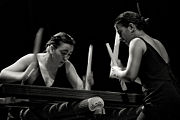
Ttukunak was something else again. Two petite young girls from Spain, they played well, uh . . .metal pipes. Their instruments went missing during their flight, so they simply went to a local plumbing shop, had several lengths of metal pipe cut to size (about six feet), carved wooden plugs to place in one end as a tuning device, and then carved two baseball-like mallets each with which to play them. All this was done in the festival field. It seemed like mission impossible, but these girls are made of plucky stuff. It was quite astonishing the results they got. Virtuosos, their performance suggested that maybe theres not too much to do in their home town for young girls, with acquiring skills in whacking metal pipes preferable to watching Spanish soaps on TV.
The festival newspaper Moerser Morgen hailed alto saxophonist John Zorn as a jazz superstar. Really? I hadnt realised. At Moers he went back to his early days in the 1980s and solo concerts, climaxed by duck calls made with his saxophone mouthpiece in a cup of water. Its fascinating how many sounds you can get out of a saxophone over the course of an hour when you really try. They say history doesnt repeat itself, but you couldnt help get the feeling that the enfant terrible of the old Downtown scene had gone full circle, arriving back where he started. Joined by Ttukunak for an encore, it was as if an angry, squawking bird had got caught-up in wind chimes.
Perhaps the exploitation of freedom today demands a little more tonal variety than a solo saxophone recital can offer. The form has been over exploited over the years and like a reading of Paradise Lost, it is no doubt good for the soul, but as Dr. Johnson once said, no one ever wished it were longer. Certainly Gunda Gottschalk Crossroads showed how important varying musical textures can be in more abstract forms of music; her voice was accompanied by Xu Fengxia on guzheng, Barre Phillips on bass and a legend of the former East German free scene, Gnter Baby Sommers on drums and percussion.
Gottschalks expansive and central role within her ensemble was contrasted by Anne-Lis Pols with the Free Tallinn Trio with Anto Pett and Jaak Soor on guitar and electronics. Pols was a superbly accomplished vocalist and the trio produced an integrated, rounded performance. She wove her detailed onomatopoeia into textures created by piano and guitar, contrasted by staccato passages and whispers that came haloed in Soors electronics. It was one of those fascinating, hypnotic performances that seemed to make time stand still.
Big bands, once functional, originally played music for dancing but inevitably became jazz orchestras with the increasing sophistication of arrangers. Today, we have learned to expect ingenious tonal variations, billowing ensemble colours and shimmering textures from composer and arrangers like Maria Schneider, whose compositions and orchestrations are things of great aesthetic beauty, best appreciated in the concert hall and art houses of the world. However, there are a couple of young big bands in Europe who have developed a far less esoteric perspective, and have returned to the basic principals of providing music for dancing. They give it a contemporary spin by exploiting volume and rock rhythms, and go beyond the traditional jazz repertoire to create music that fulfils the function of pop and rock music in club culture.
The New Cool Collective Big Band in Holland is one, and Samel Samlssons Big Band from Iceland is another, operating in the bawdy world of the everyday, where art gains its greatest immediacy, and they succeed in supporting the counter intuitive notion you can go out to listen to jazz and party. Samelssons set had the 2,500 Moers audience up on their feet, doing just that. It was a reminder that some of the best jazz ever made, you could dance to.
However, the festival highlight was provided by vocalist Sidsel Endressen and Punkt (Jan Bang electronics, Erik Honor electronics). She improvised a whole set to samples taken from earlier concert performances plus a few ambient sweeps and mysterious sounds Bang and Honor threw into the mix. It was an astonishing performance, where every interior detail appeared to have been worked out in advance. It wasnt just three intuitive minds producing a work of evanescent beauty that even made the sampled steel pipes of Ttukunak sound interesting.
The Saturday night performances were climaxed by Jason Moran & The Big Bandwagons presentation of In My Mind Monk at Town Hall 1959. This multi-media presentation began with archive images on a screen at the rear of the stage and the classically trained Moran joining in duet with a Monk soundtrack. The project was an exploration of Morans relationship with Monk, who inspired him to take up jazz.
The Moran trio, joined by a five piece British horn section, worked to a backdrop of grainy archive images and video art. They performed tunes written by Moran and inspired by Monk, and the occasional Monk classic, such as Little Rootie Tootie, Thelonious and Crepuscule with Nellie. Halfway between concert recital and a university tutorial, it was an important reminder of where the music came from. At one point the band left the stage, and let a videoed interview with Monk take over.
After a while the crowd became restless, after all they had come to hear music. A slow handclap brought the band back onto the stage, but although Moran took Monks harmonies to interesting new destinations before returning them to their familiar settings, this was music of the past rather then the present, a feeling underlined by grainy iconography of 1950s America, Cadillacs and all.
This blog entry posted by Stuart Nicholson.
Tags:

Comments are closed.