The Jazz.com Blog
July 14, 2008 · 0 comments
Jazz Update from Umbria
Twelve years ago, a few weeks before my daughter was born, when I still had the time and stamina to do such things, I spent most of a three-day visit to Madrid absorbing the contents of the Prado, watching the visual history of post-Humanism Western civilization unfold, room after room. You’d proceed through a hallway lined with 10 Caravaggios and a half-dozen Zurbarbans, enter an enormous three-gallery suite with a hundred Titians, then another two with 120 El Grecos, another with 40 Raphaels. A hundred or so Velasquezes and a couple of hundred Goyas awaited. You could spend a year there, and only soak up a fraction of the nuances.
Among other things, this bounty of riches offered a singular opportunity to examine the way these masters of line, color, and perspective addressed identical material—to be specific, Catholic saints and various Biblical scenes—with completely different visions, shaped by their own respective positions in the timeline, their own influence tree, their own inner vision. For this jazz-obsessive, this effect was not dissimilar to exploring the different ways that Louis Armstrong, Lester Young, Charlie Parker, and John Coltrane developed their innovative vocabularies by working with and refining the same 12-bar blues and 32-bar Tin Pan Alley forms.
It’s hard not to think of these things in Perugia, a city of 160,000 situated between Rome and Florence carved into a mountain near the Tiber River, where a certain level of craftsmanship and refinement is built into the texture of daily life. This is so in the buildings, which date from the 12th through 18th centuries; in the proportions of the public plazas and snaky medieval warrens; and in the food, which is prepared with consistent excellence, and is never overdone.
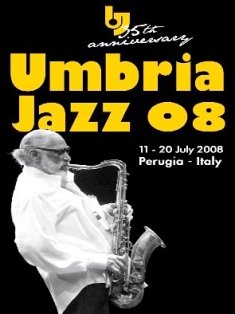
Perugia is the capital of the state of Umbria, and hosts the annual Umbria Jazz Festival, which launched its 35th season on Friday. The events transpire atop the hill. Like 18th grand dukes putting together entertainment for a massive pageant, the organizers match sounds with spaces.
New Orleans marching (Coolbone) and Zydeco (Rockin’ Doopsie) bands, swing units, and singer-songwriters perform on a terrace outside the Hotel Brufani, a converted palazzo that overlooks the valley. In an exquisite drawing room inside the hotel, singer Allan Harris performs his “Tribute to Nat King Cole.” Two 18th century theaters, both with the aspect of an exquisite jewel-box, host other major acts that depend on sonic nuance—among them this year, Bill Frisell, Enrico Rava, Charles Lloyd, Gianluca Petrella, Stefano DiBattista, Charlie Haden, Enrico Pieranunzi, Brad Mehldau, Maria Schneider, Pat Martino, and Peter Bernstein. Other first-rate groups—pianist Gerald Clayton’s trio, vibraphonist Joe Locke’s Force of Four (with pianist Robert Rodriguez and drummer Jonathan Blake), and the Harry Allen-Joe Cohn Quartet—alternate at a bar-nightclub constructed in an unembellished underground chamber in a 16th century fortress built by the Papacy (which saw the city as a strategic outpost, and imposed the Vatican there for several consequential periods between the 13th and 17th centuries) to defend itself against Perugians enraged by the Papal boot, and demolished 138 buildings owned by the Baglione family (they invented zabaglione) to do this.
The only structure that is not ancient is the floored-over soccer field just outside the medieval city walls that contains the Arena Santa Giuliani. Here the headliners—among the bookings are Sonny Rollins, Stefano Bollani with Caetano Veloso, Alicia Keys, Cassandra Wilson, Herbie Hancock, and Pat Metheny-Gary Burton—play on a huge outdoor stage in gentle breezes below the moon and stars. I have never heard such good sound in an outdoor space.
By Friday evening, Perugia’s streets and squares were packed with revelers young and old. Not so the alley in front of Teatro Morlacchi, the younger of the theaters, a five-tiered, horseshoe-shaped, 785-seater with ceiling frescos that was constructed in the late 18th century by a consortium of merchants out of an abandoned nunnery as an answer to Teatro Pavone, a smaller space closer to the town center where the local nobility gathered. Such spaces—indeed such acoustics—do not exist in New York City, where the oldest inhabited building dates from the 1830s.
The room was full for Carla Bley and Lost Chords (Britain’s Andy Sheppard, tenor saxophone; Yale’s Steve Swallow, bass; New York A-lister Billy Drummond, drums; and Italian trumpeter-flugelhornist Paolo Fresu) backing the new WATT-ECM release Banana Suite. They opened with a 45-minute version of the title track, a kaleidoscopic 5½-part suite, bedrocked on compelling ostinato. There was much ebb-and-flow, much dialogue, and fluent monologues from all members. It was my first in-person experience with Fresu, who played a lot of flugelhorn, which unfailingly did his bidding—left leg forward, right leg bent down like a javelin thrower, neck slightly atilt, he played clear, ringing melodies with a vibratoless golden tune, in contrast to Sheppard’s gruff declamations.
Sophisticated, ironic, refined, raw—in short, Italian. Bley established an apropos tone for things to come.
Tags:

Comments are closed.