The Jazz.com Blog
July 15, 2008 · 11 comments
Is Bird Dead?
One of the most surprising developments in the jazz world in recent years has been the declining influence of Charlie Parker. This shift has not been studied by jazz writers, as far as I can tell. But it is clearly one of the most significant changes of the last thirty years.
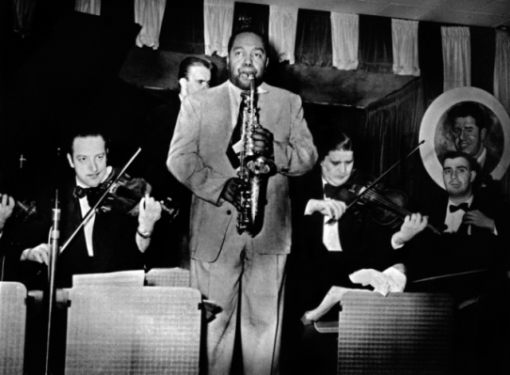
Charlie Parker at Birdland (1951), photo by Marcel Fleiss
The change is all the more remarkable since Parker was the dominant force in the jazz world during his lifetime, and his impact seemed hardly diminished in the aftermath of his death in 1955. His presence loomed so large that jazz fans held on to the phrase "Bird Lives" as a mantra and talisman long after the altoist's passing. Few things in the jazz world seemed more certain than the central place enjoyed by this exceptional artist.
When I was coming up, Bird was the cornerstone of a musical education for an aspiring jazz player. I was no different than many of my peers in this regard. I studied transcriptions of Parker's improvisations, and highlighted key passages. I made private tape recordings of his solos at half-speed—slowing them down so that I could hear what was happening more clearly—and listened to them over and over again. As a teenager, I not only listened to every studio recording, but I also tracked down all of the alternate takes (I found them in the archives of a local college library), and even listened to the incomplete takes. (You might be surprised by how many Bird studio performances ended within ten seconds. Parker clearly liked to have everything click into place right out of the starting gate.) Like the rest of my generation, I knew dozens of his compositions, and frequently called them at jam sessions.
And here is the kicker. I did all of this even though I had no desire to play in the style of Charlie Parker. My personal aesthetic vision took me in a different direction. Yet I felt that it was essential to study and assimilate Parker in order to develop my own sound. But inevitably (as always happens) bits of his musical thinking entered into my playing as a result of this period of study. I saw this as a natural development. You can't escape the pervasive influences of your time and place. The best you can hope for is to adapt them to your own personality and emotional temperament. As I saw it, coming to grips with Parker was a key step toward that goal, and part of what being a jazz musician in the modern day was all about.
I don't think this happens any more. Certainly not to the same extent it did three or four decades ago. I could name a half dozen jazz musicians who have more influence than Bird on the current crop of players.
Why do I believe that Parker's influence is on the wane? First and foremost, I need to point to the evidence that is literally on the record. I listen to new releases by jazz artists every day—I have probably listened to more than 300 new jazz CDs since the start of the year —and the evidence is overwhelming. The younger generation of improvisers has largely abandoned Bird and the bop vocabulary that was so pervasive just a few years ago. I don't hear Bird on the surface of this music, or under the surface, or even hiding off in corner. Bird has flown the coop. Newly minted jazz players are now looking elsewhere for inspiration.
Other role models from the past are far more dominant. Who are the historical figures with the most influence today? Based on my listening, I would highlight some of the musicians who played with Parker (Thelonious Monk, Charles Mingus, Miles Davis) or rose to fame shortly after his death (John Coltrane, Ornette Coleman, Bill Evans). Each of these artists appears to exert more influence than Charlie Parker on the current crop of jazz players. In an odd twist of history, several of the sidemen who accompanied Bird have seemingly nudged him aside in the pantheon of jazz greats.
Some of the most popular current role models are quite surprising—for example, Chet Baker, who led a marginal existence in the jazz world during his lifetime, but seems to exert a potent posthumous influence on European players. Others current-day icons are hardly unexpected—who can be surprised to hear the spirit of Sonny Rollins and Keith Jarrett in the work of the up-and-coming soloists. In some instance, a set of musical values espoused by a record label (Blue Note, ECM) is shaping the sensibilities of twenty-something improvisers. But the bottom line is that Bird is not a central figure in this process. He has lost much of the mesmerizing control he had once exerted over the jazz world.
You can hear this in how the younger players shape phrases. Or perhaps it might be better put: how they don't shape phrases. Bird's phrase-ology possessed a marked ebb and flow. He is often remembered for playing lots of notes, but the power of his solos also came from how he punctuated them with pauses, how he started and ended his phrases. Compare several typical 32 bar choruses by Parker with those by Coltrane, and pay attention to the rests and breaths. You will see a marked contrast. Today, the Coltrane-inspired approach reigns supreme. It is not uncommon to hear improvised phrases in which the listener hardly notices how they begin and end—since so much happens in between! By comparison, Bird seems almost succinct on his classic Savoy and Dial sides—perhaps not as conversational as, say, a Lester Young solo, but still with a degree of concision that one rarely hears nowadays.
Even more surprising is the gradual disappearance of Parker's distinctive approach to chromaticism. Parker had developed countless devices for bringing non-scalar notes into his phrases. He had his patented ways of incorporating flat fifths and sharp fifths, or for placing major sevenths against a minor seventh chord, and so on. This vocabulary was borrowed and ransacked by later generations, and for a time you couldn't go to a jam session without hearing everybody dipping into Bird's bag.
And now? A certain modal-flavored style of phrasing is much more popular, and although this approach also brings unusual and unexpected notes into the phrases, it does so in much different ways from bebop. Even more interesting: this modal style of phrasing is frequently used today by improvisers in non-modal songs. The saxophonist can be flying over a standard set of changes and launch into a modal pattern (which often sounds like it was carefully crafted in the practice room) that fits, more or less, with the underlying harmonies. And, even if it clashes a little with the chords, this is okay—since the conflict between the changes and the pattern adds an exotic flavor to the solo. Some soloists are quite skilled at deliberately setting up a "train collision" of this sort between a melodic pattern and a looming chord change, and have a host of ways of either avoiding or increasing the impact at the last moment.
This style of playing can be very exciting . . . but it sure ain't Bird! You will find none of these techniques in the music of Charlie Parker. Although Bird is viewed as the ultimate free spirit of his era, the man who broke all the rules, the fact remains that his own playing followed a strict and unyielding set of precepts, almost mathematical in their rigor. Many later developments—for example, the popular pattern-based approach, with lots of fourths thrown in for spice (hey, I sure hope the Woody Shaw estate is collecting royalties on these licks)—would have been anathema to Bird. Parker, for all his modernism, would take a blues note over a perfect fourth any day of the week.
Should we be concerned with this? I have no desire to go on a nostalgia kick—and I will be the first to admit that the current crop of jazz artists is, in many ways, the most skilled and best trained in the history of the music. Yet it should always be a cause of concern when a valuable body of knowledge from the past no longer finds devotees who will master it and pass it on to the next generation. What is happening in the jazz world is no different than a post-Einstein generation forgetting their Newtonian physics. Inevitably, neglecting the towering figures of our past will diminish our future.
To some extent, the jazz world is undergoing what Thomas Kuhn called a "paradigm shift." One of Kuhn's most interesting findings, based on his study of scientific revolutions, is how slowly these transformations gain momentum. Paradigm shift is not an overnight affair. Usually one or two generations must elapse before it is completed. Perhaps this is what we are seeing now in the jazz world. Certainly it is sobering to consider that, in a music so frenetic and fast-paced, some regime changes happen so gradually that we often fail to understand their full implications until our world is already altered irrevocably.
For part two of "Is Bird Dead?" click here. In this next installment, I I explore some of the reasons for the these changes, and define the essence of the "new way" of improvising that appears to be on the rise.
This blog entry posted by Ted Gioia.
Tags:

i would think if u listen to the right guys, all the informations there, literally, i remember when i really heard bird, and well, i'm still feeling it, that's one of the reasons why i can't stand that movie bird! i'm not a wind player, i would say, in my mind he is alive and well, in fact his music is timeless, it will alway's be there for the real listeners. regardless of what day and age, the music for some reasons finds the right people, institution or no institution.
I'm so glad that you brought up this subject. I have recently taken up the alto saxophone along with an interest in the music of Charlie Parker, but have myself run into many challenges along the way. I think one of the reasons for the diminishing influence of Parker's music is the sheer monolithical technicality of it all. To half - quote Howard McGhee, with bebop, a player can't feel the music; he has to know. I find myself entranced when I hear the way Bird would fly across his instrument. But being of limited talent and limited musical knowledge, I find his talent frustatingly immense. His is an ability I could never hope to touch. Sure, I can try. And I will. But as someone who grow up on rock music, with it's abandonment of all things technical and musically industrious, I doubt that I can.
What players do you listen to, Ted? The younger players I hear and play with all have absorbed tons of Bird and it informs their playing on a lot of levels. Bird is to improvisers what Bach is to classical composers. Because a composer doesn't replicate Bach doesn't mean that he didn't study and absorb The Art of the Fugue. Similarly, because a jazz player doesn't play things that derive from Bird in an obvious way doesn't mean that Bird's influence is not present. It seems that you are commenting on the lack of coherent and concise soloing among many younger players-- I agree, by the way -- but attributing it to a lack of study of Charlie Parker. Solos that wander all over the lot and phrases that have no clear beginning or end can, and do, contain a lot of Bird references. They reason they are aimless has more to do with favoring information over emotion and communication, in my opinion. Note those last three words carefully. A further note to Michael C. --- Don't ever think that any musician's abilities are beyond you. Just keep your head down and practice. A lot. Admire other musicians if you will, but don't deify them in any way. It's not healthy for you.
Thanks for the encouragement, John. Lack of time is another factor that will probably keep me from that goal. Perhaps that is why his Such is the lot of the amateur. Just throwing this out there, can anyone explain the practice regimen of the bebop musician? I've gotten as far as understanding the importance of thirds, arpeggios, and well placed chromatics. But I know a great part of that sound is hinged on a taut rhythmic sophistication that still escapes me. Hope I'm not turning this into a saxophone tutorial...
Sorry about the sentence above. It should just read: "Such is the lot of the amateur".
John, thanks for your comments (and thanks to the other posters as well). Perhaps, as you suggest, the influence of Bird is lurking under the surface of the younger generation. Yet I don't hear it in the music - certainly not to the same extent I did 10-15 years ago. I will talk more about this in part two of my Bird article. But here is a quick anecdote. When the jazz.com site was preparing to launch, I was in discussions with dozens of jazz writers, many of them also musicians (and most of them a couple decades younger than me). I invariably asked what artists from the history of jazz music they might be interested in reviewing for our review database. After several weeks of this, I noticed a surprising pattern. Most of the younger generation had tremendous enthusiasm for jazz recorded from 1956 to 1976, but very few expressed interest in the music recorded from 1935 to 1955. It is interesting to note that the sound quality of jazz recordings improved dramatically around 1956. Could it be, I wondered, that recording quality is subtly (or not subtly, as the case may be) dictating which recordings the younger generation are studying and assimilating? I have continued to consider this matter, and tried to gather additional evidence, and am forced to admit that something of this sort is taking place. In the current jazz scene, recordings from, say, 1948 or 1949 simply do not have the influence that recordings from 1958 or 1959 enjoy. This situation is especially detrimental to the influence and reputation of musicians (such as Charlie Parker or Art Tatum or Clifford Brown) who died right before the big step forward in recording technology took place. I suspect that this factor may also be exerting a negative impact on the reputations of artists such as Bud Powell, Lester Young and Lennie Tristano, who lived longer than Bird, but whose best music was recorded before the advent of high fidelity stereo sound. I would be happy to discover that I am wrong on this count, and that the legacies of these artists are secure, but all the evidence I see points to the contrary. I will deal with these (and related) issues at greater length in forthcoming blog articles.
I'm not convinced Parker's influence has ebbed that much. It's a much studied part of the standard practice of playing jazz and perhaps by now, the influence isn't as obvious as it once was, given the years of development since, and the resulting layering or compounding of influences. I do feel there's been a bit of homogenization in regards to sax playing, however. From my perspective, I don't hear many [sax] players that stray very far from a common set of influences. Are there alto players under 50 with voices as distinctive as Dolphy, Coleman, Konitz, and Desmond? Like them or hate them, at least you know who you are listening to. Today, I'm afraid I hear a lot of technically terrific sax players, but very few with a strong voice of their own. OT: Is m.malloy possibly a drummer once from GR MI?
I appreciated your critique of contemporary jazz. I also share your opinion about the effect that recordings have had on the appreciation of a lot of artists during the bebop period. It also of course applies to the recordings from the beginnings of jazz up to bebop. I look forward to your further exploration of this critique because I also share the view that technique has dominated over originality in current popular opinion in jazz. Then again that is always a trap in music and of course all art. The light of the really great stars today may take time to reach the jazz public.
I agree with you on this basic point, Ted, and the point about sound qualities making a difference. Perhaps the longer recorded solos after the LP was invented are more impressive to younger players, too. I also think there's another point that Andy Bey mentioned to me recently. I was asking him about his youth in Newark, N.J. in the 1940s and 1950s and he said, "The blues were still accessible in our culture back then. I think I'm from the last generation that had natural access to the blues as a way of life, a way of talking, a way of being." Aside from the technical issues you mention, if you believe as I do that there's truth in what Bey says, then there's no way a kid today can sound like Bird or Monk or Zoot Sims or any of the guys from that generation. They can still be good in their own way, but it can't be the same. It's something else they are bringing to it.
Great article. You make a lot of thoughtful observations on this subject. My comments are based upon the fact that the music is simply growing past where Parker brought it. This is due to the passage of time. Musicians two or more generations removed from Bird's are doing what he did with regard to musical growth during his time - they are carrying on that tradition, that's all. And, any creative player under 60, certainly doesn't sound like the Beboppers. Check out some of the music being made by the more forward thinking players among current generations of musicians from Kansas City (saxophonists like: Chris Burnett, Logan Richardson, Dennis Winslett, etc. to name a few). You can find their music online or at iTunes, etc. But, the point is that they don't sound like Bird at all, but they still "know" him well. Isn't it time for a paradigm shift in the music?
I have to say that I don't see what you're talking about. I play in a Jazz band, and every single altoist has a copy of the Charlie Parker Omnibook, and they practice it regularly, and study a lot of Bird's music. I see a lot of Bird-influenced players now-a-days. Even myself as a Trombonist have listened to and learned some of Charlie Parker's solos (although I personally lean more towards J.J. Johson, Curtis Fuller, and Dizzy Gillespie, but brass will be brass). I think the essence of the evolution of Jazz is the idea of developing from "the thing" before. First came Dixieland, then Swing developed from Dixieland. Then in the early forties, Bebop developed from swing due to such artists as Coleman Hawkins, Roy Eldridge, and Art Tatum. Hard Bop developed from their. After this, I find that we had a huge issue where people felt that they had to divert from the norm instead of develop from it. This is wear cool jazz, jazz-rock, and smooth jazz come in. They were reactions against what jazz had been for fifty years, so to the comment above, I don't think it's time for a paradigm shift, I think it's time to develop further. What unites jazz, and any music, is that it comes from the same roots. If you move to a different tree, you've lost those roots, and you become something else.