The Jazz.com Blog
July 20, 2008 · 1 comment
Herbie Hancock & Gerald Clayton in Italy
Ted Panken continues to report on exciting happenings at the Umbria Jazz Festival in Italy. Below is his fourth update from the festival, which includes accounts of performances by Herbie Hancock and Gerald Clayton. See also Panken’s first, second, and third dispatches from Perugia, with his coverage of concerts by Sonny Rollins, Cassandra Wilson, Charles Lloyd, Pat Martino and others. T.G.
The proceedings commence at 6:30 every evening in the Sala Cannoniera (Cannon Room), a barely embellished, brick-walled chamber located in the upper reaches of the Rocca Paulina, a massive fortress constructed in the free city-state of Perugia in 1543. Pope Paul III (Alessandro Farnese, the father of three children and grandfather of two Cardinals, who were teenagers when he appointed them at his assumption of the papacy in 1534) ordered it built to show the town’s staunchly anti-clerical citizens—who had battled for autonomy against Papal authority since the 11th century—who was boss. To emphasize the point, Farnese, then 75, commanded that 138 buildings belonging to the Baglione family be razed to the ground.
This year, Sala Cannoniera is the Umbria Festival’s de facto nightclub, presenting bills that mix the vernacular (the rollicking blues and boogie-woogie pianist Jo Bohnsack, and New Orleans singer-guitarist Chip Wilson) with hardcore jazz. Representing the latter, Harry Allen, the tenor saxophonist, and Joe Cohn, the guitarist, co-lead a quartet in which they dialogue on challenging mainstream to postbop repertoire that occasionally strays off the beaten path, while vibraphone master Joe Locke helms a commanding quartet (pianist Robert Rodriguez, bassist Ricardo Rodriguez, and drummer Jonathan Blake) that is equally comfortable with meters spanning swing, clave, and post-MBASE 9's, 11's and 13's.
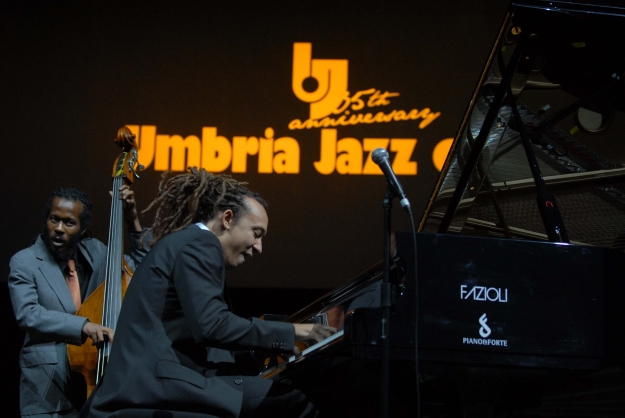
So is Gerald Clayton’s superbly interactive young trio (Joe Sanders, bass; Justin Brown, drums), who allow the 24-year-old pianist to bring forth an apparently bottomless well of reference while navigating repertoire that spans Ray Bryant-style soul jazz, the standards songbook and bebop, the Euro-Classical canon, and his own originals, which embrace the harmonic complexities of the modern lexicon. Even among a generation of technical wunderkinds, Clayton stands out for his musicality—the nuance of his touch, the precision of his articulation, his ability to communicate a story in his solos. He’s one of a handful of pianists of his generation—Taylor Eigsti is another who immediately comes to mind—whose approach would not have been out of place at Bradley’s, the iconic Greenwich Village saloon-salon where from 1971 to 1996 New York’s finest 88'ers gathered after their own gigs to cheer each other on, transforming the room from a place where musicians met to hang and imbibe into an oral repository of the tradition.
On more than one occasion, Clayton has substituted for Hank Jones as Roberta Gambarini’s pianist, and he could probably parlay his off-the-hook chops and intimacy with the tradition into a comfortable career. At 1:45 a.m. or so early in the week at Sala Cannonieri, he played a Duke Pearson song, “Is That So,” which was a Bradley’s staple of John Hicks, who heard it as a medium swinger; Clayton played it almost rubato, fragmented his lines, and during the swing section incorporated a quote from Charlie Parker’s “Cool Blues” into his flow. But it’s evident that Clayton’s aim is to be in touch with 21st century imperatives.
Umbria’s organizers take pride in “breaking” young talent to the international stage, and cite Brad Mehldau (1994) and Diana Krall (1996) as examples; that they may regard Clayton as next on this list was evident at Santa Giuliani Arena, where his trio opened for Herbie Hancock before a crowd of some four thousand, who demanded an encore—Clayton obliged with an up-tempo romp, signifying upon and offering his own extensions of Hancock’s long-assimilated vocabulary of the ‘60s and ‘70s.
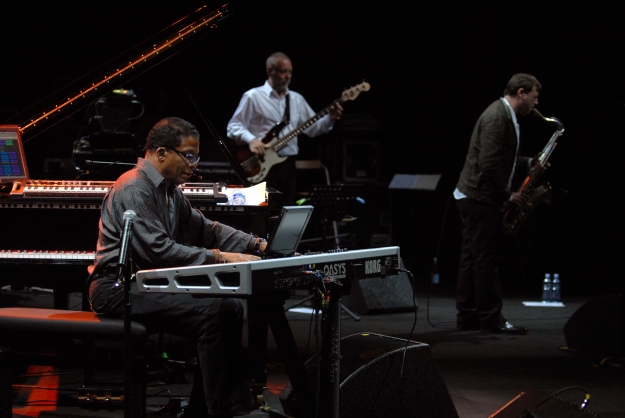
On a marathon tour supporting his Grammy-winning The River, Hancock has assembled a caravan comprising two singers (Amy Keys and Sonia Kitchell) and a sort of super-group comprising Chris Potter on tenor saxophone, Lionel Loueke on guitar, Dave Holland on bass, and Vinnie Colaiuta on drumset. Hancock emcees and guides the flow from the acoustic piano and assorted keyboards. The show, tailored for arenas, feels more like a vaudeville program in which different acts show off their individual talents than a cohesive concert. Sometimes it’s jazz, sometimes it’s funk, sometimes it’s pop, but each tune stands by itself, with no connective flow.
For one thing, Kitchell saw fit to treat the Joni Mitchell repertoire—“River” and “All I Want”—as though she were channeling Janis Joplin, eliminating the simmering emotion and fluid phrasing that Mitchell’s lyrics demand For another, Keys, assigned to sing a blues and a Donny Hathaway song, has a stirring, but not particularly flexible voice—she sounds more suited to be lead singer in the back-up chorus than to front this kind of band.
There is no better fusion-rock-funk drummer than Colaiuta, whose mega chops make him an idol of under-35 drummers of every aesthetic persuasion (backstage, Justin Brown was ecstatic at his execution of some particularly difficult figures). Yet, Colaiuta does not place much air into songs where air is called for. Nor was there much room for Dave Holland to contribute—when playing acoustic, Colaiuta overwhelmed his sound in the mix, while on the fusion repertoire, Holland played electric bass for the first time since his 1990 tour with Hancock, Pat Metheny and Jack DeJohnette, and played it competently, but with insufficient muscle to really project Hancock’s funk a la, say, Paul Jackson. That said, no living bassist can match the mojo Holland put on a characteristically virtuosic, poetic solo feature, nor the panache with which he nailed the preceding group instrumental, Loueke’s “Seventeens,” so named for its 17-beat structure. A little later, Benin-born Loueke had his own solo turn, using real-time electronics to transform his voice into a harmonious African choir and to create guitar loops, placing bits of paper between his guitar strings to transform the instrument into a musique concrete device, melding the techniques into a seamless narrative arc in the most organic way.
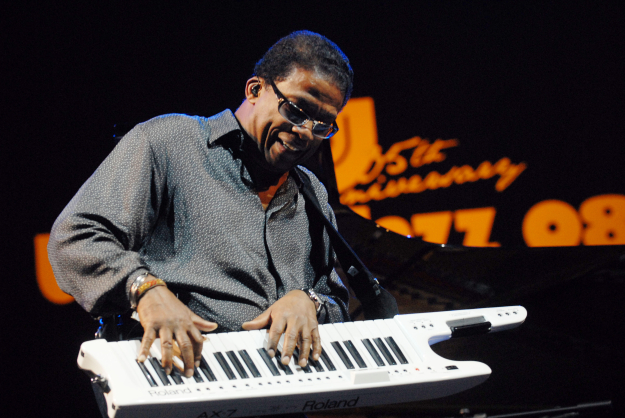
Hancock played superbly, setting up orchestrations with his various electronic keys, exploiting the dynamic range and augmented bass register of the Fazioli acoustic grand piano, moving effortlessly from funk to rubato to jazz feels. On the final setlist tune, as if to remind us that he is, after all, Herbie Hancock, he offered a playful abstract solo introduction that gradually resolved into “Cantaloupe Island,’ launching Potter into an extended solo flight. The crowd again demanded an encore—they got two.
Tags:

I recently started listening to jazz,i remember Herbie HANCOCK from the 80's with the jam RocK IT.I would like to see him perform live. ThANKS.