The Jazz.com Blog
July 21, 2008 · 1 comment
The Festival of a Thousand Gigs
Imagine a jazz festival with almost 1,000 performances in more than 100 venues, all crammed into ten days of musical mania. Thierry Qunum reports on the jazz riches at the Copenhagen Jazz Festival the latest in jazz.coms on-going coverage of important musical happenings around the globe. T.G.
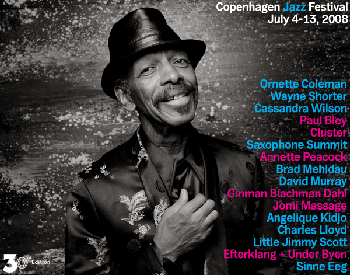
Can you imagine a European capital city of 1.3 million inhabitants whose city center displays Ornette Colemans face in black and white, on large upright hanging flags on a good many of its lampposts? If you had been in Copenhagen, Denmark, during the first half of July you wouldnt have had to imagine it, youd have witnessed it!
In fact, the Copenhagen Jazz Festival (CJF) is very proud to have Ornette on its program for its 30th edition. The CJF may be the biggest and strangest festival I have yet to encounter. Its my second time here in 5 years, and Im still impressed by the size, the stylistic diversity (70% Danish groups, from dixieland bands to free improvisers, 30% foreign); as well as by the efficiency of the organization and quality of the program.
Its Denmark, some will argue, one of those Scandinavian countries where the governments, regions and cities have a strong interest in jazz and culture at large, and are willing to support them financially. Obviously true: how could the CJF otherwise program almost 1000 concerts over 10 days in 101 venues?
Of course, some of these venues are in charge of their own program, remarks Christian Dalgas, one of the festival executives; although he adds that the venues subsequently refer to the festivals office for centralized support and promotion. But the big concerts of the Giant Jazz series like Ornette Coleman, Cassandra Wilson, Wayne Shorter, Brad Mehldau or Charles Lloyd held in prestigious venues like the Copenhagen Opera or the Glassalen, in the world famous Tivoli amusement park, are organized by the festival office, just like the seventy some open air events (Maceo Parker, Marilyn Mazur, Chaka Kahn , Esperanza Spalding), the concerts in museums and public libraries, and the Jazz for Kids program.
In other words, for ten days its almost impossible to ignore that Copenhagen hosts a jazz festival. Even if you are here for the summer retail sales or on a quiet weekend by the Baltic sea, theres a good chance youll come face to face with Ornette Coleman -- looking down at you from a lamppost, or in the show window of almost every second shop youll enter.
As far as I am concerned, I had come to the CJF mostly to hear Danish jazz, and I had only three days to spend here. A little organization was then necessary and, after having carefully studied the city map and the program, I immersed myself, on a rented bike, in Copenhagens peaceful flow of urban cyclists in order to reach my jazz destinations.
I didnt have to go far to see one of the most interesting concerts of my stay: Megaphone, a most European band that features Danish drummer Stefan Pasborg, Lithuanian tenorist Liudas Mockunas, as well as Marc Ducret on guitar and Paul Brousseau on keyboards, both from France. They played for free in mid-afternoon, just outside the Pumpehuset, close to Tivoli. This was an ideal setting for such a highly inventive quartet, whose range goes from Balkanic to rock and free jazz influences, with touches of electronics. But the bands main asset is the high level of musicianship of its members, whove played with each other for years. At the end of their set, the audience was still there, and enthusiastic, in spite of the slight rain that had started falling.
Since the program of the CJF allows some musicians to play several times in the same place or in different venues, I was to see more of Pasborg, whom Ive known for some years and who definitely is one of the young drummers and bandleaders to keep an eye on in Denmark. At the Studenterhuset, close to the city center, he led his Odessa 5 quintet, completed by four horns that play a mix of brass band music and free improv, in front of a full house. The same applies to what is arguably Pasborgs most popular band, Ibrahim Electric, a trio with organ and guitar that maintains a steady, thick groove, halfway between the rock and jazz traditions of the sixties. The Stengade 30, in the cosmopolitan northern district of Nrrebro, housed them for three nights on end.
Another young and upcoming Danish musician might be better known by non-Danish readers, since hes played a lot with American musicians: guitarist Jakob Bro. With its intimate, intense music, his trio filled a caf in the Christianshavn district, close to the famous free commune of Christiania. Bros open chords, airy melodies, and laid back version of Love Me Tender obviously were attuned to the peaceful mood of their devoted Danish audience. His Nonet that played two days later at the Jazzhouse, right in downtown Copenhagen includes his trio, but is of course a much more powerful unit, with its two bassists and two drummers. Still, it can aptly handle the soft toned tunes that the guitarist favors. But when it plays full strength, especially behind a fiery soloist such as George Garzone, lovers of peace and quiet better beware.
By the way, Bros Nonet features another young interesting Danish musician: Kresten Osgood, one of its two drummers. He was also to be heard in several settings during the CJF, the most interesting of which was a beautiful duet with Ed Thigpen. Some may not be aware of the fact that Thigpen, presently 77, has settled in Copenhagen in the early seventies and serves as a father figure for all Danish drummers and many other musicians. Even though his gait is a bit wavering nowadays, the former Oscar Peterson and Ella Fitzgerald sideman displays a remarkable fitness as soon as he sits at the drums. It was perhaps a rather bold gesture from Osgood to play a duet with such a master, even on a beautiful afternoon, in the friendly outdoor setting of the Zum Biergarten caf, not far from the Tivoli. In fact, the young Dane chose to play in an aptly sober yet very personal way beside the ever musical and tasteful drumming of his elder, whom he obviously admires and who never tried to overdo his mastery. This was a beautiful example of trans-generational comradeship and mutual respect.
In the evening of the same day, Danish guitarist Mark Solborg and his MS4 quartet had their frequent guest Herb Robertson join them for a great performance at the Borups Hjskole, a cultural center close to the Royal Palace. The obvious common feeling between the American trumpet player and Danish tenorist Anders Banke (like Solborg, a former member of Mold, a local quartet that is considered as a landmark in contemporary Danish jazz) produced beautiful unisons and great interaction. The hornplayers were supported by a very efficient rhythmic team, and the music was marked by sparse guitar chords and contrapuntal single lines.
The next day, again at Zum Biergarten, Solborg and Robertson were joined by Lotte Anker on tenor, alto and soprano saxes and Peter Bruun (again a former member of Mold) on drums for a fine hour of adventurous music, full of contrasts between Ankers deep, beautiful sound and Robertsons use of his set of mutes and plungers and his half valve technique as elements of surprise. Anker is one of the few women on the Danish improvised music scene, and her dedication to creative playing is always impressive to see, whether she performs with Europeans such as Marc Ducret or Django Bates, or with Americans Craig Taborn or Marilyn Crispell, not to mention Danish fellow citizens Marilyn Mazur or Stefan Pasborg.
But it would be unfair not to mention a few non-Danish groups that I couldnt resist listening to, with great pleasure or with mixed feelings. The David Murray Black Saint Quartet, for example, is obviously a fine band and its international fame earned it a spot in the Giant Jazz series at Tivolis Glassalen. But the pattern of the tunes it plays is always built on the same solo rotation, and the leaders extrovert tenor style has not evolved in years so that his use of the same rise to climax on each of his choruses can often become paradoxically tedious.
The same goes for the alto summit that veteran Danish drummer Alex Riel had assembled at the Copenhagen Jazzhouse to celebrate his jubilee. Who would want to criticize Phil Woods, Bobby Watson, or their excellent younger Danish partner Benjamin Koppel? But for five decades Riel has played with a great diversity of soloists. Its then difficult to be satisfied to watch Riel show up at a concert to celebrate his half-century as a drummer, only to find him relegated to a rhythm section along with French bassist Pierre Boussaguet and Kenny Werner where he merely supports a series of bop licks played on standards and blues, no matter how great the instrumental mastery of the hornplayers.
Finally the most satisfying non-Danish band was Mark Heliass Open Loose trio with Tony Malaby and Tom Rainey. Brilliant, inventive, open and loose, thanks to three beautiful musicians whose interplay has reached a stunning level along the years, while feeding on other music in various groups. These three should have been invited to play all around Copenhagen, just to spread the good news that American jazz can build a groove, convey a melody and still remain the sound of surprise.
This blog entry posted by Thierry Qunum.
Tags:

I would like to say that i love your blog www.jazz.com a lot now.. back to business lol I cant say that fully agree with what you wrote... care to clear things up for me?