The Jazz.com Blog
July 22, 2008 · 3 comments
This Stamp is First Class
Even if jazz musicians aren't making much money, they soon will be on your money -- be on the lookout for the Duke Ellington quarter. Not to be outdone, the US Postal Service has issued a series of stamps featuring the regal Duke and other icons of African-American music. Jazz.com's arnold jay smith reports on the recent ceremony to commemorate their release. T.G.
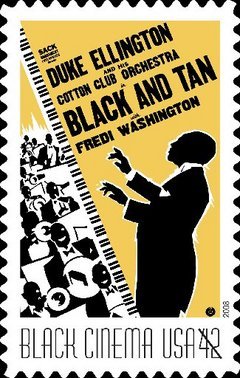
Keeping to their penchant of honoring black Americans, the United States Postal Service issued five stamps celebrating movies with all black casts. Three of the five feature jazz or jazz-related icons Duke Ellington's Black and Tan, Louis Jordan's Caldonia, and Josephine Baker's Princess Tam-Tam. The remaining two are The Sport of the Gods, a silent film by Paul Lawrence Dunbar, and Hallelujah.
Family members spoke at ceremonies held at the Newark Museum in Newark, NJ. In addition, actor Lynne Whitfield, who starred in the Baker bio-flick, hosted the event. She was wearing a white summer dress sans Bakers bananas, who wore not much else.
The movie's title tune, Black and Tan Fantasy, is a jazz classic, and the movie also includes two other tunes and features Fredi Washington with Ellington's Cotton Club Orchestra. This short film has been available for some time and it is an excellent teaching tool showcasing the band with its phalanx of stars. Two of Ellingtons four grandchildren, both Dukes son Mercers children Paul Mercer, who leads the current version of the DE Orchestra, and Mercedes stepped to the podium to thank the USPS for so honoring their grande pere.
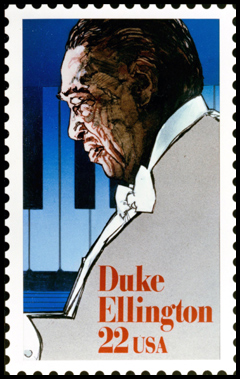
It was the second such honor bestowed upon Duke by the USPS. The first came 1986 as part of the Black Americans series. (It was the last 22 cent stamp issued by the USPS. As a postage increase had already been announced there was never a second printing; it proved to be hard to get.) A very early Ellington composition was called Three-Cent Stomp. Mercer adapted an Ellington-Strayhorn tune and called it 22-Cent Stomp.
Ellington appeared in movies with Amos n Andy (Check and Double Check), James Stewart (Anatomy of a Murder), and wrote a score for Paul Newman, Sidney Portier and Louis Armstrong (Paris Blues) as well as many short films under his own name.
Multi-faceted Louis Jordan, who has been called the other Louis in jazz," was much more than that. Whitfield noted that Jordan was an actor, a dancer, a singer, a forerunner of rap, rhythm & blues and its successor rock and roll, not to mention that he could play any and all reed instruments. And, oh, could he swing! Not only that, Jordan was a crossover juke box favorite who made records with Bing Crosby, Ella Fitzgerald, Louis Armstrong and seemingly everyone else on the then hugely popular Decca Records label with arrangements by Sy Oliver. His recordings were charted hits and his music was made into a London West End and Broadway show called Five Guys Named Moe. The late actor Ronald Reagan, who went on to greater fame in another field, once appeared with him as a backstage host for a revue. Like Ellington, Jordan made many movies and when their names appeared even under the titles late night crowds gathered. At the stamp ceremony, Jordans widow Martha spoke eloquently of him.
Sometimes called sepia movies, the flicks played theatres in both white & black neighborhoods often late at night tacked onto the features. Bakers was another story; she was a bone fide star. The lithe movements and exotic visage of this dancer, plucked from a chorus line, established her as an instant attraction. Jean-Claude Baker, one of the dozen rainbow tribe adopted children of Baker, gave an emotional dedication. Contrary to popular belief Josephine was not drummed out of her country, he said. She left voluntarily because she felt freer to do the things she most desired. However, I seem to remember that there was a tax matter. Baker went on to say that she was given many medals by France, her adopted country, for her work in the WWII resistance underground. She died a French citizen but never formally renounced her U.S. citizenship, a country she truly loved, he concluded.
Bakers dances would be considered flamboyant, perhaps even racist, by todays standards. She danced nude save that belt of bananas and appeared in African tribal settings. The walls of Jean-Claudes restaurant, Chez Josephine on West 42nd St. in NYC, are festooned with her likeness including the Princess Tam-Tam movie poster. Dubbed La Belle Africaine, Baker occasionally appeared with Ellington. I always felt that Dukes Les Plus Belle Africaine" was dedicated to her.
This blog entry posted by arnold jay smith
Tags:

Arnold, I realize blogging is unencumbered by fact-checking, but when did I call Louis Jordan "the other Louis in jazz"? I wrote a piece on him in the June issue of Jazz Times, mentioning all the things about him that you mention, and the editors called it "Jazz's Other Louis"--a phrase and an idea that appears nowhere in the piece or in anything else I have written.
Gary: Tnx for the heads-up re: headline writers; imagine my surprise! I have been victimized a few times myself. I am, if nothing else, an anal fact-checker, as you may already be aware. I saw the headline and read the column. I too have been a devotee of Jordan since I first heard my parents' 78s in my chidhood home. He is a featured artist in my Jazz History courses; no one else does that. Best regards. - Arnold
In response to the comment by Gary Giddins, we have removed the reference to him in the above article.