The Jazz.com Blog
July 23, 2008 · 0 comments
The Coltrane Fantasy Fusion CD
Jazz.com contributor Walter Kolosky frequently discusses his favorite musicians and recordings in these virtual pages. Now he offers up some musings on great recordings that might have been. T.G.
If they were to play today, would the 2008 NBA champions the Boston Celtics beat the 1957 champs, the Boston Celtics? Of course they would. First of all, the players would be over 50 years younger. (Yes, thats an old joke). But seriously, the 2008 Celtics would win because todays athletes are better trained, bigger, stronger and faster.
Such questions, most often asked in sports, are popular and harmless exercises. But they have no basis in reality. The answers can never be proved. Asking such questions about artists and, specifically for this blog, about jazz players does have merit however. It is not uncommon for a 70 year old jazz musician to be playing with a musician who is 50 years his or her junior. Due to their ages, they may not speak exactly the same musical language. But the history of the jazz tradition has prepared them to meet some place in the middle.
Well never know what it would have been like for Johnny Unitas to throw a bomb to Jerry Rice because by the time Jerry was around, Johnny couldnt throw that far. (There I go again). But in the world of jazz, we know what drummer Elvin Jones sounded like when he played with organist Joey DeFrancesco 44 years his junior because he did.
Technology allows for duets between Natalie Cole and her dad Nat. Recently Lisa Marie Presley did the same thing with her father Elvis. What if we were to take things even a step further? What would happen if jazz artists never died? What if they were available for all gigs?
I have created several fantasy jazz bands composed of individuals, had they all been alive and in their primes at the same time, could have played and recorded an album together. I then review the albums as if I were a music writer in that theoretical day and age. From time to time I intend to post these reviews at Jazz.com under the blog title Walter Koloskys Jazz Fantasy Review.
More so than most other musical forms, jazz provides many opportunities for musicians of disparate styles and cultures to play and spontaneously create together. I realize I am taking things huge steps farther by having some people who have left us join in. But in jazz music because of the continuum of influences this is a question that can be contemplated in a serious way. (We always seem to be taking ourselves too seriously anyway.)
You must suspend disbelief. You must ignore the very obvious fact that the dead people are dead. This should not be that difficult. After all, there are millions who believe Elvis is still alive. And, in fact, both he and John Lennon enjoyed hit songs long after they passed away! You also must assume that I carefully considered musical styles and personalities in the creation of these bands. You must also accept that I have chosen a particular period of each artists development in order to make the music work.
I hope you enjoy these jazz fantasy reviews. Here is my first.
Coltrane, McLaughlin, Young and Jones Past Lives (Columbia 1442)
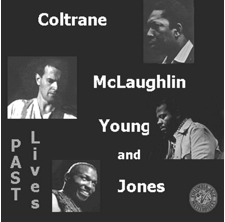
Having heard rumors that this album was going to be recorded, this reviewer was of two minds. One was filled with the anticipation of four legendary musicians at the top of their games going into the studio to produce some new hybrid of jazz and rock music. The other mind doubted these stars would be able to create and present a singular vision. Historically, these all-star get-togethers usually dont work out too well.
My doubt was tempered a bit by the knowledge that Elvin Jones has famously provided the beat for John Coltrane and that the underrated Larry Young was an important part of John McLaughlins early career. On separate occasions McLaughlin and Young had also both worked with Jones. I also knew that Young had spent many hours jamming with JC at Coltranes house. Despite this knowledge, I still could not quite imagine the group performing as a cohesive unit.
Of course, theres also the leadership question. A lack of musical focus due to the generosity of respectful players has ruined many an all-star outing. Coltrane and McLaughlin, as the leading composers, would be the candidates for taking the reins. But it would be a mistake to think that McLaughlins well-known admiration of Coltrane meant that he would cede any leadership role. After all, a musical vision is a strong force to back away from. And both players hold very strong spiritual beliefs. Would those views help or hinder the musics direction?
As it turns out, Coltrane and McLaughlin take turns trading and serving as each others foils. It also turns out that Past Lives is unlike anything we have heard in jazz before. Of course, Coltrane and McLaughlin are monsters. They abuse the limits of their instruments to such an extent that I wouldnt be surprised if they had to junk them afterwards.
Already legendary among his peers, maybe this album will bring Young the due he deserves from the public at large. On this project he does everything. He supplies the bass lines and the atmospheric sounds of the esoteric passages. But his whirling dervish soloing is phenomenal. His clearly is a unique instrumental voice.
Jones is also a powerhouse. Thud. Thud. Thud. Crash. Growl. His strength is put to good use here and his tender side is exposed several times as well.
The quartet recorded six new pieces, three each authored by Coltrane and McLaughlin. In addition, McLaughlins Birds of Fire and Coltranes Naima are covered.
While Coltrane plays his tenor throughout, McLaughlin employs his Rex Bogue double-neck and a Gibson ES-345. The group sound is overwhelmingly loud and electric. The groups message is delivered through minor scales and chords, abrupt rhythm changes, Eastern and Western sensibilities and some good straight-ahead jazz playing.
McLaughlins playing is clearly influenced by Coltranes tenor lines and this is especially evident on Coltranes originals. But Coltrane does enter McLaughlins world from time to time even playing with some feedback occasionally.
Both players share an affinity for the music of India, so it is no surprise that Coltranes new composition Joy of India opens up the album. Young provides a low-hum drone and the rolling bass line while Coltrane and McLaughlin trade Eastern modes over a bombastic Jones beat. The trading becomes so furious that the tune threatens to dissipate into pure bliss. McLaughlins Lost Planets features a beautiful otherworldly intro from Youngs B-3 and builds to a wonderful tapestry of minor chords and screeches from the upper registers of McLaughlins double-neck and Coltranes horn. The tune ends abruptly just at the point you think you are going to locate those lost planets!
McLaughlins opening arpeggios on his Birds of Fire are the same as his original, Jones even opens up with a gong, but once the tune starts in earnest, you better stand back and grab hold onto to something solid. McLaughlin, Coltrane, Young and Jones propel this composition into the realm of the Armageddon. Playing the head arrangement in unison, Coltrane and McLaughlin take it beyond its limits.
The other tunes on the album are equally as impressive. To wind down after a particularly hectic day at work the album ends on the calming note of Coltranes wonderful Naima which features only the two Johns.
Past Lives has set a high and holy water mark. Its merging of cultures and styles and its use of the entire sonic palette is a divine experiment. It will be the album to which a lot of future jazz will be compared. In retrospect, I can see this was something that had to happen. It is a communion. And now nothing else will ever be the same.
Past Lives: Joy of India; Lost Planets; Building Bridges; Birds of Fire; Sunrise; Fade Out; Fade-In; Naima
Personnel: John Coltrane (tenor sax) John McLaughlin (guitars), Larry Young (organ and synthesizer), Elvin Jones (drums)
This blog entry posted by Walter Kolosky.
Tags:

Comments are closed.