The Jazz.com Blog
July 27, 2008 · 1 comment
Life at the Gypsy Jazz Camp (Part One)
When jazz.coms Bill Barnes told me was running off to Gypsy jazz camp, I had visions of rugged but glamorous days spent in caravans and romantic evenings by the campfire listening to inspired string music. The camera pans back to show bow-top trailers and a dark woods in the background.
Okay, I admit it. I grew up near Hollywood, and it probably shaped my impressions of the life of the Romani people. As I later learned, Bill's Gypsy jazz gathering took place at Smith College, and there wasn't a single bow-top trailer anywhere in sight. But if it didnt look like a scene from a movie, the music lived up to the highest expectations.
More interesting, this event is another sign of the remarkable resurgence of interest in the music of Django Reinhardt and his modern-day heirs. Make no mistake about it, Django is hot right now, and seems to be getting hotter all the time. Barnes tells us more about this fascinating subject below, and fills us in on the real happenings at a modern Gypsy jazz camp, in the first installment of his article below. Click here for part two of Bill's report. T.G.
Driving down Interstate 91 en route to Northampton, Massachusetts, my brand new, untempered Selmer-style acoustic jazz guitar in the back seat and Django Reinhardt blaring away on the CD player, Im feeling very much like a kid on his way to Camp Gitchee Mojo-werken, missing only the nametags sewn into his underwear. Destination: Django in June, an annual week-long Gypsy jazz seminar held at Smith College.
So why, you may ask, is a middle-aged jazz guy with two grown daughters and decades of professional experience going back to school to immerse himself in the technique of a guitarist who has been dead for over fifty years?
Lingua Djanca:
A brief introduction to Gypsy jazz terminology
|
Gadje: |
Romani term for non-Gypsy. |
|
Gitans: |
Spanish-based Romani. |
|
Grande Bouche: |
French for large mouth. The original Selmer jazz guitar designed by Maccaferri, with a large, D-shaped sound hole. This design is still preferred by rhythm players in jazz Manouche ensembles. |
|
Gypsy jazz: |
Genre of music evolved after American jazz came to Europe, created by Romani musicians living around Paris in the 1930s, notably Pierre Baro Ferret and Django Reinhardt. Also called Hot Club swing, after Djangos first jazz ensemble, le Quintette du Hot Club de France. |
|
Jazz Manouche: |
More widely accepted term for Gypsy jazz, from the French branch of the Romani people, the Manouche. |
|
Petite Bouche: |
French for small mouth. The Selmer acoustic jazz guitar preferred by Django, featuring a small, oval-shaped sound hole for more intense solo projection. Only around a thousand Selmer petite bouche guitars were ever built. |
|
La pompe: |
The rhythm technique used by Gypsy guitarists in Hot Club swing music. In English, it means the pump. This distinct pulse allows one or two guitarists to take the place of drums and keyboard in a traditional Hot Club group. |
|
Roma, Romani: |
Proper name of the ethnic group commonly known as the Gypsies. The Romani people are believed to have been displaced from Northern India around 1,000 A.D. |
|
Selmer: |
Parisian musical instrument company which produced Django Reinhardts favorite guitar, originally designed for Selmer by Italian luthier Mario Maccaferri. Production on these guitars stopped in the early 1950s. |
|
Sinti: |
Also Cinti. Romani people primarily based in Germany and the Netherlands. |
|
Wegen: |
Special handcrafted guitar pick made by Dutch artisan Michael Wegen. Formed from synthetic material resembling natural tortoise shell, this plectrum is universally preferred by jazz Manouche guitarists across the globe. |
The answer isnt that simple. It begins, of course, with a reawakened awareness of Django Reinhardt, who until about a year ago had been deeply buried in some forgotten corner of my Id. As a child I had heard a few of his surviving recordings but my undeveloped musical mind had dismissed his playing as an aberration, a scratchy curiosity from a bygone era. To a kid struggling to understand Brubeck, Djangos playing was sensory overload, technical sorcery, a pinnacle as unassailable as Mount Everest. Eventually, after years of listening to and emulating Kenny Burrell, Joe Pass, Pat Martino, Howard Roberts, Tal Farlow, John McLaughlin, George Benson and all the other great guitarists who have been my inspiration, I found myself compelled to seek out the spirit of the Romani enigma who, along with Charlie Christian, had fathered jazz guitar.
If the proliferation of Django Festivals across the planet over the last ten years is any indication, Im not alone in this sudden awakening. Often referred to as the Hot Club Swing Revival, this resurgence of interest in Gypsy jazz has resulted in the formation of hot club groups all over the world. Top jazz Manouche players attract thousands to festivals held on both sides of the pond, bars and nightclubs in major cities hold increasingly popular Gypsy jazz nights and films such as Sweet and Lowdown, Swing Kids and Head in the Clouds offer glimpses of Django Reinhardts influence on our culture. From the musical score of Ratatouille to the background ambience of a Chase Manhattan Bank television commercial, jazz Manouche is revitalizing todays auditory landscape. This begs another question: Why now? What cultural paradigm has shifted to spark the interest of so many who, a decade ago, were barely aware of his existence?
Part of the answer may be found in the history of the Roma, for whom music is such an integral part of daily life. After being driven from their homeland in India over a thousand years ago, Romani musicians have been on the road ever since, assimilating influences from different cultures along the way. In a changing world, with its vanishing borders and globalized economy, this eclectic approach to music may be key to understanding its newfound appeal.
It was perhaps inevitable that American jazz, still in its infancy when it arrived in France, would capture the fecund imagination of a young Romani musician named Django Reinhardt. According to author and biographer Michael Dregni, the first time Django heard a Louis Armstrong recording, tears welled in his eyes and he cried out, My brother, my brother! From that point on, jazz became a part of the Romani musical tradition.
Following Djangos death in 1953, his musical contribution had been relegated to a side note by many jazz historians. In fact, after collectors snapped up his prolific recordings on 78s and LPs, his music almost completely disappeared for a couple of decades, aside from some poorly mastered and barely listenable anthologies which hardly did him justice.
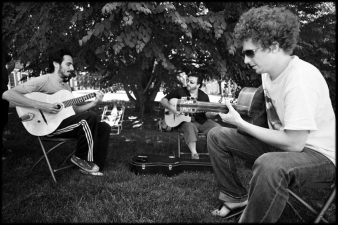
Djammin' (photo by Frederic Moretto)
Resurrected on CD in the last decades of the twentieth century, his musical legacy had been rediscovered and brought back from the brink of oblivion by new generations of Romani musicians such as Bireli Lagrene, Stochelo Rosenberg, Angelo Debarre, Jimmy Rosenberg, Dorado Schmitt and others, along with a new wave of Gadje (non-Gypsy) players. While these artists have maintained the technical standards of the master, they are not merely imitators and preservationists peddling museum shtick, but innovators in their own right. They have helped forge a new movement with a growing legion of enthusiasts, many who not only want to hear this music, but want to participate in its creation.
In this respect, Django festivals differ from all the others. Imagine a Newport Jazz Festival where half the audience shows up with saxophones, trumpets, guitars, pianos, basses and drum kits, setting up impromptu jam sessions within yards of the concert stages. What outrage and pandemonium would ensue! But this is exactly the scenario with Gypsy jazz fests from Samois-sur-Seine to San Diego, where many attendees bring their upright basses, mandolins, accordions, violins and Selmer-style acoustic guitars, to join in the peripheral jams that have become part and parcel of these events.
Musical magic can often be heard among the myriad campfires. In such an informal setting at Samois, Adrien Moignard, the brilliant young standout guitarist of the Selmer 607 project, was discovered. This year, he is being reunited with his Selmer 607 recording partners on the concert stage at Samois, along with his current group, Lensemble Zaiti.
In addition to the various concert venues and festivals honoring Django in Europe, there are Django Fests all over the United States, from San Francisco, Seattle, Austin, Mt. Crested Butte, Colorado, to Madison, Wisconsin and New York City. But there is only one event in North America exclusively devoted to clinics and master classes in jazz Manouche: Django in June, the brainchild of guitar instructor Andrew Lawrence. Originally inspired by his first pilgrimage to Samois, Andrew organized a one-day event at Smith College featuring the Robin Nolan Trio and a few instructors. Now in its fifth year, Django in June has grown into a week-long session offering instruction in this unique genre from one of the most impressive groups of such players assembled in an academic setting.
This is the end of the first part of Bill Barnes blog article. Click here for part two of "Life at the Gypsy Jazz Camp."
Tags:

Bill, Very nice article, I'll check out part II later today. It was my first time there and I had a blast. Please feel free to check out my band's website, www.HotClubPhilly.com, or the Manouche guitar site. Cheers, Barry Warhoftig