The Jazz.com Blog
July 28, 2008 · 2 comments
Remembering Johnny Griffin
Ted Panken shares his thoughts on saxophonist Johnny Griffin, who died in France on Friday. Panken recalls below his 1990 interview Griffin, conducted at WKCR while the tenorist was in New York for an engagement at the Village Vanguard. We are also publishing Panken's in-depth interview as part of jazz.com's tribute to this much loved soloist. T.G.
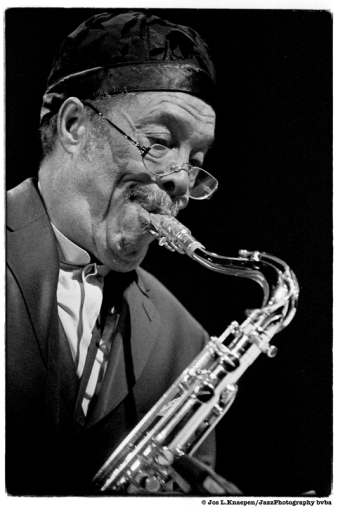
Johnny Griffin was always a little ahead of us, Andrew Hill once said of the sui generis tenor saxophonist, like Hill a native of Chicagos South Side, who died on July 25th. He was 80, and he died at home, a stone chateau in Availles-Limouzine, a small village located several hundred miles from Paris in Frances west-central Vienne district. He moved there in 1984, 21 years after relocating to Europe from the United States.
A glance at Griffins discography at the time he moved gives a sense of his position in the jazz firmament.. Then thirty-five years old, he had led thirteen albums for Blue Note (3), Argo (1), and Riverside (9). He co-led another ten in the previous three years with the popular Eddie Lockjaw Davis-Johnny Griffin tough tenors quintet. He played in Art Blakeys Jazz Messengers (theyd been tight since 1945, when their pathsBlakey was touring with Billy Eckstine, Griffin, then 17, was with Lionel Hamptoncrossed in Los Angeles) on seven 1957 sessions, and on another two with Thelonious Monkanother good frienddocumenting the Five Spot Quintet.
Griffin also stamped his singular tonal personality on a half-dozen classic LPs of the period: Clark Terrys Serenade To A Bus Seat, Wilbur Wares The Chicago Sound, Philly Joe Jones Blues for Dracula, Randy Westons Little Niles, Tadd Damerons The Magic Touch, and Wes Montgomerys Full House.
Indeed, in 1963, no conversation about the state of the tenor saxophone could be complete without mention of Griffins name. As the discography indicates, he was a child of bebop, a harmonic polymath, an unsurpassed changes player, equally comfortable conjuring melodic paths through the gnarliest sequences Monk could offer, bleeding your emotions to the limit with a romantic ballad, or romping through blues ditties that blended South Side rawness with Kansas City swing, like Muddy Waters playing bebop tenor. Like Joe Williams and Gene Ammons, both South Siders of similar sensibility, Griffin knew how to sell those melodies, transforming his metal instrument into an analogue for the human voice with formidable presence and dramatic weight. Nicknamed the Little Giant for his jockey frame, he had a gigantic sound, which he was able to sustain and inflect with timbral nuance and inflection at tempos machine gun to rubato. His tonal personality was all about joie de vivre and communication.
Some on-line tributes to the late Johnny Griffin
"Made in Chicago Tough Tenor" by Howard Reich (Chicago Tribune)
"Johnny Griffin, Saxophone Giant, is Dead at 80 by Jeff Tamarkin (Jazz Times)
"Johnny Griffin (1928-2008)" by Marc Myers (JazzWax)
"Johnny Griffin, 80, Jazz Saxophonist Dies by Ben Ratliff (The New York Times)
"Johnny Griffin RIP" by Doug Ramsey (Rifftides)
"RIP Johnny Griffin" by Darcy James Argue (Secret Society)
Johnny Griffin, 80; Sax Player Known for Hard, Fast Sound by Adam Bernstein (Washington Post)
Why did Griffin move? There were personal reasonstax issues, marital troubles, frustration with the roadblocks attendant to the life of an itinerant black jazz musician, a little too much lush life. Perhaps because he had been so far ahead of the curve, a mature stylist and bandleader when Coltrane and Sonny Rollins were still finding their voices, Griffin was not inclined to follow the uncharted pathways that defined the cusp of the 60s zeitgeist. The infrastructure that had sustained himthe national inner city nightclub circuitwas beginning to fray, and perhaps he saw that future pickings would be increasingly slim
In any event, Griffin enjoyed forty-five happy, productive years in Europefirst Paris, Bergambacht in the Netherlands, Availles-Limouzine. During the 60s, he had steady work at the Paris Blue Note and toured the continent as a saxophone gunslinger with various rhythm sections. Within a few years, he had a steady job in the saxophone section of the Kenny Clarke-Francy Boland Big Band, calling upon a full complement of musical skills learned at Chicagos DuSable High School, where bandmaster Walter Dyett started him on clarinet and oboe. Happy as a giantwell, little giantfish in the European pond, he would not perform in the States again until the fall of 1978, when he recorded with Dexter Gordon (Great Encounters), made the first two of five domestic studio recordings for Galaxy, and assembled a New York based working quartet with the late pianist Ronnie Matthews, bassist Ray Drummond and drummer Kenny Washington, a unit that he began to bring to Europe. As the '80s, progressed, pianist Michael Weiss and bassist Dennis Irwin joined the mix, and would remain his American partners for the next decade-plus. They have a lot to do with the aesthetic success of The Cat and Dance of Passion [Antilles], which kicked off Griffin's last series of well-produced ensemble recordings, in the early '90s.
It became Griffin's custom to schedule homecomings during his April birthday week, which he would spend with family in Chicago, monetizing the trip with engagements at Chicago's Jazz Showcase and New York's Village Vanguard. He was beginning night two of a week-long Vanguard run on April 18, 1990, when he joined me on New York's WKCR for an edition of the "Musicians' Show," selecting and remarking upon the music that inspired his formative years. Never before published, his remarks offer a window into the sensibility of one of the singular jazz individualists.
During the course of this this radio interview, Johnny Griffin played the following recordings:
Bud Powell, Tempus Fugit
Elmo Hope, Happy Hour
Monk, Ask Me Now
Elmo Hope, Carvin' the Rock
Ben Webster, Chelsea Bridge
Johnny Hodges, Passion Flower
Lester Young D.B. Blues
Charlie Parker, Ko-Ko
Philly Joe, Blues For Dracula
Gene Ammons, Nature Boy
Dexter Gordon-Wardell Gray Move
This blog entry posted by Ted Panken. See also Panken's interview with Griffin here.
Tags:

I had the distinct pleasure of seeing Johnny twice, once in Buffalo, New York (October 28/79), and in Toronto, Ontario (May 1962). In both instances he gracefully allowed me to interview him for a jazz radio show I was hosting at those times. What a warm and wonderful person he was, and equally wonderful as a musician. I will treasure those fleeting moments I was allowed to share in his life. Thank you "Griff" for your music. God Bless You.
I was shocked and saddened to hear of Johnny's passing. During my career as a photographer, I had the pleasure of photographing him several times when he performed at Milwaukee's Jazz Gallery. One of the photos I had been asked to take was a group shot with the band after the gig, which was also a birthday celebration. His daughter and I were friends when she resided in Chicago briefly. Griff was one of the greatest, and his music will live on forever. My best wishes and deepest sympathy to Johnny's family.