The Jazz.com Blog
July 29, 2008 · 1 comment
Response to "Is Bird Dead?"
Paris-based Thierry Quénum, a regular contributor to jazz.com, offers his comments below on the recent blog articles on “Is Bird Dead?” (You can find them here and here.) Quénum has been writing for the leading European jazz journals for two decades, and is a jury member for the Django D'Or (France) and the European Jazz Prize (Austria). Be on the lookout for his forthcoming interviews in jazz.com with Jean-Luc Ponty and Martial Solal. T.G.
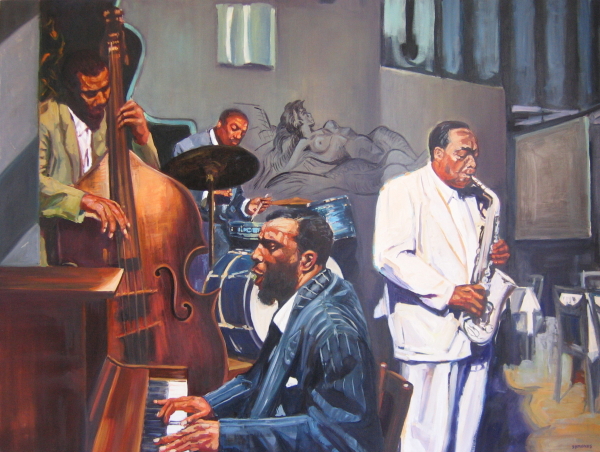
The Open Door Quartet, artwork by Michael Symonds
(1) Bird was a searching musician, like Trane. They both tried to find their own way by getting away from influences, after having absorbed them and challenged them. How many searching musicians do we really have today? I don’t blame current day musicians: once someone’s been looking for the Northwest Passage, and has eventually discovered it, what is there left to do for others as far as that type of deep searching is concerned?
For example, Bird was interested in the music of Stravinsky, Varese and other composers of his day. How many of his followers (from Phil Woods to Jessie Davis) have shown a deep interest in contemporary classical composers? How many Trane followers have explored Indian modal scales, to the extent he did? So, it’s a full time job to follow these geniuses without sounding like just one more follower. No wonder lots of young musicians prefer a more obvious, fashionable and easy way.
(2) Some early Bird (or Trane) followers have made the steps of the original geniuses hard to follow. Look at the way Bird’s legacy has been reduced to a few bop licks, taught in jazz schools and played in jam sessions (whereas Bird was also a deeply rooted and highly inventive blues player, which is largely ignored or minimized). On the other and, how many musicians or jazz educators have really been interested in the way Lennie Tristano, for example, analyzed and taught Bird’s art of improvising to his students ? Or in the way Eric Dolphy, then Anthony Braxton, then Steve Coleman actualized his phrasing up to now (even if one may not like their music)?
Besides, look at the way Trane’s revolutionary “Giant Steps” has been emptied of its initial power. Nowadays it can become anything from a vain exercise in virtuosity to a nice little ballad on an intricate chord pattern. Remember that Coltrane went elsewhere after he recorded it, and never played it again (on record, anyway, as far as I know) after he’d constructed this landmark that showed how much hardbop could be a dead end.
(3) Let’s face it : Bird or Trane (somewhat like some 17th or 18th century European philosophers / scientists who mastered all of the knowledge available in their time in the Christian world) lived in a period when they could synthesize all that had been done before in jazz music, then go forward and open new doors. Today, young musicians are flooded with such a huge amount of superficial information (that they get according to fashions and fads more than through the needs of their own search) that it’s almost impossible for them to go deep. And even if they tried, wouldn’t they be confronted with one of the problems of modern humans: their jaws have slowly become so narrow for lack of chewing on consistent food, that they wouldn’t be able to eat mammoth meat. That’s why dentists often have to extract what are usually called our “wisdom teeth” while we are still teenagers . . . because jaws are not large enough to house them. Nothing to blame modern man for: that’s the “easy way” of technological evolution. In the same way, you can’t both have the peaceful scholarly educated music-makers of today and the junkie ever-searching geniuses trained the hard way of yesterday. But don’t be surprised if you see younger players munching on cheeseburgers in a downtown diner instead of chasin’ mammoths or giant primitive birds out in the wilderness.
(4) Sound (good or bad) is something that you get used to. If you’re not familiar with old scratchy-sounding Django Reinhardt LPs, because the radio stations don’t play them or because the technology to clean the original sound and reissue them has not been developed yet, guess what? There’s a good chance you won’t like them when you do hear them, at least not at first. You and I (as youngsters) had ears that could go beyond the defects of these great recordings, or maybe we appreciated them because we didn’t know the sound could have been better. But if I can agree with you that modern day listeners can prefer modern sounds, I think that a musician who gets stopped by that sound problem is not a real musician.
A classical piano player who cannot appreciate the touch of Rudolf Serkin, Samson François or Clara Haskil on a vintage mono recording still needs a couple of years of tuition, from my point of view. And if young wannabee jazz players prefer a well-recorded solo by so-and-so to a stunning Bird chorus on an old LP, I pity them. When we stand in front of the Egyptian pyramids or any Greek temple, do we say: “Too bad they didn’t have concrete back then!” or “Gosh, how could these guys build such wonders without the technology that we have now?” You cannot learn from geniuses if you cannot admire them first, and to do so you have to be humble enough to go beyond the shallow viewpoint of the time period where you were born and raised, however technologically evolved this time period may seem to be.
This blog article was posted by Thierry Quénum.
Tags:

Thanks for keeping the past in context with the beginnings of the future. Bird/Trane Lives!