The Jazz.com Blog
July 03, 2008 · 0 comments
Monk in Morse Code; Bill Evans with Hiccups
Stuart Nicholson is the Indiana Jones of jazz, constantly on the prowl for hot music in hidden places. In recent weeks, he has briefed us on great jazz we might otherwise have neglected in Dublin, Bremen, Oslo, Moers and Estonia. Mr. Nicholson now returns to Norway, and fills us in on exciting happenings at Bergen, where he enjoyed salmon-on-a-bun (Stuart clearly doesn't hang out at the local McDonald's) while digging a jazz festival held in a former sardine factory.

And what an intriguing line-up. Stuart checked out performances by Close Erase, Epic and All Ears, All Scars . . . and other acts billed as Monk in Morse code, Bill Evans with hiccups" or the rawest desert blues on earth.
JVC Jazz Festival, eat your heart out!
Of course, even the intrepid Mr. Nicholson knows his limits. He missed the set by Public Enema (let's hope that's just an unfortunate typo on the marquee). But I think I would have taken a precautionary rain check too. Even so, what he heard was worth emailing home about -- thank goodness Stuart makes occasional stops at internet cafs on his journeys. His full report is below. T.G.
Bergen loves its reputation as one of the wettest cities on Norways Atlantic coast. On my first visit there I was told how unlucky I was that it had rained the whole time I was there, After all, said my host, its only rained twice this year. Once from January to March, and the second time from April to June.
In fact, rain once fell every day from October 29, 2006 to January 21, 2007 85 consecutive days in all. In a classic case of making a positive out of a negative, precipitation is often used in marketing the city and actually features on postcards for the tourist trade. So it was something of a culture shock to return this year and find the city swathed in the kind of sunshine typical of the Mediterranean.
It transformed the city, the second largest in Norway. Instead of gray, windswept streets there was color everywhere. The Bryggen, the famous tourist attraction and World Heritage site comprising a row of waterfront houses whose seaward facing gables represent a building tradition that dates back 900 years, looked stunning in the sunshine. A matter of yards away the open fish market on the inner harbor of Vgen was a focus for locals and tourists since there is no faster food on a sunny day than a large slice of freshly smoked salmon in a bun.
The harbor is the focal point of Bergen. In the Middle Ages, the Hanseatic League established it as thriving port for international trade while today, much of its prosperity comes from the oil trade and fishing. So it is entirely appropriate that Bergens Nattjazz festival takes place in a former sardine factory in the old harbour district. Now converted into the USF Verftet, a multi-performance arts centre, it has an excellent restaurant with harbour-side tables that have stunning seascape views across the Bergen inlet.
Over the last ten years, Nattjazz has built up a reputation as one of the most important showcases for contemporary jazz in Europe. Its proud boast is that it has been host to several key bands when they were virtual unknowns, such as Bugge Weseltofts New Conception of Jazz and Supersilent. Held over eleven days, a remarkable diversity of jazz was presented, from bands such as Medeski, Martin & Wood, Sex Mob, Scott Henderson, David Binney, Mike Stern, Ray Anderson, Jon Hassell and William Parkers Raining on the Moon from the US, and countless large and small ensembles from across Europe and Scandinavia.
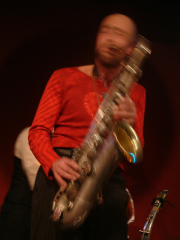
I arrived for the final two nights as the festival reached its climax. Angles is a Swedish band made up of key members from Atomic, Exploding Customer and School Days under the stewardship of saxophonist Martin Ktchen (pictured above). Mattias Sthl on vibes replaces keyboards in the rhythm section and it gave the impression that the band floated on air. However, the inclusion of a trombone alongside trumpet and sax posed some interesting questions. While it gave depth and resonance to the ensembles, it made you wonder if this is the only role left to it in jazz since very few players can play solos on the instrument that move beyond the predictable.
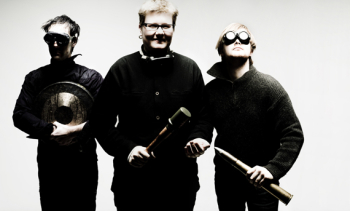
However, any band with Magnus Broo on trumpet comes with a certificate of quality, and he and Ktchen were risk takers in a set that never lost momentum and at times provided moments of genuine excitement. The Danish native and now Norwegian resident Maria Kannegaard (pictured on the right, between percussionist Thomas Strnen and bassist Ole Morten Vgan) has been around a while and has been refining her idiosyncratic approach to the piano keyboard. Her billing as Monk in Morse code, Bill Evans with hiccups, prepared you for a deconstructionist approach, but her style seemed to have its roots in Herbie Nichols. Her jump-start melodies and oblique flourishes were the product of wit and an inquisitive musical mind that almost broke free of her formative influences as she reached for her own voice.
In contrast, All Ears, All Scars didnt mess around with oblique anything. Featuring Norwegian drum wizard Paal Nillsen-Love, a DJ and vocalsist Maje Ratke who doubled on electronics, they did what it says on the packet an ear bursting, scar inducing free improv session. Ratke is a charming young lady who might be mistaken for a missionary nurse in another walk of life, but turns out to be a ferocious sound-freak whose concerts are a close approximation of Armageddon. Shock and awe doesnt come into it, youre too shocked to be awed and too awed to be shocked. I guess their soundchecks are measured on the Richter Scale by how much the earth moves, but with gradual acclimatisation they turned out to be highly sophisticated; incredibly detailed electronic textures and pulsating rhythms coalesced around Ratkes voice, which seemed to mediate the ebb and flow of this primal, ugly yet strangely beautiful music.
The All Ears, All Scars session threw the music of Eple, a Norwegian piano trio, into sharp relief -- since the sound of a pin dropping during their set would have been considered a boorish intrusion. Pianist Andreas Ulvo owes much to the pensive melancholy of the visionary Scandinavian pianist Jan Johannson (1931-1968), who drew on folkloric influences and favored a less frantic approach to improvisation. Ulvo is clearly a talent to watch out for, his improvisations unveiled long melodic lines that were stark in their simplicity, yet came invested with great meaning. World Music wound-up the Friday concerts, but Tinariwen from Mali, the rawest desert blues on earth, didnt really engage the crowd, many of whom drifted in, and drifted back out again, like me.
In contrast, there were long lines for Saturdays headliner Beady Belle and they werent drifting anywhere. She continues to grow in stature combining well written originals with dynamic performances and her next step must surely be the big festival stages of Europe. Pianist Christian Wallumrd appears on six ECM recordings, including three under his own name. They are all beautifully considered works, introspective and thoughtful they repay careful listening. But he has a slightly mad alter ego who is the pianist in Close Erase whose penchant for full throttle spontaneous improvisation with bassist Ingebrigt Haker Flaten and Per Oddvar Johansen on drums is a million miles away from his ECM personna. There was no eye contact, this trio were all ears and were never in a hurry to make their point; this was music that gained its greatest immediacy by drawing out the moment. These musicians are at the top of their profession in Norway, and it showed in the exposition of their spontaneously conceived compositions that often assumed the kind of organic unity associated with formal composition.
Winding up the festival was bassist William Parkers Raining on the Moon ensemble, which took its name from the title of a 2001 album. This was post-bop given an interesting spin by the addition of Leena Conquests wordless vocals, which brought to mind the ensembles of Doug and Jean Carn on the Black Jazz label in the 1970s. Enlivened by the impressive Hamid Drake in what was largely a straight ahead context, the slightly under rehearsed ensemble cohered around the forceful drumming. Eri Yamamoto comped in a wildly exotic style, often paraphrasing each soloist who had the slightly unnerving experience hearing bits of their solo flung back at them seconds later from the piano. Raining on the Moon may have been retro, but it was a stirring reminder of jazzs core values and if at times you got the feeling that the musics past was in danger of becoming its future, then there was enough interesting moments to suggest that this remained a promise deferred.
This blog entry posted by Stuart Nicholson.
Tags:

Comments are closed.